A Manhattan building manager should start with a DCWP-licensed towing operator and compliant signs. The property boundary, storage location, fees, and authorization process should all be settled before the first removal. Don’t wait until an unknown car blocks a tenant’s space.
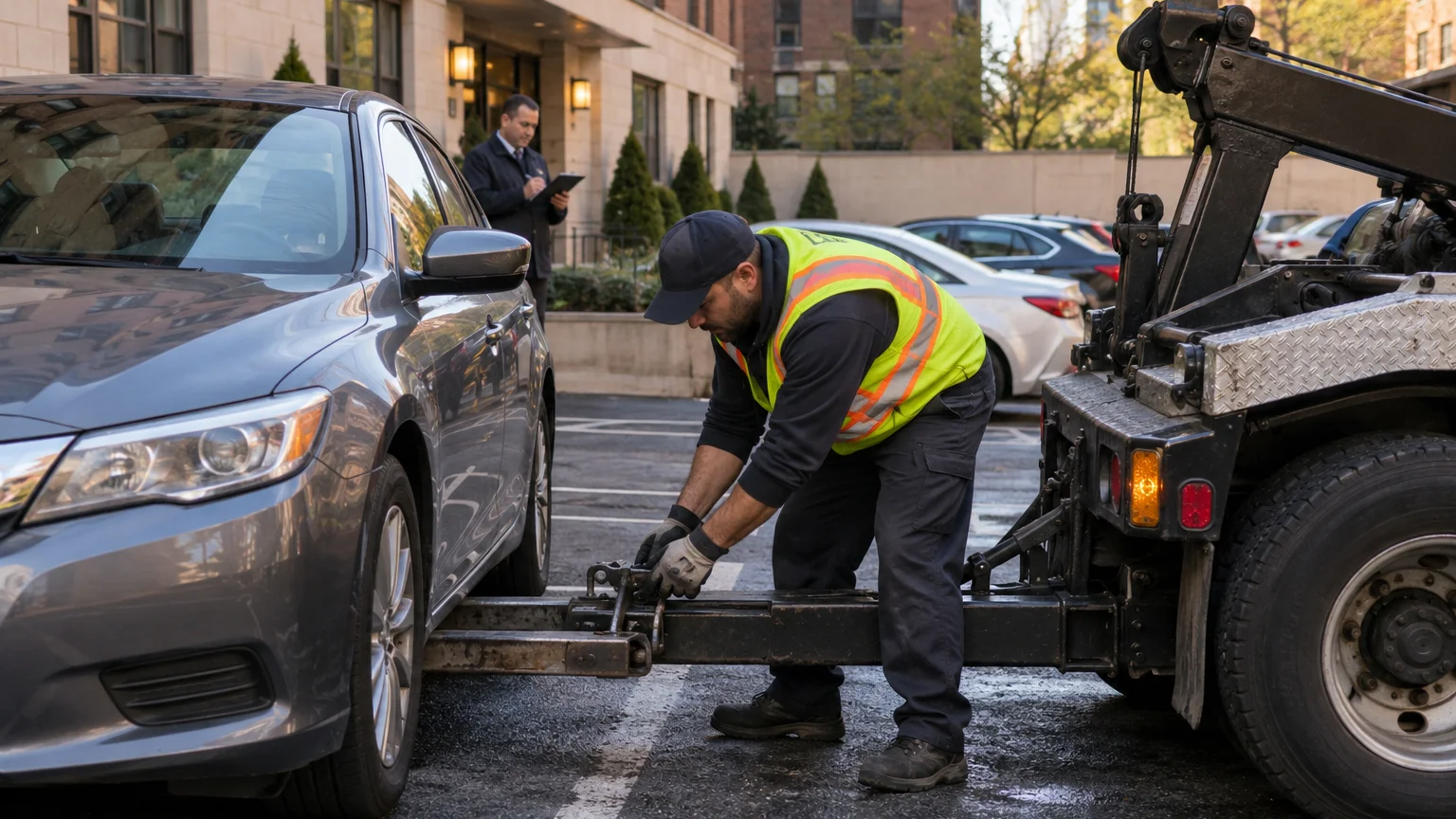
Confirm that private-property towing is the right process
First, confirm that the parking area belongs to the building. A courtyard lot, private garage entrance, or marked tenant lot may qualify. A public curb, travel lane, or metered space follows a different process.
That distinction matters across Manhattan. A car parked inside a Washington Heights apartment lot isn’t handled like one left on Broadway. An NYPD parking-violation tow, a private-property tow, and a police-directed accident tow operate under different rules.
Private-property removals fall under DCWP regulation. NYC Administrative Code §§ 20-496 and 20-497 require the towing operator to hold a DCWP towing license. Check the operator through the license-check option linked from the DCWP towing consumer page. Verify the business name shown on the license against the proposed agreement and signs.
Don’t treat a referral service as the licensed operator. Quick Tow NYC matches callers with independent local towing operators. We don’t own trucks, store vehicles, perform towing work, or hold a DCWP towing license.
Before signing anything, map the exact area controlled by the building. Include entrances, gates, parking spaces, loading areas, and access lanes. If ownership or control of an area isn’t clear, check the deed, lease, survey, or management records. Building counsel can resolve a disputed boundary before enforcement begins.
Our private property towing overview explains the service from a caller’s perspective. Building managers need an additional layer: a documented operating plan with the selected towing company.
Choose an operator and inspect the storage plan
Ask each prospective company for its current DCWP license details. Verify them yourself. Don’t rely only on a logo, truck marking, or sales document.
NYC Administrative Code § 19-169.1 requires a vehicle removed from private property to be stored within New York City. The storage location also can’t be more than 10 miles from the removal point. Get the proposed storage address before approving the arrangement. Measure its distance from the Manhattan property and keep that result with the building’s records.
The storage plan affects residents and visitors after a tow. Confirm the operator’s business name, storage address, telephone number, redemption hours, fees, and towing hours before approving the arrangement.
Ask how building staff will request and document a removal. The approved source material doesn’t confirm whether NYC requires every building to have a written towing contract. It also doesn’t confirm a universal per-tow authorization rule. Have the operator explain its procedure in writing, then ask building counsel to review it.
The same caution applies to patrol arrangements. Don’t assume an operator may enter the property and remove any vehicle without contact from management. Spell out whether the company responds only after an authorized manager calls. Identify which staff roles may approve a tow. List any spaces, vehicles, or circumstances excluded from enforcement.
No patrol frequency or response time could be confirmed from the approved sources. If those points matter, put the operator’s actual terms in the agreement. Don’t rely on an unwritten expectation.
Install every required towing sign
Signs aren’t a finishing touch. They’re part of the legal setup for towing from private property.
NYC Administrative Code § 19-169.1 and DCWP Rule 6 RCNY § 2-377 set the approved sign requirements. Place a sign at each vehicle entrance. Additional signs must run along the property perimeter, with no more than 250 feet between them.
Each sign must be luminescent and at least 12 by 18 inches. Its top must sit between 6 and 8 feet above ground level. The approved source material doesn’t confirm the sign’s required wording. Check the current code and have building counsel and the selected operator confirm the content before printing.
DCWP’s published cap for a private-lot removal is $125, including the first three days of storage. Storage may cost $15 per day after that period. If the driver returns before the vehicle has been removed, the published drop fee is $62.50. These are city limits for this towing regime, not prices from Quick Tow NYC.
Have the selected operator confirm the sign information before printing. Then compare the finished signs with the code requirements. Photograph every installed sign from the driver’s approach and from inside the lot. Record its location and installation date.
Recheck signs after construction, landscaping, gate changes, or exterior repairs. A sign can become hidden behind scaffolding, a delivery container, or new plantings. Replace damaged or unreadable signs promptly.
Our guide to NYC private-property towing sign requirements explains what a towed driver should have been able to see. A manager can use that perspective to inspect the property before enforcement starts.
Put the working rules in writing
A useful building agreement should identify the property and the selected operator. It should also describe the spaces covered, the staff allowed to request service, and the records created for each removal.
The approved sources don’t establish one mandatory contract form. They also don’t confirm that a written agreement replaces any authorization required for an individual tow. Treat the document as an operating control, not as a substitute for legal review.
Ask building counsel and the operator to address these points:
- The exact lot, garage, entrances, and spaces covered
- The operator’s current DCWP license information
- The storage address and its distance from the property
- The employees allowed to request a removal
- The evidence required before dispatch
- The process when a driver returns during hookup
- The operator’s redemption hours and towing hours
- The city-regulated fee information shown on signs
- The handling of keys, gates, access cards, and building security
- The records kept by management and the operator
- The method for reporting a complaint or disputed removal
- The procedure for updating signs when details change
For each requested tow, record the date, location, plate, vehicle description, reason, and authorizing employee. Take time-stamped photos showing the vehicle, parking restriction, nearby sign, and wider lot layout. Preserve relevant access logs or security footage under the building’s normal records policy.
Don’t promise tenants that every unauthorized vehicle will be removed. Access, documentation, operator availability, vehicle condition, and legal questions can affect the next step. State the building’s parking rules clearly, then describe how residents should report a problem.
If management wants to change enforcement rules, update the written instructions first. Check whether the signs also need changes. Staff, residents, security personnel, and the operator should receive the same current policy.
Handle long-term vehicles carefully
A vehicle that hasn’t moved for days raises a different question. It may be unauthorized, abandoned, disabled, stolen, or connected to a tenant. Don’t use an ordinary parking complaint as proof of abandonment.
New York Vehicle and Traffic Law § 1224 addresses abandoned-vehicle definitions and disposal. The approved material doesn’t confirm a specific time threshold for a vehicle left on private property. Read the current text of VTL § 1224 and have counsel confirm how it applies to the building’s facts.
Time alone shouldn’t replace documentation. Record when the vehicle was first observed. Photograph its location and condition. Check building parking records, permits, leases, and resident notices. Don’t enter the vehicle or attempt to move it with building equipment.
The approved material doesn’t confirm how 311 handles every abandoned vehicle on private property. Street complaints and private-lot removals aren’t the same process. Use the NYC 311 towing guide to check the current city pathway, then coordinate with counsel and a DCWP-licensed operator.
A suspected stolen vehicle, altered plate, or immediate safety issue needs a different response. Contact the appropriate public authority rather than treating it as routine parking enforcement. For an ordinary unwanted vehicle, our junk and abandoned vehicle removal service guide explains how referrals work.
When to call us
Call when an active parking problem is documented and the building needs an independent local operator dispatched. Our line is answered around the clock, and the operator provides the quote before dispatch. Call us at (929) 356-7857.