Finding affordable towing near me takes more than choosing the lowest opening number. Before the hook, compare the same job, destination, route, and possible charges. A clear written quote lets you see what each operator is actually offering.
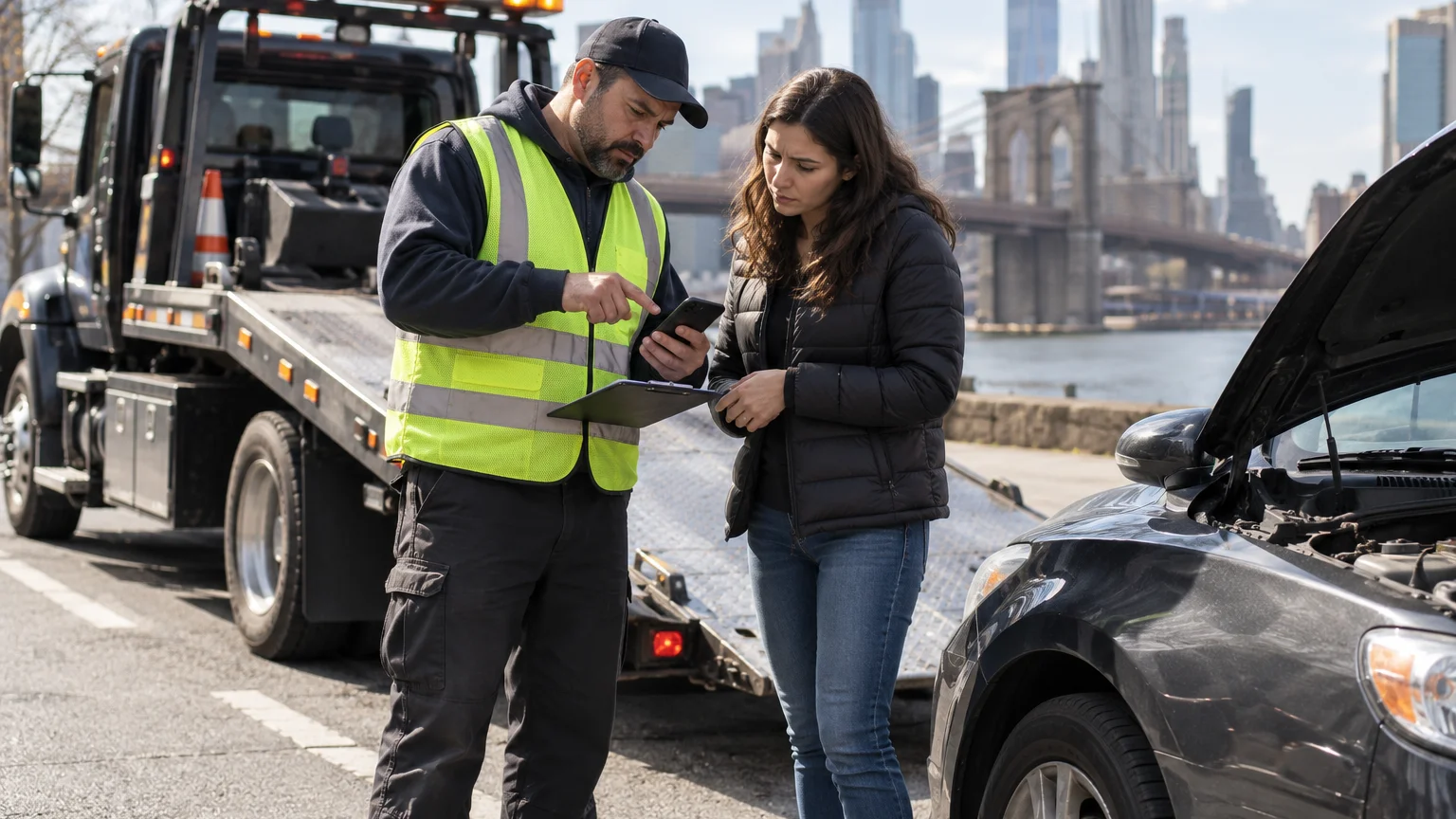
Quick Tow NYC matches drivers with independent local operators across the five boroughs. We don’t own trucks, perform towing, set prices, or collect towing fees. The operator states the price before dispatch.
Give each operator the same job details
Two quotes aren’t comparable unless both operators receive identical information. Start with your exact pickup location. Share the street, cross street, borough, and whether you’re on a shoulder, inside a garage, or in a private lot.
Then describe the vehicle and its condition:
- Year, make, and model
- Car, motorcycle, pickup, van, RV, or commercial vehicle
- Whether the vehicle starts, steers, rolls, and brakes
- Whether any wheels are locked, missing, or damaged
- Visible collision or suspension damage
- Low clearance, modifications, or an electric drivetrain
- Keys available or locked inside
- Pickup access, including garage height or tight turns
Details matter on New York streets. A disabled sedan near Broadway in Washington Heights isn’t the same job as a damaged pickup in Hunts Point. A car below a garage in the Financial District may also require different access than one beside the Van Wyck.
Send every operator the same destination too. Use a complete address, not just “my mechanic in Queens.” If you haven’t selected a shop, decide whether the vehicle should go home, to a repair facility, or somewhere else before comparing quotes.
Tell the operator if the tow crosses boroughs or leaves New York City. Trips toward Long Island, Westchester, or New Jersey need clear destinations. Our service area is the five boroughs, but those places may be long-distance destinations. Review long-distance towing options when the delivery point is outside the city.
Searching cheap towing near me can produce offers for very different jobs. Matching the details first keeps the comparison useful.
Separate the tow quote from storage and other charges
Ask what the quoted amount covers before accepting dispatch. Don’t assume one number includes loading, mileage, difficult access, recovery work, tolls, or storage. The operator should identify each applicable term in the quote.
Use a short checklist:
- What service is being quoted?
- What pickup and destination addresses appear on it?
- Does the vehicle’s current condition match the quote?
- Are tolls or route-related charges included?
- Is recovery or winching a separate service?
- Could waiting time apply at either location?
- Will the vehicle enter storage?
- When does storage begin, and who collects it?
- What forms of payment does the operator accept?
No general NYC price can answer every item on that list. Quick Tow NYC publishes no brand price. Prices for dispatched service are stated by the independent operator before dispatch.
A private tow arranged by a driver also differs from an NYPD pound tow. The NYPD publishes parking-violation tow and storage fees. Its listed release fee is $185 for vehicles under 8,000 pounds and $370 at or above that weight. Storage is $20 per night, with a 10-day reclaim period.
Those city fees aren’t a price for a tow you request after a breakdown. They belong to the NYPD parking-violation system. For a broader explanation of market pricing, read our guide to tow costs in New York City.
If an operator mentions a charge that isn’t written down, ask for clarification before dispatch. When a current figure can’t be confirmed, verify it with the operator or the agency setting it before payment.
Confirm the destination and route before the hook
The destination can change the job as much as the pickup point. Confirm it before the vehicle is loaded. Check the complete address, borough, business name, and expected receiving point.
A repair shop may have a separate vehicle entrance. A residential delivery may have curb restrictions. A dealership’s service entrance may sit on another block. Confirm those details directly with the destination. Don’t assume the tow operator can leave a disabled vehicle wherever you choose.
Route details also matter in New York City. Commercial vehicles, trucks, and tow trucks are banned from city parkways, including the Belt, FDR, Henry Hudson, Cross Island, Jackie Robinson, Bronx River, Hutchinson, Mosholu, Pelham, Ocean, Korean War Veterans, and Grand Central Parkway. The Grand Central Parkway has a limited single-unit exception between the RFK Bridge and the BQE.
That restriction can shape a trip between boroughs. A passenger car stranded near the Belt Parkway can’t simply remain on that roadway while its loaded tow truck follows the same route. Ask which pickup point and legal route appear in the quote.
The same issue arises around the Cross Bronx, BQE, Major Deegan, and approaches to the Verrazzano. Congestion, bridge access, and commercial-vehicle routing can affect how the operator plans the job. Don’t request a prohibited route to shorten the trip.
For an urgent breakdown, our emergency towing service can connect you with an independent local operator. Give the exact shoulder, exit, direction of travel, or nearby landmark. If you’re exposed to moving traffic or immediate danger, call 911.
Before the hook, repeat the destination and ask the operator to confirm it. That small step can prevent a vehicle from reaching the wrong shop, borough, or storage lot.
Get the quoted terms in writing
A spoken number isn’t enough for a clean comparison. Ask each operator to send the quoted terms by text or another written format before dispatch. Save the message and take a screenshot.
The written details should identify:
- Your vehicle
- The pickup location
- The destination
- The requested towing or roadside service
- Any stated route or distance terms
- Each included or separate charge
- Storage terms, if storage may occur
- Payment method
- The operator handling the job
Read the message for missing conditions. A quote for a rolling vehicle may not fit one with locked wheels. A curbside pickup may not cover a garage extraction. A basic tow may not describe collision recovery or a winch-out.
Avoid comparing only the largest number shown on the screen. One quote may describe the entire requested job. Another may cover only the initial hookup. The written scope tells you whether the offers match.
If the vehicle’s condition changes, update the operator before arrival. For example, mention newly discovered wheel damage or a blocked garage exit. Ask for revised terms in writing when the job changes.
Keep the quote, dispatch message, receipt, and vehicle photos together. Photograph the vehicle before loading when you can do so away from traffic. After delivery, confirm the destination shown on the receipt.
Searching tow truck near me cheap often puts speed ahead of careful reading. Take a minute before authorizing the hook. The lowest opening figure may not represent the same service described by another operator.
Quick Tow NYC can relay the job details to an independent operator. The operator sets and states the price. Payment goes to the operator, not Quick Tow NYC.
Know when a city-regulated tow follows different rules
Quote comparison applies when you’re choosing an operator for your own tow. It doesn’t replace the rules for a city-directed or private-property removal. In New York City, identify which of three towing regimes applies.
An NYPD parking-violation tow normally sends the vehicle to a borough pound. Check the city’s towed-vehicle lookup and pound information before assuming the car was stolen. The city may also relocate a vehicle without treating the move as a standard pound tow. Use NYC 311 when the lookup doesn’t resolve its location.
A private-property or blocked-driveway removal falls under DCWP rules. A DCWP-licensed towing operator may charge up to $125 for removal and the first three days of storage. Storage after that is capped at $15 per day. If the driver returns before the vehicle is removed, the published drop fee is $62.50. The storage lot must be within city limits and within 10 miles of the removal point. Check the DCWP towing consumer page for the current rules.
An accident or police-directed rotation tow follows another rate structure. DCWP publishes maximum DARP and ROTOW rates of $125 for vehicles weighing 10,000 pounds or less and $140 for heavier vehicles. Published storage is $25 per day for the first three days, then $27 per day.
Don’t apply one regime’s figures to another tow. A voluntary breakdown tow isn’t an NYPD pound release. A private-lot removal isn’t the same as an accident tow. Our guide to regulated towing fees in NYC explains those distinctions further.
If the paperwork doesn’t identify the towing category, ask the operator, DCWP, the relevant pound, or NYC 311. Confirm the current rule before paying rather than relying on an estimate.
When to call us
Call when the vehicle can’t be moved safely or you need an operator dispatched. The line is answered around the clock, and calls are recorded after a notice. Quick Tow NYC will match your job with an independent local operator who states the price before dispatch. Call us at (929) 356-7857.