A car left behind a building creates an immediate practical problem. Before arranging an abandoned vehicle tow on private property, confirm who controls the space and what DCWP requires for that location.
A private-property vehicle is not a street report
Start with the vehicle’s location. That fact determines which process applies in New York City.
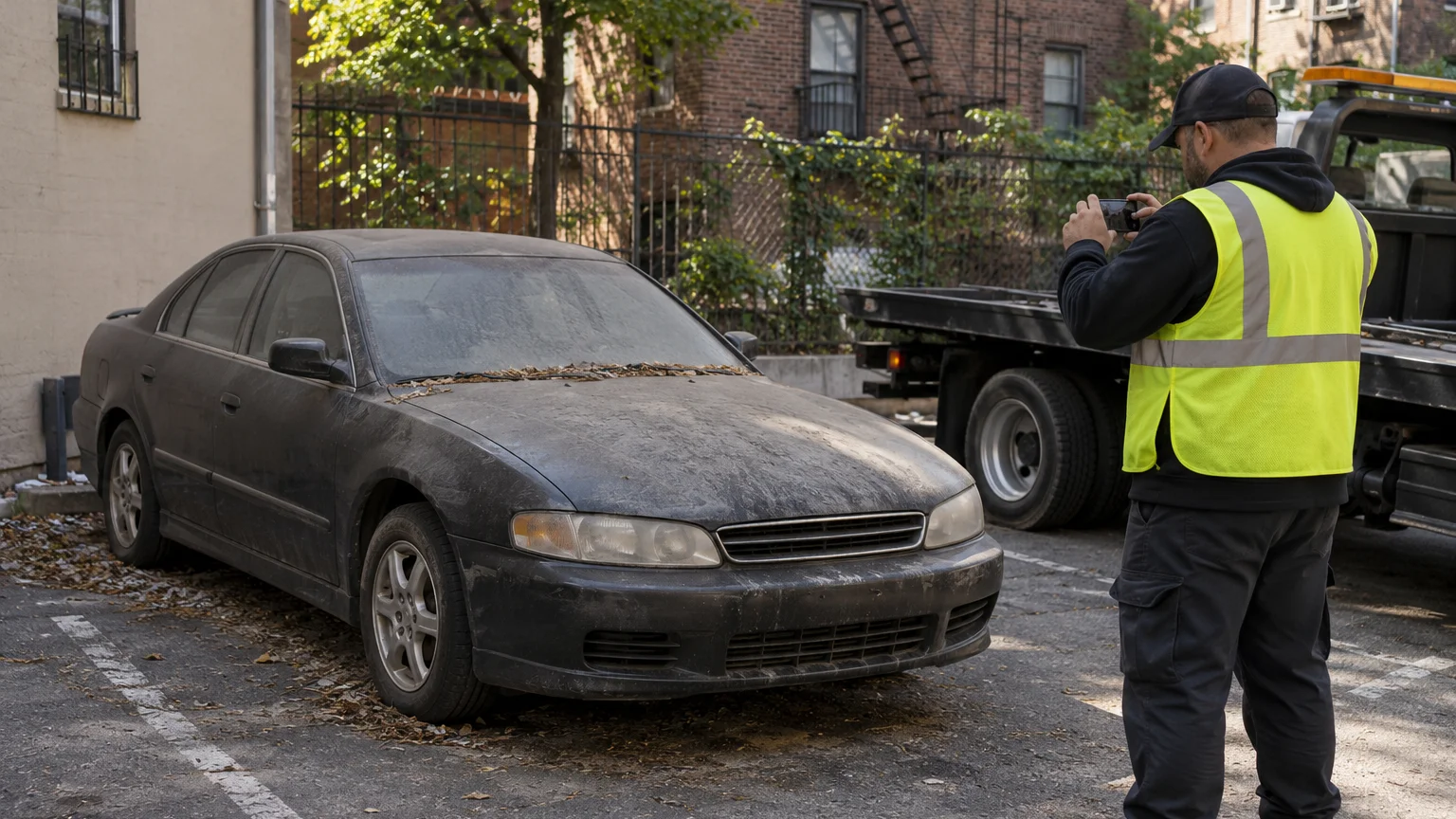
A sedan sitting inside a Bushwick apartment lot presents a private-property issue. A vehicle left along the curb outside that lot presents a public-street issue. They shouldn’t be reported or handled as though they’re the same.
For a vehicle abandoned on a public street, start with NYC311. Our separate guide explains how to report an abandoned vehicle in NYC. That reporting path also applies when the vehicle is outside your property line, even when it’s parked directly in front of your building.
A private lot, driveway, loading area, or gated parking space raises different questions. Those include who can authorize removal, whether required signs are present, and which towing operator may take the vehicle. DCWP regulates private-property towing inside New York City.
Location details can be less obvious than they seem. A Bronx apartment building may have a curb cut leading into a shared lot. A Bushwick driveway may cross the sidewalk before reaching private land. A small Queens commercial property may border a service road or shared loading area.
Check the survey, lease, property records, or management documents available to you. Don’t assume a space is private because the building regularly uses it.
If the boundary remains uncertain, contact NYC311 before arranging removal. Explain exactly where the vehicle sits. Include the borough, nearest address, and whether it’s beyond the sidewalk or gate.
Confirm ownership and permission before arranging removal
An abandoned vehicle on your property doesn’t automatically create clear towing authority. The approved New York claims available for this page don’t confirm one universal waiting period. They also don’t establish that every tenant, employee, superintendent, or contractor may authorize removal.
That means time alone isn’t enough. A dusty windshield, flat tire, or expired inspection sticker may suggest neglect, but it doesn’t answer who owns the vehicle or who can order a tow.
First, confirm your relationship to the property. A building owner may have different documents than a managing agent. A commercial tenant’s lease may define control over parking spaces or loading areas. A condo or cooperative may have its own management structure.
If you’re a renter with an unfamiliar car blocking a Bushwick driveway, contact the owner or managing agent. Don’t arrange removal solely because the car is inconvenient. If you manage a Bronx apartment lot, check your management authorization and parking records before calling an operator.
The available claims also don’t confirm a private-property abandonment clock for New York City. They don’t establish when a vehicle becomes the property owner’s vehicle. Don’t move, enter, sell, dismantle, or dispose of it yourself.
Ask DCWP or NYC311 to confirm the current process for your exact situation. Give them the property type and explain who wants the vehicle removed. Ask whether your role allows you to authorize the tow and whether any notice period applies.
A vehicle that the titled owner wants to surrender is a different situation. Our junk car and abandoned vehicle removal service explains how we connect callers with local operators. Ownership and authorization still need confirmation before dispatch.
What the property manager should document
Build a clear record before anyone touches the vehicle. This isn’t a substitute for legal advice or DCWP instructions. It gives the property owner, agency, and towing operator accurate facts to review.
Photograph the entire vehicle from several safe positions. Capture its position within the lot, driveway, or loading area. Include nearby gates, walls, parking-space markings, entrances, and towing signs. Avoid opening the car or reaching inside it.
Record the date and time of each observation. Note the license plate exactly as displayed. Write down the vehicle’s color, make, and visible condition without guessing about mechanical problems.
For a Bronx apartment lot, document which parking space the vehicle occupies. Check whether management assigned that space to a resident. Keep copies of parking permits, tenant communications, and any prior notices that already exist.
For a Bushwick driveway, photograph how the vehicle sits relative to the sidewalk and property line. A blocked driveway on a public street can involve a different process than a car parked within the driveway itself.
For a small Queens commercial lot, identify who controls the space. Keep the lease page, management agreement, or ownership record that supports that role. Record whether other businesses share the lot or loading area.
Photograph every posted towing sign. NYC’s approved rules describe signs at entrances and along the perimeter, no more than 250 feet apart. They must be luminescent, at least 12 by 18 inches, and mounted between 6 and 8 feet high. A sign’s wording and placement still need review for the actual property.
Buildings setting up an ongoing process should also review our guide to a private-property towing agreement for NYC buildings. An agreement doesn’t replace the required authorization or signage checks for a specific tow.
When a licensed towing operator enters the process
Private-property towing in New York City requires a DCWP-licensed towing operator. Quick Tow NYC isn’t a licensed towing operator, doesn’t own tow trucks, and doesn’t seize vehicles. We refer property owners and managers to independent local operators.
The operator should enter the process after the location, property control, and authority questions have been addressed. Share your photographs, property documents, and sign details before dispatch. Describe whether the vehicle is in a driveway, apartment lot, commercial lot, or shared loading area.
DCWP publishes the city’s private-property towing limits. The maximum is $125 for removal and the first three days of storage. Storage after that is capped at $15 per day. If the driver returns before the vehicle has been removed, the published drop fee is $62.50.
Those are regulated private-property towing amounts, not Quick Tow NYC prices. Our referral price is quoted before dispatch by the independent operator.
The city’s rules also address where a removed vehicle goes. The operator’s storage lot must remain within New York City and within 10 miles of the removal point. That differs from an NYPD parking-violation tow, which normally goes to an NYPD borough pound.
Review the DCWP towing consumer page before authorizing removal. It explains the private-property towing rules and published fee limits.
A property owner who regularly encounters unauthorized vehicles may need an established towing arrangement. Our private-property towing service connects owners and managers with local operators. The operator still determines whether it can accept a particular job.
If the vehicle may be connected to a crime, appears occupied, or creates an immediate emergency, don’t approach it. Contact the proper emergency or police channel instead of treating it as a routine property tow.
Which facts still need confirmation from DCWP or 311
Several important questions don’t have a verified answer in the approved claims for this page. Don’t fill those gaps with advice copied from another state.
No verified universal waiting period was available for a vehicle left on private property in New York City. Rules from Michigan, Georgia, California, or another state don’t answer a New York City property owner’s question.
The available claims also don’t confirm exactly who may authorize every private-property removal. Ownership, a management agreement, a lease, or another form of permission may affect the answer. DCWP should confirm what applies to your role and property.
These points still need direct confirmation:
- Whether the vehicle’s location qualifies as private property
- Whether you’re authorized to request its removal
- Whether a notice or waiting period applies
- Whether the property’s signs satisfy current requirements
- Whether an existing lease or parking agreement changes the process
- Whether NYC311 or another agency should handle the vehicle instead
- Whether the vehicle belongs in a towing or junk-removal process
Provide DCWP or NYC311 with concrete details. Name the borough and property type. Explain where the car sits relative to the curb, sidewalk, gate, and property line. State your relationship to the property. Mention whether the vehicle has plates and whether anyone has claimed it.
Don’t ask a towing operator to resolve an unclear ownership dispute. An operator can assess the towing job, but the property owner or manager should establish permission first.
Keep the three NYC towing regimes separate. An NYPD street tow, a DCWP private-property tow, and a police-directed accident tow follow different rules. A private vehicle left behind a Queens shop shouldn’t be treated like a parking-violation tow from the street.
When to call us
Call after you’ve confirmed the vehicle is on private property and that you may authorize removal. The line is answered around the clock, and we can refer the request to an independent local operator serving New York City.
Call us at (929) 356-7857.