A stall on Northern Boulevard in Flushing is not the same job as a stall on Atlantic Avenue, because Queens has its own pound, parkway bans, and street grid. Quick Tow NYC matches you with independent local operators across the five boroughs. We do not own trucks, we do not keep a Queens yard, and we do not perform the work.
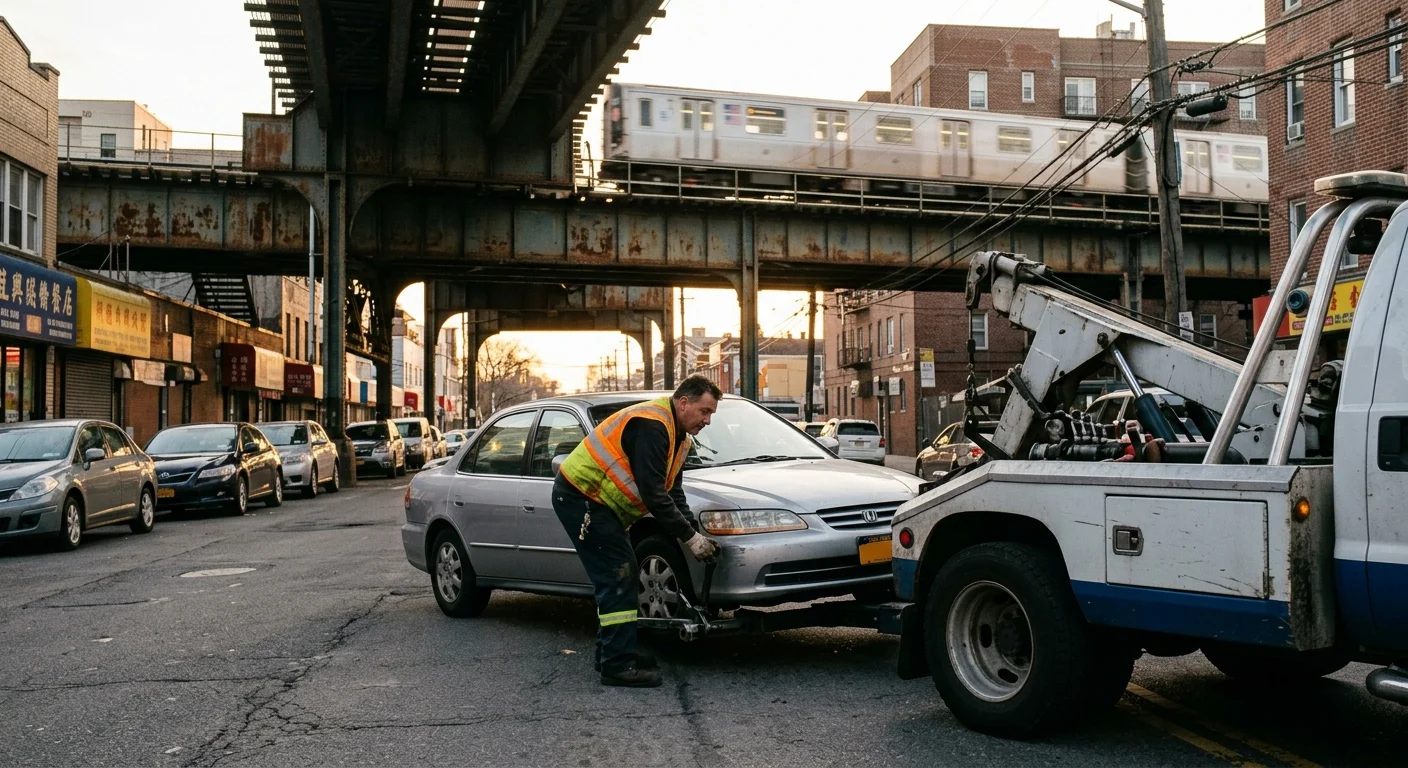
Queens jobs are not one dispatch from Brooklyn
If you’re searching tow truck Queens, you’re looking for a truck that can legally reach your block. You’re not looking for a citywide blur. Brooklyn already has its own pattern: the Navy Yard pound, the BQE ramps, the waterfront shops. Queens does not share that map.
A truck sitting in Sunset Park can be a long crawl from Jamaica or College Point. Some of that crawl is on parkways where tow trucks are banned. Treating the two boroughs as one pool is how the wrong equipment shows up on the wrong road. The operators we connect you with work the five boroughs. Pickup in Nassau, Westchester, or New Jersey is outside that area. Those places can be drop-off destinations on a long run. They are not part of the Queens pickup.
Name the Queens map the way a driver actually talks. Long Island City and Astoria sit against the East River and the Queensboro Bridge. Jackson Heights, Corona, and Woodside sit under the elevated 7 on Roosevelt Avenue. Flushing and College Point sit north toward the Whitestone. Jamaica sits on the LIRR and the AirTrain approach. South and east you hit the Belt and the Van Wyck. Each of those is a different staging problem for the operator who takes the job.
Astoria and Springfield Gardens share a borough name. They do not share a route, a pound trip, or a shop corridor. Tell the line the neighborhood, the nearest cross streets, and whether the car is on a local street, an expressway shoulder, or a lot. If you only say “Queens,” the match is a guess.
A tow truck near me in NYC search still has to land on the right borough logic. Queens is one of the five boroughs we serve. It is not a satellite of Brooklyn, and it is not one neighborhood with a lot of ZIP codes.
Parkways, the BQE, and the Grand Central truck ban
Queens is cut by roads that look similar on a phone map and are not similar in law. The Van Wyck Expressway, the Long Island Expressway, and the BQE are expressways. Trucks can use them. The Grand Central Parkway, the Belt Parkway, the Cross Island Parkway, and the Jackie Robinson Parkway are parkways. Commercial vehicles, trucks, and tow trucks are banned on those parkways.
That ban is not a courtesy. A flatbed on a parkway is itself a violation, and it shapes how an operator has to route the job. A car dead on a service road next to the Grand Central is not “right there” for a truck coming off the LIE. The operator has to stay on truck-legal streets and expressways, then work back in. The same is true along the Belt in south Queens, where the parkway is the tempting line toward JFK-adjacent blocks and is the wrong line for a wrecker.
There is a published single-unit exception on the Grand Central between the RFK Bridge and the BQE. That is a narrow window, not a borough-wide pass. Do not assume a truck can hop the Grand Central from Astoria to Forest Hills. Confirm the route with the operator before the truck moves.
This is why flatbed towing in NYC is a Queens question, not a truck-type slogan. A lowered car, an AWD, an EV, or a smashed sedan often needs the bed. The bed is also the vehicle that cannot cheat a parkway. If the drop is a shop on Northern Boulevard and the car is sitting near a Belt ramp, say both ends of the trip on the call. The match is the operator who can run a legal path, not the one who claims the shortest line.
The BQE still matters here. It is the truck-legal spine between western Queens and Brooklyn. It congests. It does not lift the parkway ban on the roads that parallel it. If your car is on the Grand Central itself, you’re in a restricted corridor. Stay out of travel lanes if you can do it safely, and tell the line you’re on a parkway, not “near the airport” or “off the highway.”
College Point pound tows versus a shop run you called
New York City is one towing jurisdiction. Your question still turns on which of three regimes has the car.
An NYPD parking-violation tow off a public street is the default pound path. In Queens that car goes to the College Point pound at 31-22 College Point Boulevard, Flushing 11354. Published NYPD release fees are $185 under 8,000 lbs and $370 at or above 8,000 lbs, plus $20 a night in storage, with a 10-day reclaim window. Confirm the current figures on the NYPD towed vehicles page before you pay. Published hours for that pound are Monday through Friday 8am to 10pm and Saturday 8am to 3pm. Sunday hours were not confirmed in the same listing. Check the NYPD page or NYC 311 before you ride out.
Bring a valid driver’s license, current registration, and a current insurance card. If you’re not the owner, you need a notarized authorization letter. Payment is cash or card in the retriever’s name. Call 311 or use the city’s towed-vehicle lookup before you assume the car was stolen. The city sometimes relocates a vehicle instead of impounding it. Where they take a towed car in NYC walks the three regimes in one place.
A DCWP-regulated private-property or driveway tow is a different job. A DCWP-licensed operator is capped at $125 for removal plus the first three days of storage and $15 a day after that, with a $62.50 drop fee if you get back to the car before it is removed. Storage has to be inside city limits and within 10 miles of the removal point under NYC Admin Code § 19-169.1. Confirm the cap on the DCWP towing consumer page. That car is at the operator’s lot, not at College Point.
An accident or rotation tow (DARP/ROTOW) is the third path. DCWP max rates on that work are $125 for vehicles at or under 10,000 lbs or $140 above that, with storage at $25 a day for the first three days and $27 a day after. Police direction after a crash is what puts you on that list. It is not a shop run you booked.
A shop run you called is none of those three. You pick the destination. The operator we dispatch quotes the price before the truck is sent. We publish no brand rate, no per-mile figure, and no hookup number. If someone quotes a city pound fee as if it were a private shop tow, you’re in the wrong conversation.
You cannot skip NYPD pound fees after the car is already in College Point. If a private-lot hookup is still in progress, the published drop fee is the path that can stop the removal. A 300-mile tow is quoted as its own job. It is not a published figure, and the pickup still has to start in the five boroughs.
Whether you can ride in the cab could not be confirmed as a citywide rule. Ask the operator on the call. Do not assume a passenger seat is part of the work.
Flushing, Jamaica, Astoria, and the airports
Flushing is Main Street, Northern Boulevard, and the 7 running above Roosevelt as you come in from Jackson Heights and Corona. Side streets are tight. Bus lanes and the commercial strip do not give a flatbed a clean curb. Say the cross street, not “Flushing, you’ll see it.” College Point is the industrial and residential pocket around College Point Boulevard and 14th Avenue, and it is also where the Queens pound sits. A parking-violation tow and a no-start in front of a house on the same boulevard are still two different jobs.
Jamaica is the transit knot: LIRR, AirTrain approach, Sutphin Boulevard at Archer Avenue, Jamaica Avenue, Hillside, Parsons. Cabs, buses, and drop-off traffic stack on top of each other. If the car is in a camera-enforced bus lane or a taxi stand, say that. The operator needs a place to stage that is not the live lane.
Astoria and Long Island City sit on the west end, against the river and the Queensboro. Ditmars, Steinway, 31st Street, and the Court Square blocks do not load the same way a College Point industrial curb does. Low garages, one-way blocks, and bike-lane curbs are the local friction. If the car is in a garage, give the clearance if you know it, and give the entrance street if you don’t.
LaGuardia sits on the north shore. JFK sits on the south. Both generate breakdowns on the Van Wyck, the Grand Central’s edges, and the local approaches. The Van Wyck is truck-legal. The Grand Central and the Belt are not. If you’re on airport property, say so. Port Authority lots and city streets are not the same permission. Abandoned-car rules for cars left on airport property for weeks belong on their own page. Do not treat them as a towing price list.
Jackson Heights and Corona share the Roosevelt Avenue 7 corridor with Woodside. The overhead structure, the column spacing, and the bus-lane cameras are the working constraints. A wheel-lift may fit a scene a bed cannot. A bed may be required for the car even when the street hates the length. That trade is why the line needs the vehicle type, not just the neighborhood.
What to tell the line so the right truck is matched
Start with where the car is. Neighborhood, plus two cross streets, plus whether you’re on a local block, an expressway shoulder, a parkway service road, a driveway, or a lot. “Queens” is not an address. “Near LGA” is not an address. “Northern and Main, Flushing, in the bus lane” is an address.
Then say what the car is. Year, make, model, and drivetrain if you know it. AWD, EV, lowered, motorcycle, and smashed bodywork are the details that push the job toward a flatbed. A standard FWD sedan on a wide College Point curb may not need that bed. Do not ask for the cheaper-sounding truck if the car needs all four wheels off the ground.
Then say which regime you’re in. You called because it won’t start and you want it at a shop on Northern Boulevard. Or you came back to an empty curb and you think NYPD moved it. Or a lot hookup is underway and you might still catch the drop. Or police are on scene after a crash. Those four sentences send four different operators, or they send you to 311 and the towed-vehicle lookup instead of a truck.
Then say the drop. Home in Astoria, a shop in Jamaica, a dealer in Long Island City, or “I don’t know yet, I need it off this shoulder.” Long Island, Westchester, and New Jersey can be destinations. They are not pickup coverage. A long run is quoted before dispatch. There is no published 300-mile number on this site.
If the car is blocking a travel lane or you are on a live expressway, that is emergency towing. Get yourself to a safe spot if you can. Do not stand in the Van Wyck to flag a truck.
Quick Tow NYC is not a DCWP-licensed towing operator. The independent local operators we dispatch quote their own price before the truck is sent. The line is answered around the clock. Calls are recorded after a notice.
When to call us
When the car is dead in Queens and you need it moved to a shop, a driveway, or off a live lane, this is no longer a push-and-hope job. When you do not know whether NYPD, a private lot, or a crash rotation already has the car, stop guessing and get the regime straight before anyone hooks it. Call us at (929) 356-7857. The line is answered around the clock, calls are recorded after a notice, and an independent local operator gets dispatched to you.