A disabled box truck needs more planning than a passenger car. Dispatch must match its size, load, condition, and location with an appropriate operator.
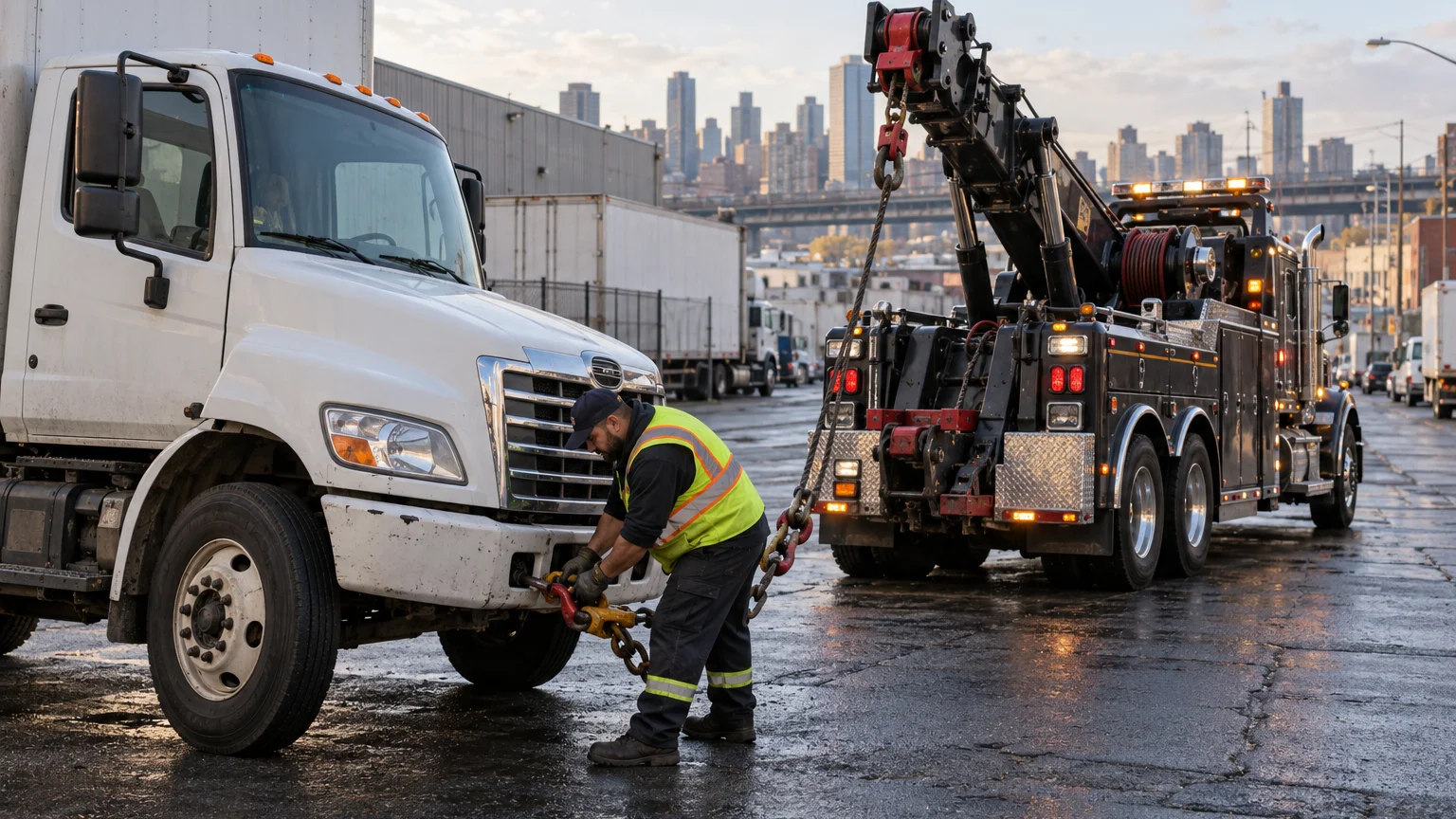
Quick Tow NYC serves all five boroughs as a referral service. We match callers with independent local towing and roadside operators. We don’t own tow trucks, perform recoveries, or operate a storage lot.
A box truck call starts with size and load
“Box truck” describes many commercial vehicles. It doesn’t tell dispatch enough to select a tow truck for the job. Start with the truck’s exact make, model, and year when known.
Tell dispatch whether it’s a rental, delivery truck, moving truck, or another configuration. Describe the cab and cargo box separately. If you know the truck’s height, length, or weight, provide those figures exactly. Don’t guess. A photo of the truck and its identifying labels may help the operator assess it.
The cargo matters too. Say whether the box is empty, partly loaded, or full. Describe the type of load without estimating its weight. Tell dispatch if anything shifted, leaked, or became unstable during the breakdown. The operator may need more information before accepting the job.
Next, report the wheel condition. Dispatch needs to know whether every wheel remains attached and can roll. Mention flat tires, damaged axles, locked brakes, steering problems, or wheels turned against a curb. Say if the truck is leaning or resting on another object.
Clearance can change the entire setup. Note any parking-garage ceiling, loading-dock canopy, scaffolding, gate, narrow entrance, or low tree branch. A wrecker tow truck that fits the vehicle may not fit the space around it.
Our heavy-duty towing referral service uses these details to find a suitable independent operator. The operator reviews the call and states the quote before dispatch.
Location decides which legal route an operator can use
An exact pickup point matters more than a neighborhood name. Share the street, nearest cross street, travel direction, and the truck’s position. “Queens” isn’t enough. “Industrial street near an intersection in Maspeth” gives dispatch a better starting point.
Say whether the truck occupies a travel lane, curbside loading space, shoulder, driveway, loading dock, or enclosed lot. Mention nearby barriers and tight turns. Photos should show the vehicle, road width, overhead space, and access from both directions.
New York City’s parkway restrictions shape commercial towing routes. Commercial vehicles, trucks, and tow trucks are banned from city parkways, including the Belt, FDR, Henry Hudson, Cross Island, Jackie Robinson, Bronx River, Hutchinson, Mosholu, Pelham, Ocean, Korean War Veterans, and Grand Central parkways. The approved Grand Central Parkway exception applies to single-unit vehicles between the RFK Bridge and the BQE.
That means the shortest map route may not be legal for either vehicle. A disabled box truck near the Belt Parkway may require a different approach than one on the BQE. The same issue affects a tow truck for a truck near the Cross Island or Jackie Robinson Parkway.
Tell dispatch the intended destination before the operator starts moving. It could be a repair facility, fleet yard, rental location, or another approved property. Confirm that the destination can receive the truck. Provide its entrance and clearance details when available.
For borough-specific context, our Bronx tow truck guide explains how major roads and neighborhood access affect calls there.
A breakdown and a crash require different information
A mechanical breakdown starts with the truck’s condition. Describe what happened immediately before it stopped. Say whether the engine runs, the transmission shifts, and the steering responds. Report warning lights as you see them, without diagnosing the cause.
Tell dispatch whether the truck can roll or move under its own power. Don’t try to force it into traffic. A roadside problem may call for assistance rather than towing, but the operator decides what equipment and work fit the reported condition.
A crash requires a different call. Dispatch needs to know whether the truck struck another vehicle, a wall, a pole, a guardrail, or street furniture. Report visible wheel damage, leaking material, broken glass, deployed airbags, and cargo movement. Say whether police or another agency controls the scene.
Police-directed accident and rotation towing follows a different process from a customer-requested breakdown tow. New York City’s DCWP describes its towing rules and consumer information on the city towing services page. If an officer directs the tow, follow the officer’s instructions about removal.
A truck off the pavement, pinned against an object, or unable to roll may need recovery work before transport. Our accident recovery and winch-out service covers referrals for those situations.
Don’t describe crash recovery as a normal roadside hookup. Photos and clear scene details help the operator decide whether the call fits its equipment. Quick Tow NYC doesn’t perform that work. We refer the request to an independent local operator.
Hunts Point freight differs from a Manhattan delivery stop
Hunts Point has freight traffic, industrial properties, loading areas, and trucks moving between warehouses. A disabled box truck there may be beside a loading dock, in a market-area approach, or on a freight street with other commercial vehicles passing.
Dispatch still needs a precise location. “Hunts Point” covers too much ground for a truck tow service call. Give the cross street, property entrance, travel direction, and any gate instructions. If the truck blocks a loading bay, say whether another route into the property remains open.
Our guide to heavy-duty towing in Hunts Point explains the local setting in more detail. This booking-stage call adds the vehicle facts an operator needs before taking the job.
A Midtown delivery stop presents different constraints. The truck may sit at a curb between parked vehicles, beneath scaffolding, or near a building entrance. Tell dispatch about clearance, traffic-lane access, loading-zone space, and the direction the truck faces. Don’t assume a tow truck can approach from either side.
A Queens industrial street creates another pattern. Streets around warehouses may have gates, loading aprons, parked trailers, or limited turning space. A location near the BQE differs from one near the Grand Central Parkway because parkway restrictions affect legal truck routing.
Each example needs the same core facts, but their surroundings change the plan. Send wide photos instead of close-ups alone. The operator needs to see how the truck sits within the street, curb, gate, or loading area.
What to have ready before an operator quotes the job
Gather the information before calling when conditions allow. A complete description reduces repeated calls and helps the operator evaluate the request.
Have these details ready:
- Exact pickup address, cross street, and borough
- Direction of travel and the truck’s position
- Truck make, model, year, and body style when known
- Exact dimensions or weight only when you have them
- Whether the cargo box is empty, partly loaded, or full
- A plain description of the cargo
- Wheel, tire, axle, brake, and steering condition
- Whether the truck starts, shifts, rolls, and steers
- Visible crash damage or leaking material
- Overhead, side, gate, and entrance clearance
- Photos showing the truck and surrounding access
- Requested destination and receiving entrance
- Contact details for the driver or fleet manager
Mention keys and access to the cab or cargo area. If the driver can’t stay with the vehicle, explain who will meet the operator. Don’t leave access arrangements unclear.
The operator may ask follow-up questions. Answer with observed facts. “The rear passenger-side wheel won’t turn” is more useful than “the axle is destroyed” unless a qualified person confirmed that diagnosis.
There isn’t a verified per-kilometer towing figure we can publish for this work. Equipment needs, access, vehicle condition, and destination differ between jobs. The independent operator sets the price and states the quote before dispatch.
A general tow truck service request can become a recovery call after the operator reviews the scene. It can also require different equipment if the truck’s dimensions, load, or wheel condition differ from the first description. Accurate information matters more than choosing a tow method yourself.
When to call us
Call when the box truck can’t move safely and you have its location, condition, load status, and destination. The line is answered around the clock, and Quick Tow NYC can refer the request to an independent local operator serving the five boroughs. Call us at (929) 356-7857.