You’re on a curb in Sunset Park with a car that will not roll. The operator who shows up with the wrong truck either scrapes the lip or cannot take a legal route off the Belt. In New York the truck type is a routing decision, not a style choice.
What each truck is built to do
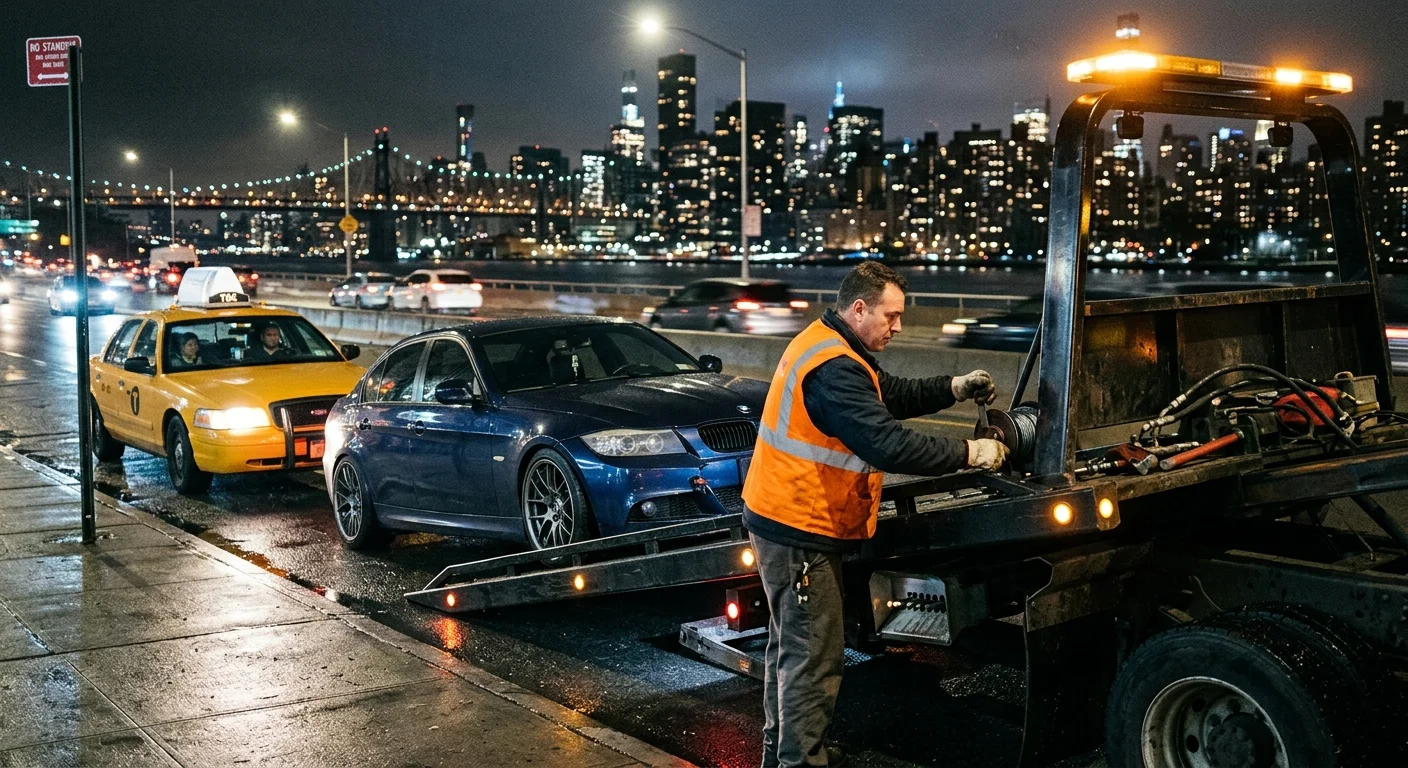
A flatbed is a hydraulic deck that tilts down to the pavement. The car is driven or winched onto it, then the bed levels. All four wheels leave the street. Nothing on your drivetrain spins while the truck moves. Operators also call it a rollback.
A wheel-lift is a hydraulic yoke. It slides under the front or rear tires and lifts that end. The other two wheels stay on the asphalt and roll behind the truck. Setup is usually quicker. The truck is shorter, so it fits more of the city’s tight blocks, one-ways, and garage ramps.
Neither truck is the default NYC truck. They do different jobs. A stock front-wheel-drive sedan with good tires can often take a short hop with the drive wheels up. Lift the front of a FWD car so the drive wheels are in the air. Lift the rear of a RWD car. Get that backwards and you can grind a transmission on a five-block run to a shop on Atlantic.
Quick Tow NYC is a referral service. We match you with independent local operators. We do not own the trucks, we do not perform the tow, and we are not a DCWP-licensed towing company. The operator who arrives picks the method that fits the pin and states the price before dispatch. There is no brand rate card on this page.
If NYPD already took the car off a public street, you are not choosing a truck. You are looking up a pound. Start with the NYPD towed-vehicles page or NYC 311, not a street-tow request.
People ask if flatbed towing is more expensive. Sometimes the quote is higher because the truck is larger and the legal route is longer. Sometimes it is not, because the wrong wheel-lift means a second truck and a second bill. Ask for both numbers on the same pin if both methods are safe for the car. Do not guess a figure from an article.
A tow dolly or a bumper-hitch flat-tow is a different tool. Those show up more on highway moves. On a New York street breakdown you are almost always choosing between a rollback deck and a wheel-lift. Dollies only enter if that operator actually carries them.
Why NYC parkways change the dispatch
This is the part that does not copy to another city with the name swapped. NYC DOT bans commercial vehicles, trucks, and tow trucks on the parkways. That list includes the Belt, the FDR, the Henry Hudson, Cross Island, Jackie Robinson, Bronx River, Hutchinson, Mosholu, Pelham, Ocean, Korean War Veterans, and Grand Central Parkway. A flatbed on those roads is itself a violation. It shapes the whole run, not just the last mile.
A wheel-lift is still a tow truck. It does not get a free pass down the Belt. Both trucks have to stay on truck routes: the BQE, the LIE, the Cross Bronx, the Van Wyck, and local streets that allow commercial traffic. The operator is not drawing the shortest line on a map. They are drawing a legal line.
Grand Central Parkway has a narrow single-unit exception between the RFK Bridge and the BQE. That is not a blanket parkway pass. Treat it as a limited cut, not a shortcut you should count on from LaGuardia or Astoria.
Size piles on after the ban. North of 23rd Street the FDR has an 8,000-pound limit. A loaded flatbed can be the wrong truck for that stretch even when the parkway rule is not the issue. The Holland Tunnel has a 12 foot 6 inch height limit and bars tractor-trailers, trailers, most hazmat, and trucks with four or more axles. If the shop is in Jersey, that is a destination, not local coverage. We serve the five boroughs. Long Island, Westchester, and New Jersey are not on the local map.
Borough by borough the trap looks different. In southern Brooklyn and near JFK, the Belt is the road everyone wants to hop. The legal move is often the BQE or a commercial surface route, not a rollback flying the parkway to the Verrazzano. In Manhattan the FDR and the Henry Hudson are the temptation from the East Side and the West Side. Operators drop to truck-legal avenues and tunnel approaches instead. In the Bronx the Henry Hudson, Mosholu, Bronx River, Pelham, and Hutchinson sit next to the Cross Bronx, which already crawls under a heavy truck mix. On Staten Island, Korean War Veterans Parkway is on the same ban list as the Belt.
If you are already disabled on the Belt or the FDR, say the parkway name on the call. Do not assume the first truck can roll that parkway to reach you. NYC DOT writes those restrictions. The operator has to plan the approach around them.
That is why a tow truck near me in NYC is not the same as a suburban rollback out of Nassau. An operator who does not know the parkway ban burns the job looping from the Belt to the BQE while you sit in a live lane.
Low cars, AWD, and damaged wheels
Ground clearance is the first visual check. A lowered car on a Boerum Hill block, a splitter on a Financial District garage ramp, a classic with original ride height in exotic and classic territory: the yoke on a wheel-lift can kiss the air dam before it ever lifts a tire. The deck of a flatbed still needs room to tilt. If the car is in a basement garage, say the ceiling is tight. The operator may send the smaller truck and add dollies, or they may tell you the car has to be rolled to the street first.
All-wheel drive and four-wheel drive are the next check. If two wheels roll and two wheels still drive, the transfer case can fight itself. That is not a New York statute. It is how those drivetrains are built. Check the owner’s manual. If the book wants all four wheels off the ground, ask for a flatbed. Do not accept “it’s only to the shop on Northern Boulevard” as a workaround.
Electric cars follow the same logic. Many manuals want a flatbed so the drive units do not spin. We do not publish a house EV rule, and New York City does not print a flatbed-only EV law we can cite here. Read the manual, then say “EV” on the call so the operator does not send a two-wheel lift by habit. The EV dispatch, including Transport Mode, is Tesla and EV towing in NYC.
Damaged wheels change the math even on a plain Camry. A bent rim in Hunts Point, a locked parking brake in Washington Heights, a tire shredded on Queens Boulevard: the rolling end of a wheel-lift has to actually roll. If it cannot, the car needs the deck. After a hit on the Cross Bronx, assume the rolling pair is not trustworthy until someone looks at the corner.
Low, AWD, EV, or a broken wheel: say those four flags in the first minute. The operator would rather send the right truck once than abort a load on a one-way in Corona.
When a wheel-lift is the wrong call
A wheel-lift is the wrong call when the car cannot safely roll on two wheels. That includes AWD and 4WD unless the operator has dollies and your manual allows that setup. It includes a smashed corner, a motorcycle, a car with no rolling tires, and most longer runs where the rolling pair would wear, heat, or wander.
It is also the wrong call when the lift itself cannot get under the car. Sports cars, air-suspension cars sitting on the stops, and anything with a deep front lip are in that group. If you have to think about the splitter, you already need the deck.
The opposite is also true. A flatbed is the wrong truck when it cannot physically work the pin. Parallel parked tight on a brownstone block in Park Slope, a one-way in Corona with cars on both sides, a garage with no tilt room: the shorter wheel-lift can often hook from an angle a rollback cannot. Alternate-side mornings make this worse. The curb is a wall of cars. A flatbed needs a longer gap than a yoke. That is not a reason to drag an AWD car two miles. It is a reason to say “tight space” so the operator brings the truck that fits, plus dollies if the drivetrain needs them.
Do not confuse this with a city relocation or a parking-violation pound tow. Those are NYPD or DCWP jobs with their own rules. This page is the breakdown you called in yourself.
Hook-and-chain is the old bumper grab. For a daily driver it is the wrong era. If someone shows up with chains on the frame of a modern unibody, stop the job and ask for a wheel-lift or a flatbed.
How to describe the scene so the right truck shows up
Give the operator a picture, not a vibe. Borough and nearest cross street. Whether you are on a parkway, an expressway, or a local street. Whether the car is in a live lane, a bus lane, or a legal spot. Drive type: FWD, RWD, AWD, 4WD, or EV. Ride height: stock, lowered, or damaged. Which wheels still roll. Where the car has to go, including a shop name if you have one.
If you are on the Henry Hudson, the Belt, or the FDR, say the parkway name. If you are under the BQE in Sunset Park or on a pier-level street in Red Hook, say that too. Vertical clearance and turn radius change the truck. If it is an alternate-side block in the Bronx, say the curb is packed.
Name the destination borough. A College Point shop from Tottenville is a different routing problem than a five-block roll in Bushwick. A shop in Nassau or Jersey is a destination tow. Say that up front so nobody plans a local pin and then hits a tunnel height or a parkway ban halfway there.
Stay out of the travel lane. If you are on an expressway shoulder, stand behind the barrier when you can. If this is a crash with injuries, call 911 first. A street-tow referral is not an ambulance.
When you call, you get a quote before dispatch. If the scene does not match what you described, the operator may need a different truck. Over-describe the pin. Under-describing is how a flatbed dies on a one-way with no tilt room.
When to call us
Once the car cannot roll safely, or you are choosing between a parkway-adjacent pin and a truck that cannot legally use that parkway, this is not a DIY shove. Call us at (929) 356-7857. The line is answered around the clock. Calls are recorded after a notice. An independent local operator gets dispatched to you.