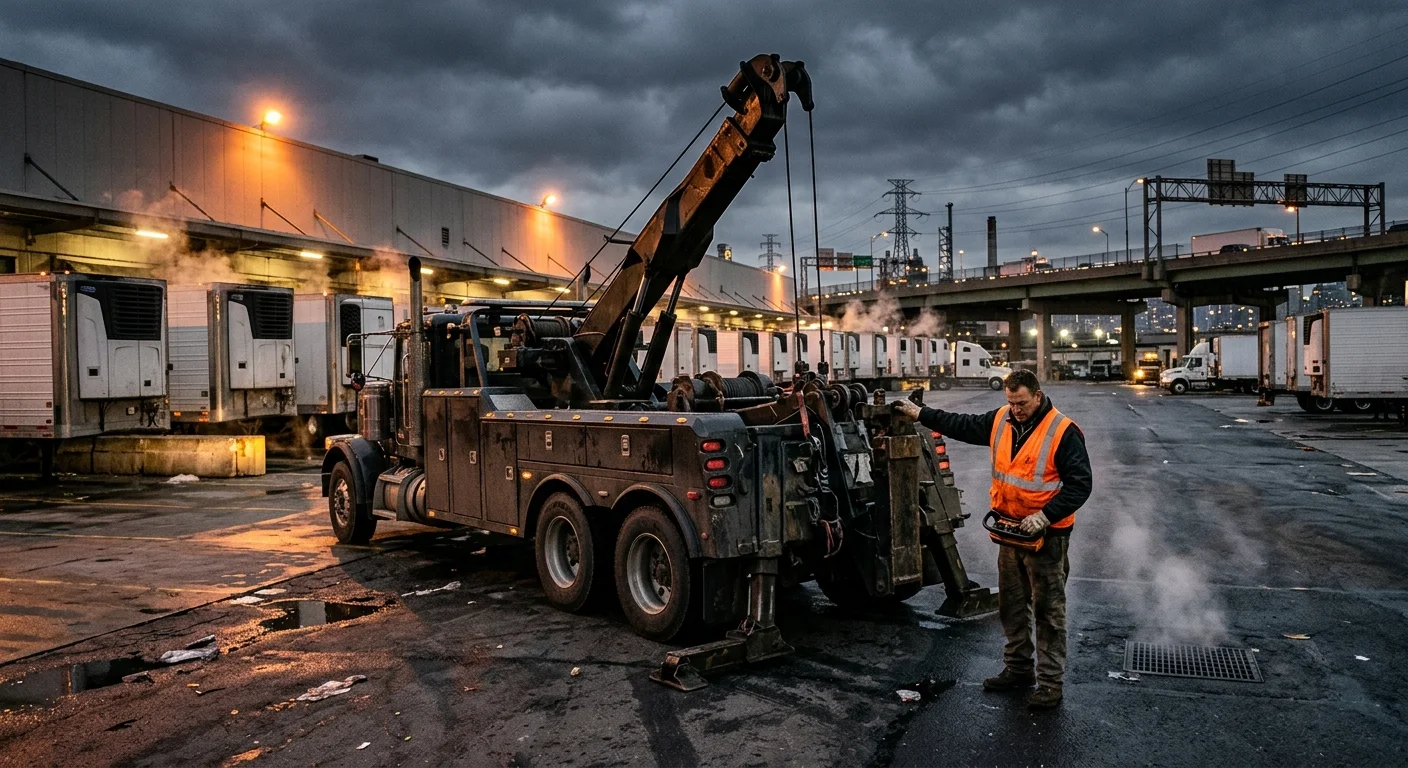
A loaded reefer that dies on Food Center Drive at four in the morning is not a sedan hook. Hunts Point moves produce, meat, and fish through the Food Distribution Center, and the vehicle in the way is often a box truck, a tractor, or a bus. Heavy-duty towing here is a commercial dispatch on legal truck routes, with the price quoted before an independent operator rolls.
Why Hunts Point runs heavy equipment
The peninsula sits on the East River in the South Bronx, just inside the Bruckner Expressway. Before sunrise, reefers stack up at the produce market, the meat market, and the fish market. Those docks run on appointment windows. A truck that will not move does not just delay one driver. It backs up a bay, then a row.
That is why heavy duty towing Bronx calls cluster here more than on a quiet block in Riverdale. The streets around Hunts Point Avenue, Halleck Street, Viele Avenue, and Food Center Drive carry freight. School drop-off is not the pattern. What fails is heavy. Trailers. Straight trucks. Tractors. Buses.
A frozen kingpin at a meat-market dock is a different recovery than a passenger car with a flat. So is a box truck with a blown steer tire on Halleck, or a tractor that will not build air on Hunts Point Avenue. Light-duty wheel-lift trucks are built for cars. They are the wrong tool on this waterfront.
Quick Tow NYC does not own wreckers, rotators, or a yard. We are a referral service for the five boroughs. We match you with independent local operators. The pros we connect you with are licensed and insured. We are not a DCWP-licensed towing operator, and we do not perform the recovery ourselves.
Hunts Point also sits against Longwood and Port Morris. Soundview is across the water. Trucks leave this peninsula for Brooklyn and Queens on the Bruckner, and for the rest of the Bronx and Manhattan on the Cross Bronx and the Major Deegan. A stall here can pin dock traffic against the river. There is no quiet side street to wait on. That mix of market, waterfront, and expressway ramps is why truck towing Hunts Point is its own job, not a citywide page with the neighborhood name swapped.
Truck routes versus parkway bans
The operator still has to reach you legally. New York City publishes truck routes for that reason. Stay on those streets. Parkways ban commercial vehicles, trucks, and tow trucks. From the South Bronx that list includes the Bronx River Parkway, Hutchinson River Parkway, Mosholu Parkway, Pelham Parkway, and the Henry Hudson Parkway. The FDR Drive is a parkway too, with an 8,000-lb limit north of 23rd Street. A flatbed on a parkway is itself a violation. That fact shapes the first turn off the peninsula.
From Hunts Point, the legal way out is the Bruckner Expressway, the Sheridan Expressway (I-895), and the signed local truck routes that feed them. The Cross Bronx Expressway takes trucks. It is also among the most congested roads in the country, on the order of 165,000 vehicles a day, including about 18,000 trucks, using NYPD 2023 figures compiled by aeelaw.com. A disabled tractor in that mix is a different job than a passenger car on a side street.
The Grand Central Parkway has a narrow single-unit exception between the RFK Bridge and the BQE. That exception does not help a combination wrecker leaving Hunts Point. Plan the route as a truck route from the first turn. If someone tells a driver to “cut over on the parkway,” they are asking that driver to pick up a second problem.
This page is not a city pound job. If NYPD towed the vehicle off a public street for a parking violation, that is a different regime. For vehicles 8,000 lbs and over, NYPD’s published release fee is $370, plus $20 a night in storage, with a 10-day reclaim window, per the NYPD towed vehicles page. Bronx reclaim runs through the Exterior Street pound. We do not run that pound. Use NYC 311 or the city’s towed-vehicle lookup before you assume the truck was stolen.
A private commercial breakdown that you call in is not an NYPD pound tow and it is not a DCWP-capped private-lot tow. The operator we match you with quotes the price before dispatch. We do not publish a brand rate.
Box trucks, reefers, buses, and broken tractors
Most of the work on this peninsula is a working truck, not a parked sedan. Box trucks lose steer tires on Halleck and Ryawa. Reefers die with product still on the clock. Tractors will not build air, or they drop a drive axle on Hunts Point Avenue. Buses fail on the Bruckner service roads. Each of those needs a heavy wrecker, a rotator, or a landoll from the operator, not a passenger wheel-lift.
Do not guess a ton rating on the phone if you do not have one. Read the door sticker if you can do it safely. Say whether the truck is loaded or empty. Say whether a trailer is still coupled. Say whether the unit has air brakes. Say whether a reefer is still running. Perishable cargo does not change our price rules. It does change how fast the fleet wants the truck off the dock.
If people are still on a bus, get them off the vehicle and out of the travel lane first. If anyone is hurt, call 911. A recovery around live traffic is accident recovery, not a parking-lot hook. If police direct a rotation tow after a crash, that is the city’s DARP/ROTOW path. DCWP publishes a max of $125 for vehicles at or under 10,000 lbs and $140 above that, with storage at $25 a day for the first three days and $27 a day after, on the DCWP towing consumer page. If you call our line for a private recovery instead, that is a separate dispatch. The operator states the price in the quote. We do not borrow the city’s cap as our own number.
Hazmat placards matter. If the trailer has them, say so. Do not assume every heavy operator will take every placard. The independent operator decides what they can recover. We do not invent that capability on the page.
Commercial towing Bronx work around Hunts Point also includes the unglamorous stall: a box truck that will not start in a yard, a tractor that made it off the Bruckner and then died on Edgewater Road, a reefer blocking a dock at the produce market. Those are still heavy jobs. They still need truck-route routing. They still get a quote before anyone is dispatched.
Bruckner and Sheridan approaches
The Bruckner Expressway (I-278) is the spine. Hunts Point Avenue, Edgewater Road, and the Sheridan Expressway (I-895) are how freight climbs onto it. I-895 is a short connector, Bruckner up to the Cross Bronx at Whitlock. Shoulders are thin. Trucks are already in the mix. A disabled unit on those approaches occupies a lane that other reefers need.
If the truck is in a live lane on the Bruckner, the Sheridan, or a ramp, treat it as emergency towing. Stay out of the travel lane. Put hazards on. Get to a safe spot if you can move at all. If you cannot move, wait for the operator off the pavement. Do not walk the expressway to “flag a wrecker down.”
A stall on the service road or on Hunts Point Avenue is still a truck-route job. The wrecker has to arrive on legal streets, line up without clipping a dock gate, and leave the same way. Parkway shortcuts are not available. The Bronx River Parkway is close on a map and useless for this work.
The Cross Bronx sits just uphill of the Sheridan. It is the congested truck road described above, not a relief valve. If the disabled unit is on an approach that feeds the Cross Bronx, say which direction you were heading and which ramp you can see. “Somewhere on the Bruckner” is not enough. Name the cross street, the mile of the peninsula, and whether you are against a Jersey barrier or a yard fence.
We do not quote arrival times. Congestion on the Cross Bronx and the Bruckner is the reason. The operator who takes the job knows those ramps. The quote you hear before dispatch is the price for that recovery, not a promise about the clock.
What to tell dispatch on a commercial breakdown
The useful call is specific. Start with the exact street, not “Hunts Point.” Food Center Drive, Halleck Street, Viele Avenue, Ryawa Avenue, Hunts Point Avenue, Edgewater Road, and Bruckner Boulevard are different recoveries. Say which way the truck faces. Say whether it is blocking a dock, a yard gate, a bike lane, or a live travel lane.
Then the vehicle. Year and make if you have them. Straight truck or tractor. Trailer on or off. Loaded or empty. Air brakes or not. Reefer running or not. Bus with passengers already off. Read the GVWR off the door sticker if you can do it without standing in traffic. If you cannot read it, say you cannot. Do not invent a class.
If it is a crash, say that. If NYPD is already on scene, say that too. A police-directed rotation tow is the city’s path. A private call to us is a referral to an independent operator, with the price quoted before dispatch. If you are not sure whether the city already took the truck, check the NYPD towed vehicles lookup and NYC 311 before you order a second recovery.
If you searched tow truck near me from a dock, you still need the heavy unit, not the closest passenger truck. Tell dispatch it is commercial. Tell them it is Hunts Point. That is how the right operator gets the job.
The line is answered around the clock. Calls are recorded after a notice. We take the information and match you with a local operator. We do not own the wrecker that shows up.
When to call us
Once the truck cannot roll on its own, or it is sitting in a Bruckner or Sheridan lane, this is no longer a jump-pack job you finish between dock appointments. Call us at (929) 356-7857. The line is answered around the clock, calls are recorded after a notice, and we dispatch an independent local operator to you with the price quoted before anyone rolls.