A stalled sedan on a Fordham side street and a box truck on Food Center Drive are different Bronx jobs. The borough mixes steep hills, freight yards, Yankee nights, and a city pound at 2444 Exterior Street. The wrecker that fits one block can fail two streets over. Give the line the street, the vehicle, and whether you called a shop or the city already took the car.
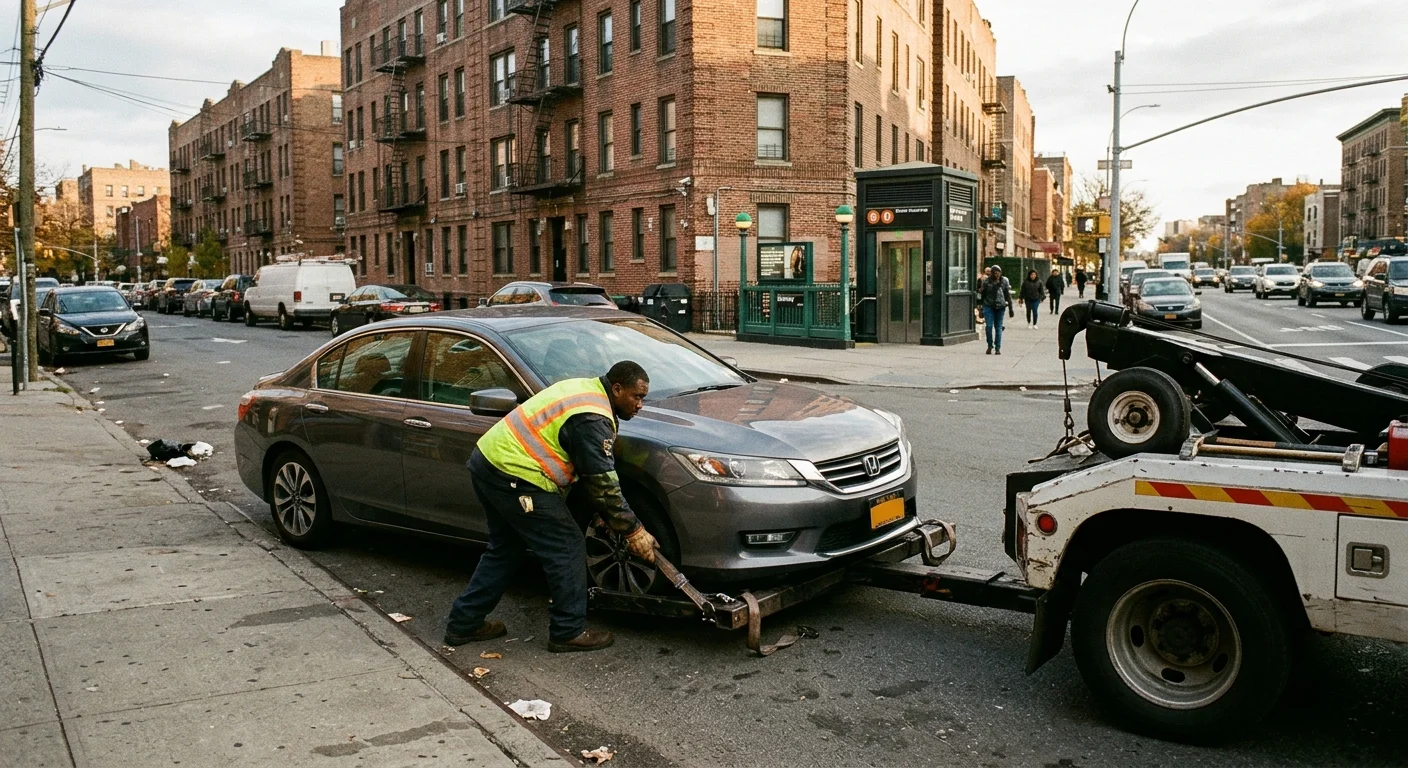
Bronx jobs split between freight streets and tight hills
The Bronx is one borough with two kinds of work. South and east, Food Center Drive, Halleck Street, and the Bruckner serve markets, reefers, and tractors. North and west, Fordham Road, Kingsbridge, and the Concourse side streets climb, pinch, and double-park. A wheel-lift that can pull a Civic off a Grand Concourse service road may be the wrong truck for a loaded box on Leggett Avenue.
Quick Tow NYC is a referral line. We match drivers with independent local operators. We do not own trucks. We do not run a Bronx yard. We are not a DCWP-licensed towing company. The operators we dispatch do the licensed work. That split matters here because the job itself splits.
On the hill blocks, the operator needs room to set up without blocking a bus or a stoop. University Heights and Kingsbridge Heights are steep. AWD cars and low-clearance sedans often ride a flatbed so all four wheels stay off the pavement. On the freight side, the match is heavy-duty towing. That is air brakes, tandems, and recovery a light wrecker cannot do. We already covered the freight-only version in heavy-duty towing in Hunts Point. This page is the rest of the borough.
Mott Haven and Port Morris sit between those worlds. You get residential one-ways next to the Major Deegan ramps. A breakdown on East 138th is a sedan job until it is a box truck that missed a turn onto Bruckner Boulevard. Tell the line the cross streets. “The Bronx” is not an address. “Grand Concourse and East 167th, sedan, in the curb lane” is.
Riverdale and Fieldston add winding residential roads, parked cars on both sides, and the Henry Hudson nearby. A wrecker that is legal on a truck route still has to stay off the parkway system.
If you searched tow truck near me in NYC, the Bronx answer is local in a tighter way than a Queens grid. Neighborhoods change every ten blocks. The operator that knows Exterior Street may still need a different truck for a Fordham hill.
Truck routes, the Deegan, and parkways a wrecker cannot use
NYC parkways ban commercial vehicles, trucks, and tow trucks. In and around the Bronx that list includes the Bronx River Parkway, the Hutchinson River Parkway, the Mosholu Parkway, the Pelham Parkway, and the Henry Hudson Parkway. A flatbed on a parkway is itself a violation. That shapes how the operator routes your car, even when the pickup looks simple.
The Major Deegan Expressway (I-87) and the Cross Bronx Expressway are truck routes. The Cross Bronx carries about 165,000 vehicles a day, including about 18,000 trucks, and ranks among the most congested roads in the country (NYPD 2023 figures compiled at aeelaw.com). A disabled car in a Cross Bronx travel lane is an emergency towing job with traffic at your back. Stay in the vehicle with hazards on if you are safer there. If you can reach the shoulder or a ramp gore, do that. Do not stand in a live lane.
The Bruckner Expressway, I-95, and the Sheridan (I-895) are the freight spine. Operators who work Hunts Point already think in those ramps. A sedan dead on the Deegan north of 138th still has to leave on a legal truck route. The operator cannot hop on the Henry Hudson to save time.
If the car needs to go into Manhattan, the FDR Drive has an 8,000-lb limit north of 23rd Street. That cap can decide whether a loaded wrecker belongs on that road. Confirm the destination with the operator before the truck moves. Our price is quoted before dispatch. We publish no per-mile figure.
Heading toward Queens, the Grand Central Parkway still bans most trucks. There is a published single-unit exception between the RFK Bridge and the BQE. That is a routing fact, not a shortcut you should guess from the shoulder.
Parkway bans also change a Yankee Stadium night. River Avenue and 161st Street clog. The nearby parkways stay closed to the wrecker. The operator works surface streets and truck routes: Jerome, the Grand Concourse, the Deegan ramps. Build that into your expectations. We do not quote arrival times.
If you broke down on a parkway, say so on the call. The match has to be a truck that can legally get to you, or a plan to reach you from an interchange. After the Ida remnants on September 1, 2021, cars sat abandoned on the Major Deegan in floodwater. Weather jobs still follow the same rule: truck routes in, parkways out.
Exterior Street pound tows versus a shop you called
Two Bronx tows get mixed up. One is a tow you asked for, to a shop in the borough. The other is an NYPD parking-violation tow. That car goes to the Bronx pound at 2444 Exterior Street, Bronx 10468, per the city’s NYPD towed vehicles page.
NYPD publishes the release fees: $185 if the vehicle is under 8,000 lbs, $370 at 8,000 lbs and over, plus $20 a night in storage. You have 10 days to reclaim. Confirm those figures on the NYPD page before you pay. Hours currently listed are Monday through Friday 8 a.m. to 8 p.m. and Saturday 8 a.m. to 3 p.m. Sunday hours are not listed there. Bring a valid driver’s license, current registration, and a current insurance card. If you are not the owner, you need a notarized authorization letter. Payment is cash or a card in the retriever’s name.
If you are not sure the city took the car, use the NYC 311 towing guide and the towed-vehicle lookup before you assume it was stolen. The city sometimes relocates a vehicle instead of impounding it.
A private-lot or driveway tow is a third regime. DCWP-licensed operators are capped at $125 for removal plus the first three days of storage, then $15 a day, with a $62.50 drop fee if you return before the car is removed. Storage has to stay inside city limits and within 10 miles of the removal point (NYC Admin Code § 19-169.1). Those caps are on the DCWP towing consumer page. Confirm them there. They do not describe our price. Our operators quote before dispatch.
Accident and rotation tows (DARP/ROTOW) sit under DCWP maximums of $125 or $140 depending on weight, with storage at $25 a day for the first three days then $27. NYPD rotation tows publish $50, or $100 for a double, with storage $10 a day for the first three days then $12. Those are city numbers. They are not a shop-tow quote.
A fair Bronx tow price is the city’s published fee when the city took the car, and a written operator quote when you called for a shop. There is no brand flat rate on this page. Hunting the cheapest wrecker on a parkway is how you get a truck that cannot legally finish the trip.
If you called for a shop tow, the car does not go to Exterior Street. It goes where you and the operator agreed. If NYPD took it for a parking violation, calling a private wrecker will not open the pound. Pay the city, bring the documents, and go to 2444 Exterior Street.
Scofflaw boots are a Department of Finance process, not a shop dispatch. Default-judgment parking and camera tickets can bring a boot at $350 or more, a tow 48 hours later if unpaid, and an immediate tow at $2,500 or more, invalid registration, or a public-safety issue. Use NYC 311 and Finance for that path.
Hunts Point freight, Yankee nights, and residential blocks
Hunts Point is the heavy job. Tractors, reefers, and lowboys on Food Center Drive need heavy-duty equipment, not a light wheel-lift. Read the freight walkthrough on the Hunts Point post if that is your scene. This section is how that zone sits next to everything else.
Leave the market and you are in Longwood, Soundview, and Castle Hill in a few minutes. A sedan on Lafayette Avenue is a neighborhood tow. A bobtail that died on the Bruckner ramp is not. Say the body type, the load if you know it, and whether the vehicle can roll.
Yankee nights change the South Bronx grid. River Avenue, 161st Street, and the blocks around the 4 train fill with buses, vendors, and double-parks. A breakdown there is still a light-duty match for most cars. The constraint is access. The operator needs a place to stage without sitting in a live lane on the Deegan service road. Give a cross street you can actually wait on.
Residential Bronx is the rest of the map: Fordham, Belmont, Tremont, Parkchester, Throggs Neck, Co-Op City, Wakefield, City Island. Alternate-side rules still apply. Cars towed off public streets for parking violations end up at Exterior Street, not at a shop you picked. Hydrant, crosswalk, and corner rules live in Vehicle and Traffic Law § 1202: 15 feet from a hydrant, 20 feet from a crosswalk, 30 feet from a signal or stop sign.
On the hill streets, mention if the car is nose-down, in a driveway, or against a stoop. Winch-outs and accident recovery are licensed operator work. Do not drag a car off a grade with a strap from a friend’s SUV.
If the destination is a shop on Jerome, Webster, or Boston Road, say the shop name and the street. If you only know “somewhere in the Bronx,” the operator still needs a pin. We serve the five boroughs. Westchester, Long Island, and New Jersey are not in the local service area. They can be named as long-distance destinations when that is the actual job.
What to tell the line so the right truck is matched
Start with the borough and the exact corner. “Bronx, Grand Concourse and East 170th” beats “near Yankee Stadium.” Add the vehicle: year if you have it, sedan or SUV or box truck, two-wheel drive or AWD, and whether all four wheels turn.
Say what happened in one line. Dead battery after a jump is roadside. Overheated on the Deegan shoulder is a tow. Hit from behind on the Bruckner is accident recovery, and NYPD may already be directing a rotation truck. If the car is gone from a street spot, run the towed-vehicle lookup. Do not dispatch a wrecker to chase a pound tow.
Tell us if you are on a parkway, a truck route, a lot, or a one-way hill. Parkway location changes routing. A private lot is DCWP territory, with the $125 cap and the $62.50 drop if you get back before the hookup leaves. A public-street parking tow is NYPD and Exterior Street.
Name the destination. A Fordham body shop is a short borough move. A shop in Queens is still inside the five boroughs. A drop in Yonkers is a long-distance destination, not local Bronx coverage.
We quote before dispatch. There is no published brand rate, no per-mile number, and no cheapest-Bronx-tow figure here. City pound fees are the city’s. Private-lot caps are DCWP’s. Shop tows are the operator’s written quote. Ask for that quote before the truck rolls. Ranking “the best” Bronx company from a directory will not tell you whether that truck can legally leave the Hutchinson.
The line is answered around the clock. After a recording notice, the call is recorded. New York is a one-party consent state (Penal Law § 250.00 / § 250.05). An independent local operator is then matched to the job. We do not promise a clock time. We do not claim a fleet parked in the Bronx.
If you are in a live lane, get out of traffic if you can do it safely. Then call. Give the cross streets. Stay on the line long enough for the match.
When to call us
When the car cannot roll, when you are on the Deegan or the Cross Bronx, or when a hill or a parkway makes a friend with a strap a worse idea, stop treating it as a do-it-yourself job. Quick Tow NYC matches you with an independent local operator. The line is answered around the clock, calls are recorded after a notice, and the price is quoted before dispatch. Call us at (929) 356-7857.