A clutch that dies on Water Street is a different job from a Civic with a flat. The bike is light, the plastics scratch if they kiss the deck, and a boom that works on four wheels can drop two wheels on their side. If you need motorcycle towing in New York City, you want a bike-capable flatbed and soft straps, matched to the street you are actually on.
Why a bike is not a small-car tow
A car sits on four patches of rubber. A motorcycle sits on two, and the whole machine wants to fall the second the kickstand leaves the pavement. That is the whole job in one line. Weight class does not save you. A 400-pound sport bike is easier to ruin than a 3,000-pound sedan because there is no second axle to keep it honest.
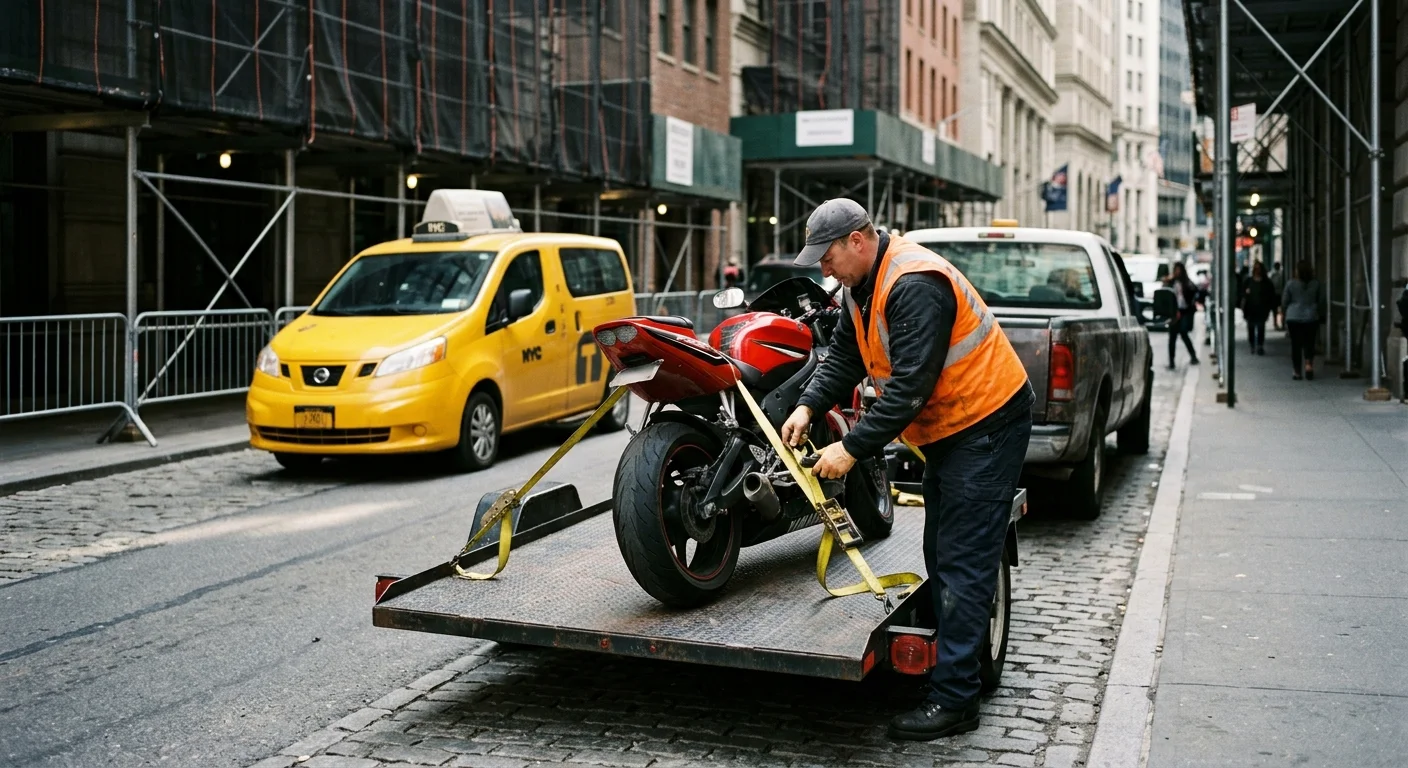
A wheel-lift scoops a car’s tires and tows it on the remaining pair. A bike has no remaining pair. The operators we dispatch for a motorcycle bring a flatbed, a front-wheel chock, and cloth straps. The bike rolls or gets winched onto the deck. The front tire sits in the chock. The straps hold it upright through the steel plates on the Williamsburg Bridge and the stop-and-go on the BQE.
A regular wrecker still gets sent when the call is vague. Searching tow truck near me does not tell a driver you have a Panigale on its side next to a hydrant. Say it is a motorcycle when you call. Name the make if you know it. Say whether it rolls, whether the forks are bent, and whether the fairing is already cracked. That is how dispatch avoids sending a car-only boom to a two-wheel pickup.
Sport bikes, cruisers, scooters, touring bikes, and trikes all ride a deck. They do not all tie down the same way. A Gold Wing is wide and heavy. A 250 scooter is light and will slide if the straps are lazy. A wrecked bike that cannot stand needs extra hands and a slower load. Vintage bikes with old paint and loose head bearings need softer anchor points than a new adventure bike with crash bars. Tell the line what is in the street. The quote is built from that, not from a car menu with the word bike taped on.
If NYPD already took the bike off a hydrant, a bus lane, or a street-cleaning block, that is a city tow, not a roadside pickup. Parking-violation tows go to a borough pound. Published release fees on the NYPD towed-vehicles page are $185 under 8,000 lbs, $370 at or above, and $20 a night, with a 10-day reclaim window. Start with the city towing guide before you assume it was stolen. Manhattan and Staten Island do not have a confirmed dedicated pound in our records, so use the lookup rather than guessing an address. Bronx bikes often land at 2444 Exterior Street. Brooklyn parking tows often go to the Navy Yard entrance at Sands Street and Navy Street. Queens often goes to 31-22 College Point Boulevard in Flushing. Our line is for a bike still with you: breakdown, shop-to-shop, or a bike that went down in the street.
Manhattan garage ramps and curb realities
The Financial District is the hard version of this work. Pearl Street, Water Street, and the one-ways around South Street Seaport stack scaffolding, delivery vans, and a curb with no shoulder. A bed that squares up on Queens Boulevard will not square up on a FiDi block without sitting in a crosswalk. The operator may bring a shorter bed, or stage around the corner and walk the bike to the truck. Say the cross streets. Say if a scaffold tunnel is covering the curb.
Manhattan garages make the geometry worse. Ramps under office buildings south of Chambers are steep, low, and drawn for sedans. A wrecker’s cab may not clear the beam. A long bed may not make the turn at the bottom. Tell dispatch the garage name, the street entrance, and whether the bike is already on the sidewalk. If the attendant will not let a truck in, the load happens at the curb. That takes longer. It also keeps a fairing off a concrete wall.
Midtown loading zones fill early. A dead bike on 11th Avenue near the Lincoln Tunnel approach sits in bus traffic. On the East Side, the FDR Drive north of 23rd Street carries an 8,000-lb limit, so a heavy wrecker does not treat that stretch as a free lane. Uptown, Washington Heights hills add a second problem. A bike with a seized rear wheel does not roll down Broadway. It has to be lifted or winched. Say that on the call so the operator brings a winch, not only a ramp.
Curb rules are local and they are written. VTL § 1202 sets the distances at hydrants, crosswalks, signals, and railroad crossings. A laid-down bike in front of a hydrant on Amsterdam is still in the way of a fire company. A bike on the sidewalk in front of a bus stop will not wait for a friend with a van. If you can push it to a legal spot without standing in live traffic, do that. If you cannot, stay clear of the travel lane and wait for the truck. Do not stand in the FDR shoulder to “just hold it up.”
The parkways that look like Manhattan shortcuts are closed to this work. Commercial vehicles, trucks, and tow trucks are banned on the FDR’s parkway segments, the Henry Hudson, and the rest of the city’s parkway list. A flatbed on those roads is itself a violation. The operator we match will take truck-legal expressways and the surface grid, even when the Henry Hudson looks faster from Inwood to a Bronx shop.
Tie-downs, forks, and fairings
The damage riders remember is rarely the breakdown. It is the strap that crushed a plastic fairing, or the chain that bit a triple tree. Soft straps belong on the forks, usually at the triple clamp. They do not belong on hollow handlebars. They do not wrap painted bodywork. The front suspension compresses a little so the bike cannot bounce. The rear gets its own strap at the swingarm or a solid frame point. Exhaust cans and brake lines are not anchor points.
A front-wheel chock keeps the tire from rolling when the truck hits bridge joints. Without it, the bike walks on the deck. Walking is how a new Ninja puts a hole in its own radiator on the way to a shop in Long Island City. Two rear straps stop the back end from hopping when the bed hits a pothole on the BQE.
Chains have a place on cars. They chew motorcycle plastics. If an operator arrives with only chains and no chock, stop the load and call us back so we can match another truck. Quick Tow NYC does not own the rigs. We match you with independent local operators who run bike-capable beds. Stay on scene if you can. Ask to see the anchor points before the bed comes up. Bounce the bars once the straps are tight. If the bike still nods, it is not ready for the bridge.
A bike that already went down needs a different load. Bent clip-ons, a cracked case, or a fork tube that no longer sits square means the bike may not stand in a chock. The operator may strap it to a pallet, add wheel nets, or pad it on its side if that is the only way it will ride without making the crash worse. That is accident recovery, not a clean dealer transfer. Take photos before it moves. That is your record of how it sat in the street.
Scooters and mopeds look easy and then slide. The deck is slick. A floorboard is not a frame. Say “scooter” on the call. Trikes and Slingshots need a wider bed and four contact patches tied independently. Vintage bikes with drum brakes and old rubber need slower winching. None of this is secret shop wisdom. It is the difference between a bike that starts at the drop and a bike that needs a new fairing because the strap sat on the wrong plastic.
Borough-to-borough moves and parkway limits
Shop-to-shop is the quiet half of bike towing here. A Ducati that will not start in Red Hook still has to reach a specialist in Long Island City. A Harley with a dead stator in Astoria may be headed to a shop off Atlantic in Brooklyn. A sport bike that grenaded on the Cross Bronx may be going to a tuner in Bushwick. Those runs cross borough lines. They also cross the parkway problem.
NYC parkways ban commercial vehicles, trucks, and tow trucks. That list includes the Belt, the FDR, the Henry Hudson, Cross Island, Jackie Robinson, Bronx River, Hutchinson, Mosholu, Pelham, Ocean, Korean War Veterans, and Grand Central Parkway. There is a narrow single-unit exception on the GCP between the RFK Bridge and the BQE. Everywhere else, a flatbed on a parkway is a ticket. The Belt was the city’s deadliest single road in the 2023 NYPD crash figures, with 1,348 crashes and 8 fatal. It is not a shortcut for a loaded bike.
Truck-legal paths are the BQE, the LIE, the Cross Bronx, the Major Deegan, the Van Wyck, and the surface grid. The Verrazzano carries more than 220,000 vehicles a day. A Staten Island pickup headed to a Brooklyn shop uses that bridge, or it stays on the Island. We do not list a Staten Island pound because none is confirmed. If the city took the bike, use the lookup.
The Holland Tunnel bans tractor-trailers, trailers, four-or-more-axle trucks, and most hazmat. Height is 12 feet 6 inches. A standard motorcycle flatbed is usually under that. Confirm with the operator if the truck is a taller unit. Lincoln and Midtown have their own limits. Dispatch needs the origin borough, the drop shop, and whether the bike can roll onto the bed.
We serve the five boroughs: Manhattan, Brooklyn, Queens, the Bronx, and Staten Island. Long Island, Westchester, and New Jersey are outside the service area. They may show up as drop points on a long-distance quote. A Corona pickup to a Sunset Park independent, a Flushing dealer run, or a College Point shop hop is in-area work. The price for any of it is stated in the quote before dispatch. There is no published per-mile figure, hookup fee, or after-hours amount on our side.
Private-lot tows are a third regime. If a DCWP-licensed operator already hooked the bike from a driveway or a garage, the city’s published cap is $125 for removal plus the first three days, then $15 a day, with a $62.50 drop fee if you return before it leaves. That is on the DCWP towing consumer page. That path is not our dispatch. A bike still on the street with you is.
How dispatch matches a bike-capable operator
Quick Tow NYC is a referral service. We do not own trucks, we do not run a yard, and we are not a DCWP-licensed towing operator. The line is answered around the clock. After the recording notice, the call is recorded. We take the pickup, the drop, and the bike details, then we match an independent local operator who has a bike-capable flatbed.
The operator sets the price. You hear it before anyone rolls. We do not publish a brand rate. We do not publish an average, a cheapest-tier, or a weekend number. A short rolling hop from a Bushwick sidewalk to a shop five blocks away is a smaller job than a wrecked bike in the left lane of the Cross Bronx. The quote is the number that applies to your pickup, not a menu copied from a car tow.
AAA is its own program. We cannot confirm what a given membership will cover on a motorcycle in New York, and we are not that club. Check your card and the fine print for motorcycle towing, mileage caps, and after-hours rules. If the club cannot send a bike-capable truck, you can still call us for a matched operator. The quote on our side is still stated before dispatch.
Say these things on the call, in this order if you can:
- Borough and nearest cross street, plus garage name if you are underground
- Street, garage ramp, or expressway shoulder
- Whether the bike rolls, and whether it will sit on a kickstand
- Sport bike, cruiser, scooter, trike, or vintage
- Drop: home, dealer, or independent shop, with the borough
A wheel-lift is the wrong tool for this. A flatbed with a chock is the right one. If you are in live traffic and people are going to get hit, call 911 first. Then call us for the recovery once the scene is controlled.
We serve every city in the five boroughs. The operator who shows up is local to the work, not a truck we keep on a lot. You get the quote, you accept it, and the truck moves. That is the whole match.
When to call us
A bike you can roll three quiet blocks to a shop is still a walk. A bike on its side on the Cross Bronx, in a Financial District garage ramp, or with a bent fork is past that. Call us at (929) 356-7857. The line is answered around the clock, calls are recorded after a notice, and an independent local operator gets dispatched to you.