You come back to a curb in Washington Heights or Corona and a bright metal boot is locked on the front wheel. That clamp is NYC scofflaw enforcement, the collection step after unpaid parking and camera tickets go to default judgment. The New York City Department of Finance boots at $350 or more in those judgments. Then the city tows if the debt still sits unpaid.
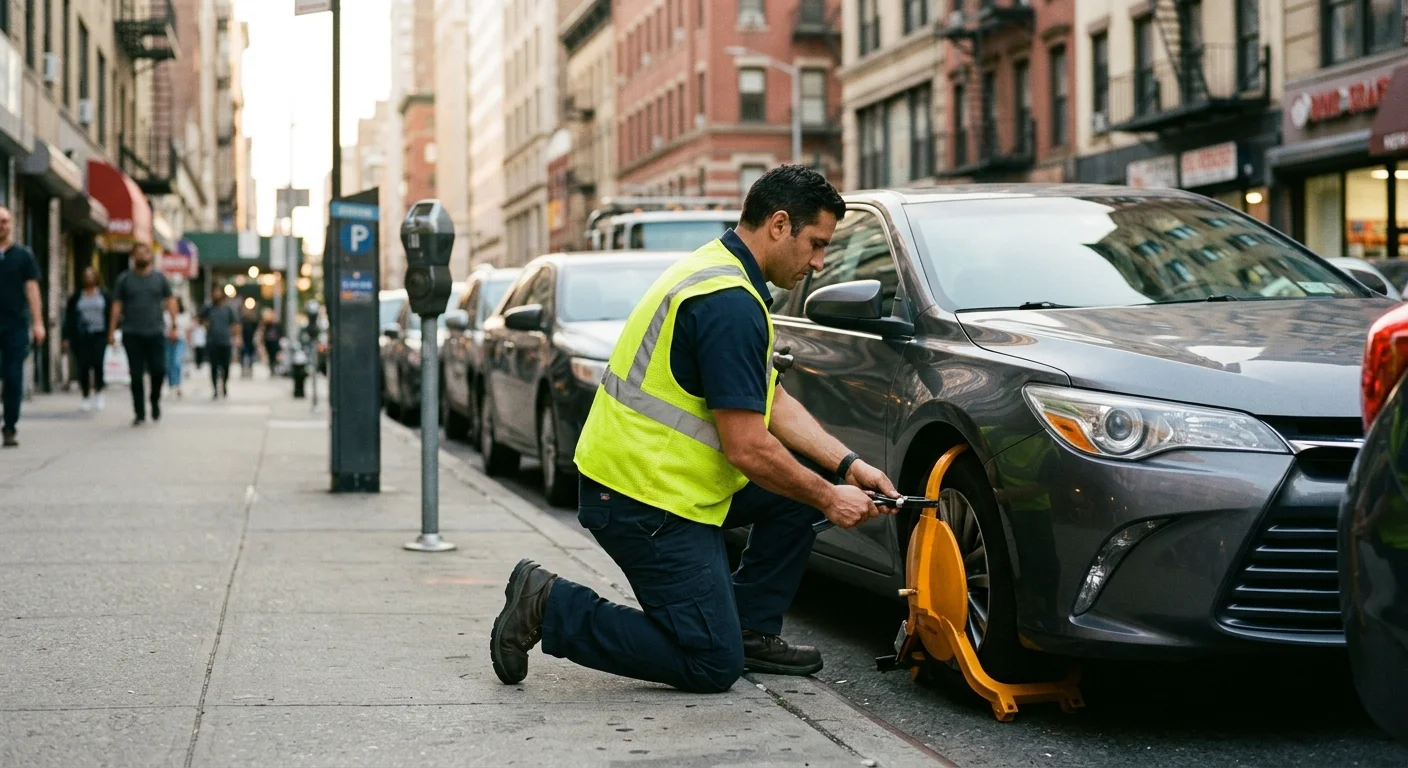
What scofflaw means on an NYC street
Scofflaw here is a city Finance label. It means the plate already carries default-judgment parking or camera debt, and a marshal or sheriff crew can immobilize the car on a public street. It is collection on old tickets. It is a separate path from a same-day hydrant tow or a lot-owner hookup in Bushwick.
Those tickets start at the curb. VTL § 1202 sets the classic street rules: 15 feet from a hydrant, 20 feet from a crosswalk, 30 feet from a signal or stop sign, 50 feet from a railroad crossing, plus bridges and tunnels. Alternate-side parking adds another stack. The city wrote about 1.9 million ASP tickets in 11 months of FY2023, at a $65 fine, and cars still get towed when they block cleaning or emergency access. One unpaid orange envelope is a fine. Leave a pile of them to go to judgment, and the same plate becomes a scofflaw target.
Camera tickets sit in that same bucket. Red-light and bus-lane judgments count toward the $350-plus boot line the same way a street-parking judgment does. Finance published that threshold. NYC booted 134,945 vehicles in 2023.
This is five-borough work. A plate that lives in the Bronx can pick up the boot on Exterior Street, on a Grand Concourse side street, or next to a meter in Sunset Park. The car does not have to be in the borough where the old tickets were written. Crews read the plate against city debt, then clamp the wheel where the car sits tonight.
Invalid registration can skip the waiting period entirely and go straight to a tow, along with a public-safety issue or debt at $2,500 or more. That expired-sticker path is the same family of city enforcement as a registration tow. Confirm the live status of the plate with NYC Department of Finance or NYC 311 before you assume the empty space is a theft.
Quick Tow NYC does not run this program. We are a referral service. We match drivers with independent local operators. We do not own trucks, and we are not a DCWP-licensed towing company. Marshals, the Sheriff, NYPD, and Finance handle scofflaw boots and the tow that follows.
The boot first, then the tow
On a typical scofflaw stop the crew boots first. The car stays on the block. You still have a window to pay. Finance’s published rule is a tow if the debt is still unpaid 48 hours after the boot. That 48-hour clock is the one to treat as real. Older blog posts talk about a two-hour sweep. That shorter clock could not be confirmed in the city figures we can publish, so use Finance and 311, not a rumor from the sidewalk.
Some plates never get the 48 hours. Finance says the city tows immediately at $2,500 or more in those judgments, or when registration is invalid, or when there is a public-safety issue. A dead-expired sticker on the Van Wyck shoulder and a $350 boot on a quiet Corona block are not the same job. One can leave with a clamp and a notice. The other can leave on a hook.
How to get the boot off
The paper on the windshield is the city’s instruction sheet. Pay the default-judgment debt through NYC Department of Finance, then follow the release steps printed on that notice. Confirm the live process with NYC 311 before you put a hand on the clamp. We could not confirm a publishable self-service unlock fee, a return-location rule, or a single official boot-removal phone line, so we are not printing one. Finance sets those mechanics. 311 is the public front door.
Do not wait until hour 47 if you can pay today. Storage and pound time start after the tow, and the reclaim clock is short. If the car is already gone, skip the boot notice and go to the city’s towed-vehicle lookup. That lookup, and the pound list, are how you find a towed car in NYC.
Cutting or moving a booted car
People search for a penalty for pulling a city boot off. We looked for a figure we are allowed to publish. None is in our approved city sources. Ask NYC Department of Finance or 311 for the current rule. Do not cut the device, drive on it, or drag the car to a driveway in Inwood and call it solved. Damaging city equipment and moving an immobilized plate are enforcement questions the city answers, and a second tow is an expensive way to learn that.
If the boot is off and the car still will not start, that is roadside work for an independent operator, quoted before dispatch. The scofflaw clamp itself stays a Finance problem.
Default judgments and how to check your plate
A default judgment means the ticket went unpaid and uncontested long enough for Finance to docket it as debt. Open tickets you still plan to fight are a different pile. The boot line Finance publishes is $350 or more in default-judgment parking and camera tickets. We are not repeating unofficial counts like “five tickets in a year, even before judgment.” That version is not in the city figures we can stand behind.
Check the plate the boring way, on a phone, before you park overnight on a Bronx River side street or leave a second car on the Hill in Washington Heights. Use NYC Department of Finance parking records and NYC 311. Search the plate, the plate type, and the state. Pull judgments and open tickets. If the number you see is already over $350 in judgments, treat every public-street park as a boot risk.
Camera debt hides easier than a ticket under the wiper. A bus-lane hit on Fordham Road or a red-light shot in Queens still lands on the same plate. If mail went to an old address in Sunset Park after you moved to the Bronx, the judgments can stack while you think the slate is clean. The boot is often the first notice that feels real.
Pay through Finance. Keep the receipt. If a crew is already on the block, the notice on the glass still points you back to that same department. Marshals and the Sheriff run the street operation. Reach them through 311 or Finance. We are not printing a second phone number on this page.
If you share a family plate, one person’s ignored camera tickets can boot the car your sister drives to a night shift in College Point. Run the plate, not the person you think got the last envelope.
How to tell a scofflaw tow from a private-lot tow
New York City is one towing jurisdiction with three live regimes. A scofflaw boot-and-tow is city collection. Mix it up with a lot tow or a crash tow and you will call the wrong desk, pay the wrong cap, and look in the wrong yard.
Regime one is an NYPD parking-violation pound tow. That is the default when a car leaves a public street for a parking violation. Published release fees are $185 under 8,000 pounds and $370 at or above, plus $20 a night in storage, with a 10-day reclaim window, all on the NYPD towed-vehicles page. A hydrant grab on the FDR service road can land here even when the plate is otherwise clean.
Regime two is a DCWP-regulated private-property or driveway tow. A DCWP-licensed operator takes the car from a lot or a blocked driveway. The consumer cap is $125 for removal plus the first three days, then $15 a day, and a $62.50 drop fee if you get back before the car leaves, under NYC Admin Code § 19-169.1 and the DCWP towing consumer page. Storage has to stay inside city limits and within 10 miles of the hookup. That is a private-lot job, and towing fees in NYC are regulated on that path. Know-your-rights copy on drop fees and signage belongs here.
Regime three is an accident or rotation tow, DARP or ROTOW. Police direct it after a crash. DCWP’s published max is $125 at or under 10,000 pounds, or $140, with storage at $25 a day for the first three days and $27 after.
Scofflaw sits next to regime one in the pound system, with Finance and marshal or sheriff crews on the front end. Look at the paper on the glass. A boot notice and judgment language points to Finance. A private-lot invoice and a storage yard in the same borough points to DCWP. A crash and a precinct rotation points to DARP or ROTOW. If the space is empty and you have no paper, use 311 and the towed-vehicle lookup before you file a stolen-car report. The city also relocates cars without a full impound.
A fourth confusion is a dead car you want moved off a street in Tottenville or Hunts Point. That is an operator dispatch, quoted before we send anyone. It is not a scofflaw release.
Getting the car after the city takes it
Once the hook is on, the 48-hour street window is over. The car is in the pound system. Start with 311 and the city’s towed-vehicle lookup. Do not guess a Manhattan address. A dedicated Manhattan tow pound is not confirmed on the public list we use. Staten Island has no published dedicated pound on that same list. Use the lookup.
Confirmed NYPD pound addresses are:
Bronx: 2444 Exterior Street, Bronx 10468. Hours Monday through Friday 8am to 8pm, Saturday 8am to 3pm.
Brooklyn Navy Yard: entrance at Sands Street and Navy Street. Open continuously from 7am Monday to 5am Sunday.
Queens / College Point: 31-22 College Point Blvd, Flushing 11354. Hours Monday through Friday 8am to 10pm, Saturday 8am to 3pm.
Bring a valid driver’s license, current registration, and a current insurance card. If you are not the owner, you need a notarized authorization letter. Pay with cash or a card in the retriever’s name. NYPD’s published reclaim window is 10 days, with storage at $20 a night on top of the $185 or $370 release fee. Those figures live on the NYPD towed-vehicles page. Confirm them at the window, because Finance debt can still sit on the plate after the pound is paid.
Miss that window and the car keeps accruing storage, then leaves the easy reclaim path. Read what happens if you don’t pick the car up before you let day 10 go by. Private storage lots also sit under Lien Law § 184, with certified-mail notice rules, if the job was a DCWP lot tow instead of a city pound. Match the paper to the regime before you argue the wrong statute.
Getting out of College Point or the Navy Yard with a dead battery is a second trip. NYC parkways ban commercial vehicles, trucks, and tow trucks (Belt, FDR, Henry Hudson, Cross Island, Jackie Robinson, Bronx River, Hutchinson, Mosholu, Pelham, Ocean, Korean War Veterans, Grand Central, with a GCP single-unit exception between the RFK Bridge and the BQE). A flatbed on the Belt is itself a violation. Tell the operator the reclaim point and the destination so the routing stays on expressways and streets that allow the truck.
When to call us
Call us when the city work is done and the car still will not move, or when the empty space was a private lot or a crash, not a Finance boot. Quick Tow NYC is a referral line for the five boroughs. We do not own trucks, and we are not a DCWP-licensed operator. The line is answered around the clock, calls are recorded after a notice, and an independent local operator gets dispatched to you with the price quoted before dispatch. Call us at (929) 356-7857.