The empty curb does not tell you which yard has the plate. In New York City, a car towed off a public street, a private lot, or a crash scene follows three different systems, and those systems do not share one pound. Which regime took it decides where a towed car in New York City actually sits.
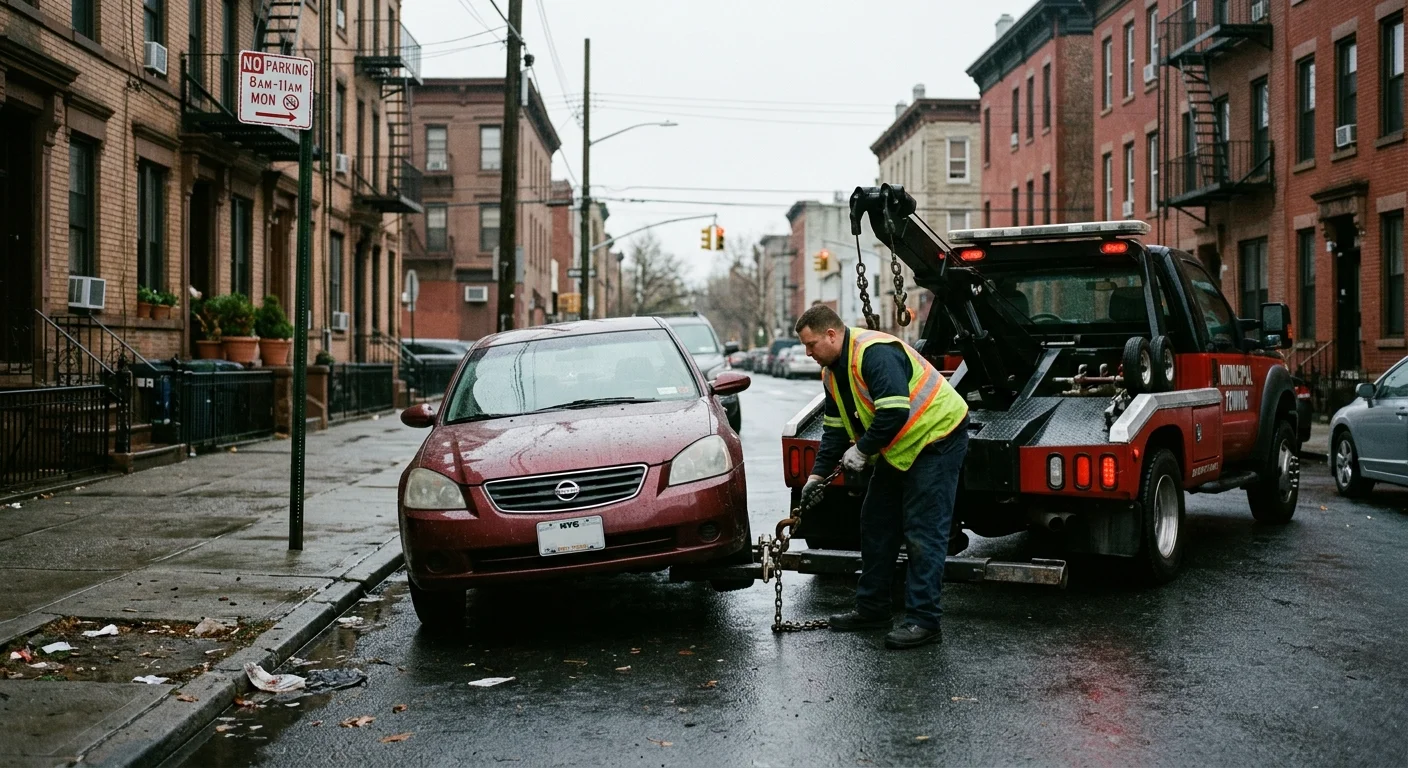
The three towing regimes in New York City
New York City is one towing jurisdiction. A hook in the Financial District and a hook in Hunts Point sit under the same city rules. The split is not city versus suburb. It is which of three regimes took the car.
An NYPD parking-violation tow is the default when a car leaves a public street for a parking violation. That is the usual path after alternate-side cleaning, a hydrant within 15 feet under Vehicle and Traffic Law § 1202, a bus lane, or a no-standing stretch along the FDR. The car goes to a borough NYPD pound, not a supermarket lot and not a random “impound lot near me” pin on a map.
A DCWP-regulated private-property or driveway tow is a different job. A DCWP-licensed operator removes the car from a lot or a driveway. The car goes to that operator’s storage lot, inside city limits and within 10 miles of the removal point. That lot is not an NYPD pound.
An accident or rotation tow under DARP or ROTOW is the third regime. Police direct it after a crash. The car goes to the rotation operator’s storage. Do not assume the Navy Yard has a Cross Bronx wreck because that is where a street-cleaning tow from Brooklyn often lands.
A fourth path is not a tow at all. The city sometimes relocates a vehicle for a street fair, a film shoot, or emergency access. Use NYC 311 and the city’s towed-vehicle search before you treat the plate as stolen.
Scofflaw enforcement sits beside these three, not inside them. The Department of Finance can boot a car at $350 or more in default-judgment parking or camera tickets, then tow it if the debt stays unpaid 48 hours after the boot. An immediate tow can follow at $2,500 or more, or for invalid registration or a public-safety issue. Confirm that path on the city’s search. Do not guess a pound.
Quick Tow NYC is a referral service. We match drivers with independent local operators. We do not own trucks, we do not run a pound, and we are not a DCWP-licensed towing operator. City dollar figures in this post are the city’s published fees. Re-check the live schedule before you pay.
NYPD pounds in the Bronx, Brooklyn, and Queens
The NYPD publishes three parking-tow pounds. Use those three names. Do not invent a Manhattan address or a Staten Island yard.
The Bronx pound is at 2444 Exterior Street, Bronx 10468. Published hours: Monday through Friday, 8 a.m. to 8 p.m., Saturday 8 a.m. to 3 p.m. A Grand Concourse or Hunts Point parking hook often lands here.
The Brooklyn pound is at the Brooklyn Navy Yard. The entrance is Sands Street and Navy Street. Published hours run continuously from 7 a.m. Monday to 5 a.m. Sunday. Park Slope, Sunset Park, and other Brooklyn street tows commonly feed this lot after an NYPD parking hook.
The Queens pound is at 31-22 College Point Boulevard, Flushing 11354. Published hours: Monday through Friday, 8 a.m. to 10 p.m., Saturday 8 a.m. to 3 p.m. Corona and Flushing plates often show here after a parking-violation tow.
A dedicated Manhattan pound could not be confirmed on the city’s published list. A Staten Island pound could not be confirmed either. If the car left Washington Heights, the Financial District, or Tottenville, ride only after the lookup names the site. Neighborhood logic is a wasted trip. The NYPD towed vehicles page lists the pounds and the published fees.
Those published NYPD release fees are $185 under 8,000 pounds and $370 at 8,000 pounds and over, plus $20 a night in storage, with a 10-day reclaim window. Re-check that schedule the morning you pay. Tow and storage are the pound’s bill. The parking ticket is a Department of Finance bill. Treat them as two payments.
Arrest and investigation holds are not parking pounds. Property Clerk sites the city publishes include Erie Basin at 700 Columbia Street, Brooklyn, and Springfield Gardens at 174-20 North Boundary Road. Payment there is credit card only, per the city. Ask NYC 311 which Property Clerk site has the plate. Do not mix that path with Exterior Street.
Queens and the Bronx close Sunday on the published schedule. Miss the window and you wait, with storage still running at $20 a night once the car sits past the tow day.
Private-lot yards versus a city pound
A private-lot tow does not go to Exterior Street, the Navy Yard, or College Point unless the city’s record says so. It sits at the operator’s storage lot.
NYC Admin Code § 19-169.1 covers private-property signage, the hookup and drop rule, and the 10-mile storage limit. The lot must be inside city limits and within 10 miles of where the car was removed. A Bushwick driveway hook should not disappear to New Jersey. This brand serves the five boroughs. Long Island, Westchester, and New Jersey are not origins we serve. They may be named only as long-distance destinations.
DCWP publishes the private-property cap on its towing consumer page: $125 for removal plus the first three days of storage, then $15 a day after. The published drop fee is $62.50 if you return before the car is removed. Confirm those numbers on the live page before you pay. Our price is quoted before dispatch. It is not a city cap, and we do not set yard fees.
This is the curb where your rights when towed in NYC matter. DCWP Rule 6 RCNY § 2-377 sets signage specs: entrances and perimeter signs no more than 250 feet apart, 6 to 8 feet high, luminescent, at least 12 by 18 inches. A lot that skipped that rule is a DCWP complaint, not an NYPD pound argument.
Map searches for “tow yard near me” mix city pounds and private lots. The regime is the filter. A supermarket lot in Sunset Park and a hydrant on the same block send the car to different places. If my car got towed from a gated lot in Corona, I am not riding to College Point unless the city’s search says the NYPD took it.
Accident and rotation tows follow a different path
A crash on the Cross Bronx Expressway, the Belt Parkway, or the BQE is not a street-cleaning pound job. Police direct an accident or rotation tow. DCWP max rates for DARP and ROTOW are $125 at or under 10,000 pounds, or $140, with storage at $25 a day for the first three days and $27 a day after. Re-check the live DCWP schedule before you pay.
NYPD publishes a separate rotation-tow schedule: $50, or $100 for a double, then $10 a day for the first three days and $12 a day after. That is not the $185 parking-pound release. Do not pay the wrong schedule at the wrong window.
The car usually sits at the rotation operator’s storage, not the College Point parking pound. Confirm that on the city’s lookup. If the car is still in a live lane after police clear the scene, an independent operator can be dispatched through emergency towing. The price is quoted before dispatch. We do not own the wrecker.
Tow trucks are banned on NYC parkways, including the Belt, the FDR, the Henry Hudson, Cross Island, Jackie Robinson, Bronx River, Hutchinson, Mosholu, Pelham, Ocean, Korean War Veterans, and Grand Central. A flatbed on a parkway is itself a violation. That changes how a crash car leaves those roads. It does not change which parking pound holds an alternate-side hook from a local street.
If the plate still does not appear, keep theft and relocation open. Use NYPD if you see a break-in. Use NYC 311 if you think the city moved the car for a parade or a water-main cut.
How to confirm with 311 before you pay
Do not pay a yard that cannot prove it has the plate. Start with NYC 311 and the city’s towed-vehicle search. Have the plate, the state, the borough, and the cross streets ready.
This page is about where the car sits, not how to click the search. For the lookup steps, use find your towed car in NYC. Come back once you know whether you are going to Exterior Street, the Navy Yard, College Point, or a private lot.
Pay the agency that holds the car. An NYPD parking pound collects the published tow and storage. A DCWP private operator collects under the DCWP cap. A rotation yard collects under DARP, ROTOW, or the NYPD rotation schedule. Mixing those windows costs another night of storage.
Re-check the live fee on the NYPD or DCWP page the morning you go. The figures here are the city’s published amounts. They are not our quote.
If the car sits past the NYPD 10-day reclaim window, you have a different problem. Lien Law § 184 governs a garage keeper’s tow lien, including certified-mail notice within 5 working days. Read what happens if you don’t pick up the car in NYC before storage runs.
Do not prepay a random yard that calls you first. Match the name and address to the city’s record. Quick Tow NYC does not collect city pound fees and does not hold your car.
What to bring when you go get the car
Bring a valid driver’s license, current registration, and a current insurance card. If you are not the owner, bring a notarized authorization letter. Pay with cash or a card in the retriever’s name.
Show up with originals. A closed Bronx window, a missing insurance card, or a card in another person’s name is another night at $20 on an NYPD parking pound. Queens and the Bronx are closed Sunday on the published schedule. The Navy Yard runs longer, then shuts from 5 a.m. Sunday to 7 a.m. Monday.
If default-judgment parking or camera debt sits on the plate, that is a Department of Finance problem, and it is how a boot-and-tow starts. Handle Finance on its own track. Do not expect the pound window to take that debt as the same bill as the $185 release.
Photograph the car before you drive out. Note the wheels and any fresh scrapes. That record is for you.
A rental still needs the same license, registration, and insurance trail, plus the agreement that shows you can take the car. Out-of-state plates follow the same three regimes. The car does not go to New Jersey because the registration does.
Confirm hours on the NYPD towed-vehicles page the day you go. Holidays and weather change windows. NYC 311 can tell you if the site is open.
When to call us
City lookup and a pound window are yours to handle when the search already names the yard. Call us when the car is still in a live lane, on a private lot you control, or disabled after a crash and you need an independent local operator dispatched. The line is answered around the clock. Calls are recorded after a notice. We do not run a pound and we do not set city fees. Call us at (929) 356-7857.