You walked back to a Midtown East garage, a Jackson Heights supermarket lot, or a hospital garage in Washington Heights, and the space was empty. That is usually a private-property tow under New York City Department of Consumer and Worker Protection rules. The truck, the storage lot, the fee cap, and who you pay all change once the car left a private lot.
A private-lot tow is not an NYPD pound tow
New York City is one towing jurisdiction. Your next step still turns on which of three regimes took the car.
An NYPD parking-violation tow starts on a public street. The car goes to a borough NYPD pound. Published fees on the NYPD towed-vehicles page are $185 under 8,000 lbs, $370 at or above, $20 a night in storage, and a 10-day reclaim window. Alternate-side blocks, hydrants, and no-standing zones on Second Avenue live in this bucket.
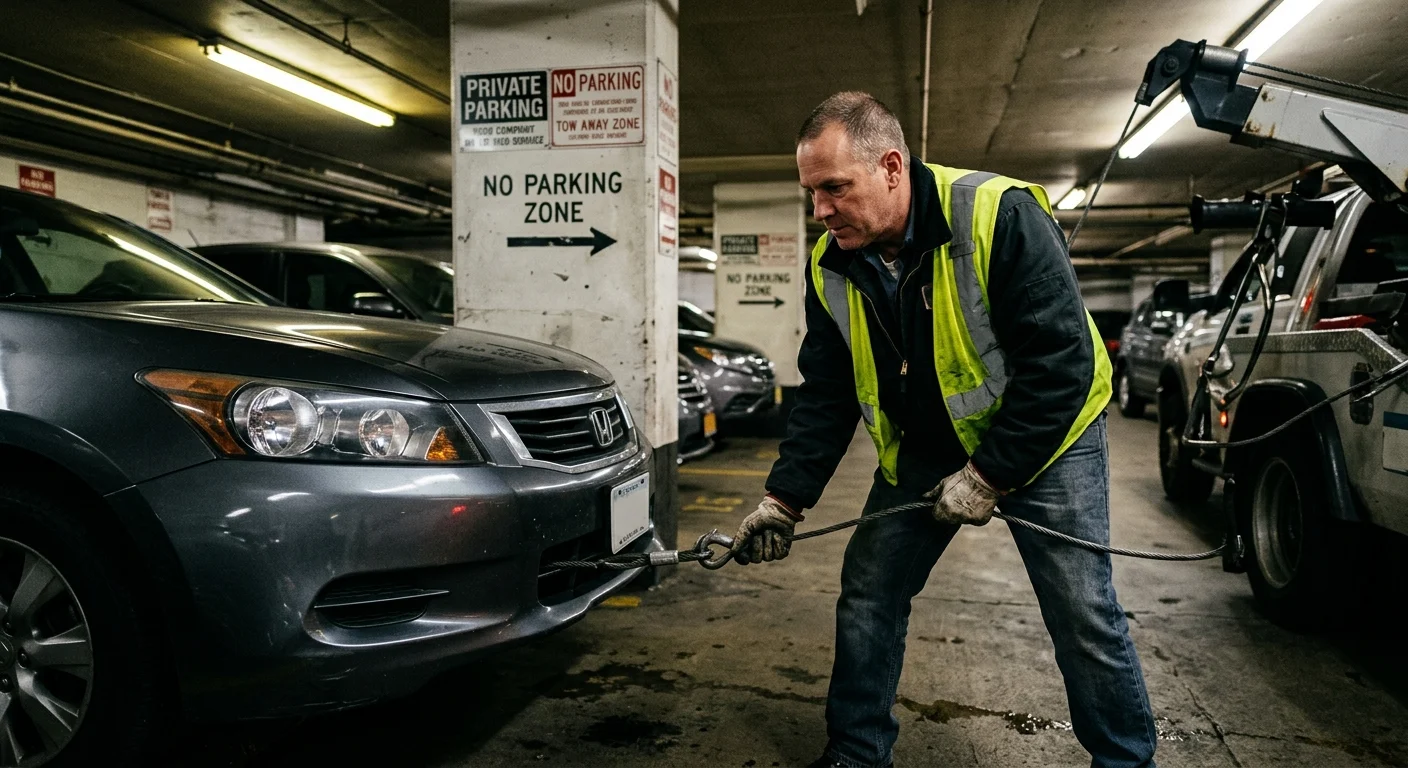
A DCWP private-property or driveway tow is the empty stall in that garage. A DCWP-licensed operator takes the car to the operator’s own storage lot. The city’s published cap is $125 for the removal plus the first three days of storage, then $15 a day after that. There is a $62.50 drop fee if you return before the car is removed. Those figures come from the DCWP towing consumer page and NYC Admin Code § 19-169.1. Storage has to stay inside city limits and within 10 miles of the removal point. A car blocking your own apron is a different file: blocked driveway towing starts with 311, not a supermarket-lot invoice.
An accident or rotation tow, DARP or ROTOW, is police-directed after a crash. DCWP posts a different max there: $125 or $140 depending on weight, and storage at $25 a day for the first three days, then $27 a day. A hook on the FDR, the BQE, or the Cross Bronx after a collision is this path.
The city sometimes relocates a vehicle instead of impounding it. Check NYC 311 or the city’s towed-vehicle lookup before you treat the car as stolen.
A scofflaw boot is still a different job. The Department of Finance can boot at $350 or more in default-judgment parking and camera tickets, tow if unpaid 48 hours after the boot, and tow immediately at $2,500 or more, or for invalid registration, or a public-safety issue. That happens on a public street. It is not the supermarket lot on Roosevelt Avenue.
Quick Tow NYC is a referral service. We match drivers with independent local operators. We do not own trucks, we do not perform the work, and we are not a DCWP-licensed towing operator. We did not take your car from that garage. For the wider map of your rights when towed in NYC, read that guide, then come back to the private-lot numbers below.
Signs, drop fees, and the ten-mile rule
NYC Admin Code § 19-169.1 is the private-property rule. It covers the signs, the hookup and drop, and the 10-mile storage limit. DCWP Rule 6 RCNY § 2-377 sets the sign specs: signs at the entrances and along the perimeter no more than 250 feet apart, six to eight feet high, luminescent, and at least 12 by 18 inches. Garage managers should use our page on private property towing sign requirements in NYC. Drivers should still read those signs. They are how you find the operator’s name and lot.
The $125 figure is the removal plus the first three days. Day four starts the $15 daily storage. That is the city’s published private-property cap, not a brand quote from us. Whether towing fees are regulated in NYC depends on the regime. Private-lot work is capped. A roadside hook you request yourself is quoted before dispatch.
The drop fee is $62.50 if you return before the car is removed. In a cramped Midtown East aisle, that means you still see the truck and the car is not gone yet. Once the truck has left the garage, you are in storage, and the drop no longer applies.
The ten-mile rule is geographic, not a slogan. The storage lot has to sit inside city limits and within 10 miles of the removal point. A Jackson Heights supermarket tow should stay in that band. A Washington Heights hospital-garage tow should too. If the yard is outside the city, or clearly farther than 10 miles, that is a DCWP complaint, not a reason to overpay.
People call the worst of this aggressive towing. Missing signs, a refused drop, or a lot past the 10-mile line are the facts that matter. Photograph first. Pay after you match the invoice to the published cap.
How to tell a DCWP lot from a city pound
If the car left a public curb, look for a borough NYPD pound. The Bronx pound is at 2444 Exterior Street, Bronx 10468, with listed hours Monday through Friday 8 a.m. to 8 p.m. and Saturday 8 a.m. to 3 p.m. The Brooklyn Navy Yard pound entrance is Sands Street and Navy Street, listed as open continuously from 7 a.m. Monday to 5 a.m. Sunday. The Queens pound is at 31-22 College Point Boulevard, Flushing 11354, with listed hours Monday through Friday 8 a.m. to 10 p.m. and Saturday 8 a.m. to 3 p.m. Confirm hours on the NYPD towed-vehicles page or through NYC 311 before you travel. Hours change.
A dedicated Manhattan tow-pound address could not be confirmed for this page. Which pound serves Staten Island also could not be confirmed. If you parked on a Manhattan street or on Staten Island and the car is gone from the curb, use NYC 311 and the city’s towed-vehicle lookup. Do not guess a yard.
A DCWP private-lot car does not go to Exterior Street, the Navy Yard, or College Point. It goes to the operator’s storage lot. The sign on the garage pillar or the chain-link entrance should name the company. The truck should show DCWP license information. If the city’s lookup is empty after you check it, you are probably in the private-lot regime.
NYPD reclaim documents, per nyc.gov, are a valid driver’s license, current registration, and a current insurance card. A non-owner needs a notarized authorization letter. Payment is cash or card in the retriever’s name. Operator lots set their own intake. Confirm with that operator and with DCWP. Any extra document rule that is not on the DCWP consumer page could not be confirmed here.
What to photograph and who you pay
Before you pay anyone at a Queens supermarket lot or a Washington Heights hospital garage, photograph the posted signs, the empty stall, the operator name, and the truck if it is still on site, including any DCWP license marking on the truck. At the storage lot, photograph existing damage and the odometer if they let you walk the car. Keep copies of every receipt.
You pay the DCWP-licensed operator who took the car. You do not pay an NYPD pound window for a private-lot hook. You do not pay a stranger in the aisle without a written receipt. The city’s private-property cap is $125 for the removal and the first three days, then $15 a day. If the invoice is higher, stop and check the DCWP consumer page before you hand over a card.
Quick Tow NYC publishes no brand price of our own. If we dispatch an independent operator for a job you request, that price is quoted before dispatch. We do not run a storage lot. We cannot release a car we never took.
If you manage the garage, private property towing is the service path that has to follow the same sign, drop, and 10-mile rules. The operators we connect you with are licensed and insured. We are not.
If the lot skipped the rules, what 311 and DCWP are for
Use NYC 311 to confirm whether NYPD has the car, and to start a consumer complaint when a private lot skipped the rules. DCWP licenses the operators and publishes the caps. Bring photos of missing or undersized signs, a drop that was refused while the car was still on site, a yard past 10 miles, or a bill above $125 plus lawful storage.
New York Lien Law § 184 covers the garage keeper’s and tow lien. Certified-mail notice is due within 5 working days. Lienholder notice is due within 20 days. The lien is void if the vehicle leaves possession after 30 days. The lien is capped at any written estimate. If the operator is holding the car and you have heard nothing, that statute is the one to read. Confirm the current text on the New York Senate Lien Law § 184 page.
A proposed statewide parking bill is not NYC Admin Code § 19-169.1. Albany debate does not change the $125 cap DCWP already posts for city private-property tows. Pay against the city rule in front of you. Take the invoice to DCWP if the lot skipped it.
When to call us
If the car is already on a DCWP operator’s lot, that operator holds it until you pay their lawful invoice. Call us when you need an independent local operator after the release, or when you run a lot in the five boroughs and need a lawful private-property hook. The line is answered around the clock, and calls are recorded after a notice. Call us at (929) 356-7857.