Police lights on the FDR, a crumpled bumper on the BQE, or a wet Belt Parkway shoulder put you in a different system than a hydrant ticket. An accident tow in NYC is usually a police-directed rotation job, not a ride to an NYPD pound. Where that truck takes the car, what you photograph, and who you pay all get decided in the next hour, often while traffic is still moving.
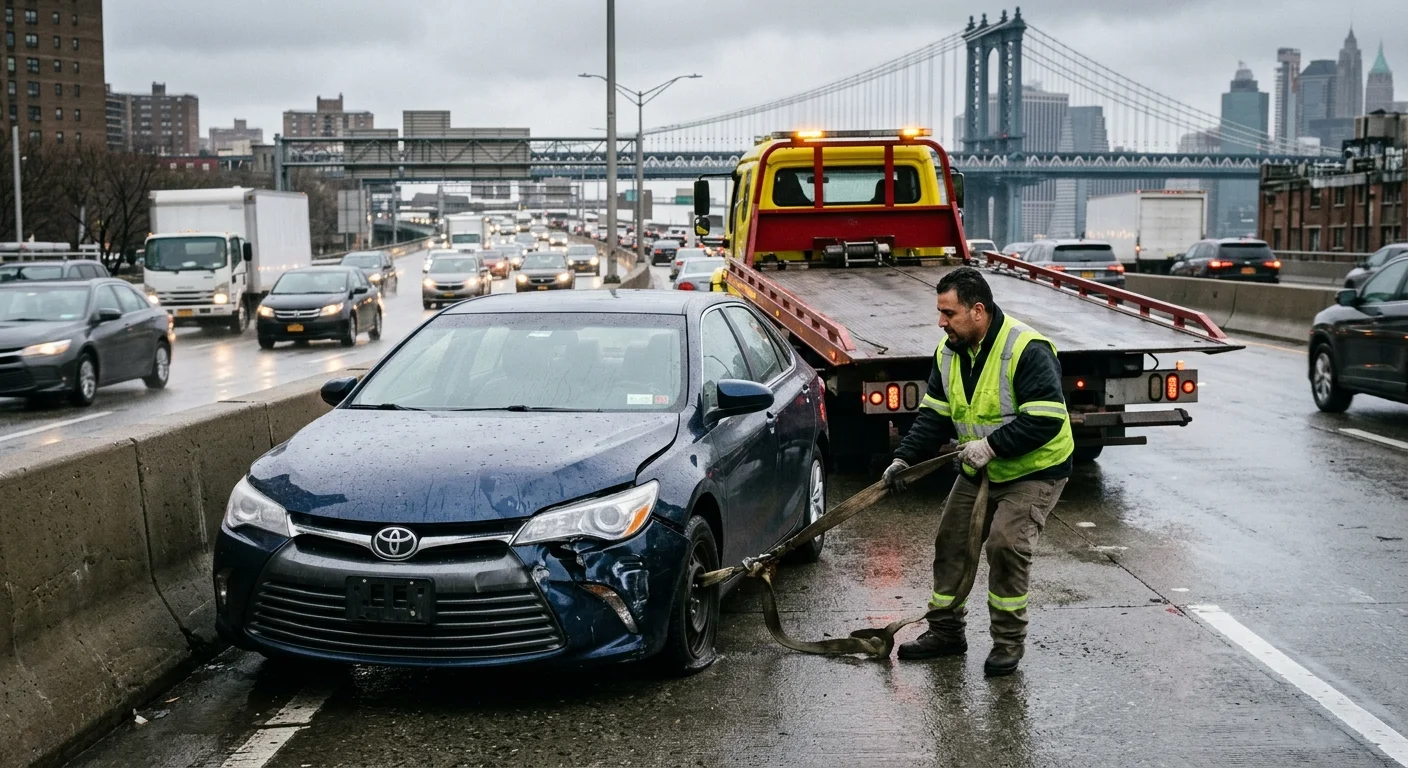
Accident tows are not parking-violation tows
New York City is one towing jurisdiction. Your question is still which of three regimes took the car.
An NYPD parking-violation tow is the default when a car comes off a public street for illegal parking. The city’s NYPD towed-vehicles page publishes those fees: $185 under 8,000 lbs, $370 at or above, $20 a night in storage, and a 10-day reclaim window. Those cars go to a borough pound. The Bronx pound is at 2444 Exterior Street. Brooklyn’s is the Navy Yard, entrance at Sands Street and Navy Street. Queens is at 31-22 College Point Boulevard in Flushing. A dedicated Manhattan pound address could not be confirmed. A Staten Island pound could not be confirmed either. If you think the car went to a city pound, use the city’s towed-vehicle lookup before you start driving.
A DCWP-regulated private-property or driveway tow is the second regime. The DCWP towing consumer page and NYC Admin Code § 19-169.1 cap that work at $125 for removal plus the first three days of storage, $15 a day after that, and a $62.50 drop fee if you return before the car is removed. The car goes to the operator’s lot, inside city limits, within 10 miles of the removal point. That is a driveway fight, not a crash.
The third regime is the one this page is about: an accident or rotation tow, DARP or ROTOW. It is police-directed after a crash. DCWP publishes maximums of $125 for vehicles at or under 10,000 lbs, or $140, with storage at $25 a day for the first three days and $27 a day after. Those dollars are city caps, not a quote from us. Quick Tow NYC publishes no brand price. Any work we match is quoted before dispatch.
A fourth path is not a tow at all. The city sometimes relocates a vehicle for a parade, a fair, or a street closing. Check the NYC 311 towing guide and the towed-vehicle lookup before you file a stolen-car report.
VTL § 1202 is how a hydrant, a crosswalk, or a signal gets you towed on a quiet Tuesday. A crash on the Cross Bronx Expressway, among the most congested roads in the country at about 165,000 vehicles a day, is not that statute. Do not walk into a pound with cash for a $185 release if the officer called a rotation truck. You will be in the wrong line.
Rotation and recovery versus a pound tow
Rotation means the police called the next licensed operator on a list. Recovery means the car is not sitting neatly on four tires at the curb. A pound tow is a parking-enforcement ride to Exterior Street, the Navy Yard, or College Point.
Quick Tow NYC does not run the rotation. We are a referral service. We match drivers with independent local operators. We do not own trucks, we do not perform the work, and we are not a DCWP-licensed towing operator. If an officer already assigned a DARP truck, that is the truck they directed to the scene. Whether you can refuse it and call your own operator is not a single published rule we could confirm for every crash on every road. Ask the officer before anyone puts a hook on the car.
NYPD also publishes a separate rotation-tow schedule: $50, or $100 for a double, then $10 a day for the first three days and $12 a day after. That is not the DCWP DARP/ROTOW cap. Get the written rate from the operator who actually hooked the car. Ask the insurer which schedule they will honor. For how the three regimes sit next to each other on a bill, read how NYC towing costs actually break down. Do not guess from memory at the shoulder.
Recovery is the messy half. A winch-out from a low underpass after standing water. A car nosed into a wall on the Major Deegan. A blocked shoulder on the FDR or the BQE, where there is often no shoulder worth standing on. Belt Parkway was the city’s deadliest single road in 2023, with 1,348 crashes and 8 fatal, per NYPD figures compiled by aeelaw.com. None of those scenes is a tidy hook-and-go. Accident recovery and winch-outs are that work: winching, uprighting, and carrying a car that may not roll. A flooded underpass with no crash file is the winch-out page, not this rotation file.
A flatbed carries all four wheels off the pavement. After a crash, a bent suspension or a locked wheel is common, so dragging an axle is the wrong tool. The operators we dispatch will tell you that in the quote. We do not quote a per-mile figure, a hookup fee, or an after-hours amount. Those numbers are stated in the quote, or they are not our numbers.
Routing is its own problem. Commercial vehicles, trucks, and tow trucks are banned on NYC parkways: the Belt, the FDR, the Henry Hudson, Cross Island, Jackie Robinson, Bronx River, Hutchinson, Mosholu, Pelham, Ocean, Korean War Veterans, and Grand Central. There is a Grand Central Parkway single-unit exception between the RFK Bridge and the BQE. A flatbed on a parkway is itself a violation. The FDR also has an 8,000-lb limit north of 23rd Street. The operator has to leave the scene on a legal truck route, not the parkway that got you there.
What to photograph before the truck leaves
Once the cars move, the scene is gone. Photograph it before the bed tilts.
Get the positions of both vehicles, damage on all sides, license plates, signals, lane markings, and a wide shot that shows the road. On an expressway, grab a mile marker or an exit blade if you can do it from behind a barrier. The Van Wyck, the LIE, and the Cross Bronx all look the same in a close-up of a bumper. A sign that says “Exit 6N, Bruckner” is the difference between a clean claim and an argument.
Photograph the truck too. Company name on the door. Any DCWP license marking you can see. The authorization form, filled in, before you sign. If you cannot tell who they are, do not sign. Keep a copy of every page they hand you. Know your rights when you are towed in NYC covers what you can refuse at the curb, including repair paperwork that has nothing to do with moving the car.
Sign only a tow authorization that names pickup and destination. Do not sign an authorization to repair. Do not sign a blank form. Do not sign a “designated representative” form unless you mean to let that company speak to your insurer. You pick the shop. The tower does not.
Pull what you will need in the next few days: license, registration, insurance card, keys, medication, glasses, and anything in the trunk you cannot replace from a lot. Note existing damage in the photos so a later scratch on the lot does not land on you.
If anyone is hurt, call 911 and stay out of the live lane. Hazard lights on. Stand behind a barrier if there is one. The FDR north of 23rd Street and long stretches of the BQE do not give you a safe shoulder. A car in traffic is not cover.
Insurance, storage, and who you actually pay
Three pots of money show up after a crash, and they are not the same person.
You may pay the rotation operator at the scene or at their lot. City DARP/ROTOW caps, again from DCWP, are $125 or $140 for the tow and $25 a day for the first three days of storage, then $27. NYPD’s separate rotation schedule is $50, or $100 double, then $10 and $12 a day. Which one applies depends on which program the officer used. Get it in writing. Your insurer may reimburse some or all of it later. That is a claim question, not a promise from us.
You may then pay a second operator if the car has to move from a yard to a shop. That second run is ordinary towing. Our price for matching that work is quoted before dispatch. There is no brand flat rate, no per-mile figure we can print, and no after-hours number we are allowed to invent.
You pay the body shop for repairs, or you wait on the carrier. Storage is the charge that grows while those conversations happen. An NYPD pound is $20 a night, with a 10-day reclaim window, if this was actually a pound tow. A DARP lot is $25 then $27. A private-property lot is a different cap. If the car sits, New York Lien Law § 184 lets a garage keeper claim a lien, with certified-mail notice due within 5 working days. The lien is capped at any written estimate. If the vehicle leaves possession after 30 days, that lien is void. Read the statute if a yard is already holding the car.
Who you pay is on the receipt. Keep it. Carriers ask for the date, the pickup, and the destination. Reconstructing that from a Cross Bronx shoulder two weeks later is harder than it sounds.
If the car is at an NYPD pound instead, the reclaim rules are the city’s: valid license, current registration, current insurance card. A non-owner needs a notarized authorization letter. Payment is cash or card in the retriever’s name. Parking judgments have to be cleared with Finance before the pound will release the car. Tickets are not paid at the pound.
How to get the car to a shop instead of a yard
Name the shop before the truck leaves. Say the shop’s name and street address out loud, and see both written on the authorization. “Take it to your lot” is how storage starts. “Take it to the shop on Northern Boulevard in Corona” or “the body shop on Atlantic in East New York” is a destination.
Ask the officer and the operator whether that destination is allowed on this job. City consumer pages describe DARP as police-directed. We could not confirm a single published sentence that says every rotation truck must honor every address in the five boroughs. So ask, and get the answer on the form. Stay inside New York City if you can. Quick Tow NYC serves Manhattan, Brooklyn, Queens, the Bronx, and Staten Island. Long Island, Westchester, and New Jersey are long-distance destinations, not our service area.
If the car already went to a yard, you still have a move. Call the lot, confirm the address, and arrange a transfer to the shop you chose. That is a second tow, quoted before dispatch. Do not wait a week hoping the insurer will magically relocate it. Daily storage does not pause for voicemail.
Tell the driver, clearly, that you do not want repairs from the towing company. Repeat it. Leave the authorization-to-repair line blank, or strike it. You choose the shop. If your carrier later points you to a network shop, that is an insurance decision, and it still does not require you to sign the tower’s repair form at the crash.
If the car will not roll, say so when you call. A winch-out, dollies, or a low-clearance bed are part of recovery, and they belong in the quote. A wheel-lift under a damaged all-wheel-drive car is the wrong tool. Let the operator match the equipment to the wreck, then get the destination in writing before the bed comes up.
When to call us
Call when the scene is stable, the officer has said you may choose an operator, and you need the car taken to a shop you name instead of an unnamed yard. We match you with an independent local operator in the five boroughs. The line is answered around the clock, calls are recorded after a notice, and the price is quoted before dispatch. Call us at (929) 356-7857.