The keys are on the passenger seat. The door just clicked shut. You’re on Bedford Avenue, a side street off Metropolitan, or a curb by McCarren, and the handle does nothing. That is an auto lockout in NYC, and it is almost always a roadside job.
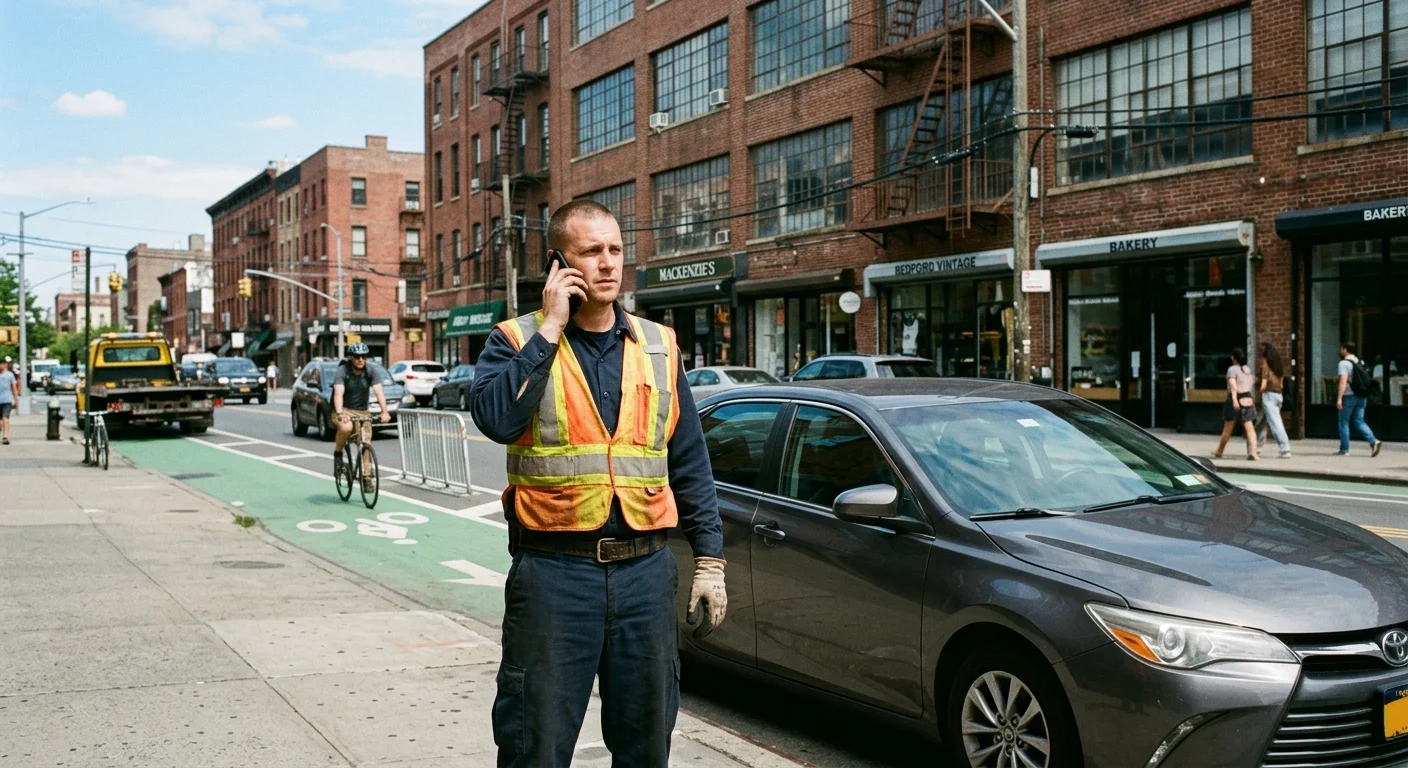
Keys in the car on a Brooklyn curb
A vehicle lockout is the car closed and you outside it. The keys or the fob are on the seat, in the trunk, or dead in your pocket, and the doors will not answer.
In Williamsburg it happens on Bedford, Driggs, Lorimer, Roebling, and Grand. It happens on Kent and Wythe by the waterfront lofts. It happens one neighborhood north toward Greenpoint, and south of the BQE toward Broadway and into Bed-Stuy. The protected bike lane is next to the parked cars. A loading dock or a Citibike corral is often behind you. Alternate-side rules still run on many of these blocks. New York wrote about 1.9 million ASP tickets in 11 months of FY2023, at a $65 fine, and cars do get towed when they block cleaning or emergency access. Waiting in the travel lane or the bike lane is how a lockout becomes a ticket.
If the car is gone, pause. The city relocates vehicles as well as tows them. Use the NYPD towed-vehicles page and the NYC 311 towing guide before you treat it as stolen. An NYPD parking-violation tow goes to a borough pound. A private-lot tow is a DCWP job with different caps. An accident rotation tow is a third path. None of those is a lockout on Bedford.
If the car is still on the curb and you can see the keys, stay with it if you can do that safely. Leave the weatherstrip alone. Leave the window alone. A hanger, a wedge, or a hard pull on the handle is how a lockout becomes a regulator, a bent frame, and then a tow. New York’s rule on owning a consumer lockout kit could not be confirmed from the sources this site uses. Forcing the door on a public curb still wrecks the car.
Many late-model cars lock themselves when you walk away with the fob. That is why a two-minute coffee on Bedford turns into this call. You do not need to reprogram auto-lock on the street. You need the door open, then you drive.
Quick Tow NYC is a referral service. We match drivers with independent local roadside operators in the five boroughs. We do not own trucks. We do not employ locksmiths. We do not open the door ourselves. The operator who arrives does the work. The price is quoted before dispatch.
Give the block, not the neighborhood. Bedford at North 7th, west side. Berry by the park. A hydrant on Union. A rack of bikes blocking the passenger door. That is what gets a lockout-capable operator to the right curb.
Lockout versus a tow you do not need
A lockout and a tow are different jobs. If the car is where you left it, and the only problem is a locked door, you want roadside assistance. The operator’s work is to get you in so you can drive. Keys on the seat do not need a wrecker.
You need a tow when the car cannot stay, or cannot roll. A car on a hydrant can still be ticketed or towed while you wait. VTL § 1202 is the parking-prohibition section: hydrant, crosswalk, signal, stop sign, railroad, bridges, tunnels. A car blocking a Williamsburg fire lane, a loading dock, or a bus stop is in the same kind of trouble. If the car has to leave the curb and it will not start, that is emergency towing.
If the car already left without you, that is not roadside entry. Confirm which regime took it. NYPD parking-violation release fees, published by the city, are $185 under 8,000 lbs and $370 at or above, plus $20 a night in storage, with a 10-day reclaim window. DCWP private-property and driveway tows are capped at $125 for removal plus the first three days, then $15 a day, with a $62.50 drop fee if you return before the car is removed. Those figures come from the NYPD towed-vehicles page and the DCWP towing consumer page. They are the city’s numbers. They are not our price. We publish no brand price. An operator’s roadside quote is stated before dispatch.
Do not treat this page as a locksmith listing. Ranking results for auto lockout NYC are full of key-cutting shops. Quick Tow NYC does not cut keys, program fobs, or rekey ignitions. If the only key is lost, opening the door may still leave you needing a locksmith after. That is a separate trade. If you are comparing roadside options in general, use our buying guide to roadside help in NYC. That piece is how to choose a service. This piece is the lockout job: door shut, keys inside, Williamsburg curb.
Manhattan garages, outer-borough streets, and bikes on the rack
Williamsburg lockouts follow the bridge. You parked under a walk-up after dinner on the Lower East Side, or on a ramp that barely clears a sedan. The operator still has to reach the door. Low ceilings, stacked spots, and attendant-only floors change the job. Name the garage, the floor, and whether a truck can enter.
Outer-borough streets are the rest of it. Greenpoint-adjacent blocks around McGuinness and Franklin. Bed-Stuy toward Nostrand. Side streets off the BQE where a truck cannot sit without blocking two lanes. Delivery vans double-parked on Broadway. A Citi Bike corral on Bedford that eats the whole passenger side. A cargo bike on the rear rack, which is common here, and which can keep a hatch or a door from moving.
Tell dispatch about the bike on the rack. Tell them about the stroller you can see through the glass. Tell them if the engine is running and the doors locked. That happens with push-to-start cars on Grand Street. Tell them if a child or a pet is inside. If someone cannot breathe, or a child is in danger, call 911. That is an emergency, not a roadside queue.
If the lockout cannot finish and the car has to be moved, routing matters. Commercial vehicles, trucks, and tow trucks are banned on NYC parkways: the Belt, the FDR, the Henry Hudson, the Cross Island, the Jackie Robinson, and the rest of that city list. A flatbed on a parkway is itself a violation. From Williamsburg, the BQE and the Williamsburg Bridge are the usual paths. An operator who works the five boroughs will not take a banned road to a job they cannot legally run.
We serve Manhattan, Brooklyn, Queens, the Bronx, and Staten Island. Long Island, Westchester, and New Jersey are not lockout coverage. They may be named as long-distance destinations only.
No tool list belongs here. Methods vary by year, make, and lock. A scratch-free open is a promise this brand does not make. The operator on scene decides how to work the door.
What to say so dispatch sends a lockout-capable operator
The line is answered around the clock. Calls are recorded after a notice. New York Penal Law § 250.00 and § 250.05 make this a one-party-consent state, and this line records both sides after it says so. You leave what the operator needs.
Give the borough and the exact block. Williamsburg, Brooklyn, Bedford and North 6th, west side, in front of the loft with the dock. Skip “near the bridge.” Skip “by the park.”
Give the car. Year, make, model, color, plate if you have it. A 2012 Civic and a 2024 Tesla are different doors. Push-to-start with the fob on the seat is a different job from a metal key in the ignition and the engine running.
Say what failed. Keys locked in. Fob dead. Trunk only. Handles dead. No spare. The phone app did nothing. Include it if the engine is on. Include a child, a pet, or a medical bag on the seat.
Say the curb constraint. Hydrant. Bus stop. Bike lane. Alternate-side about to start. Garage ramp with a height bar. Doorman who will not let a truck in. Construction fence on Wythe. That is how a lockout-capable roadside operator gets the job instead of a wrecker that cannot help.
Ask for the quote before anyone rolls. The operator sets the price. We do not. If the job changes on scene, from lockout to jump start, or from lockout to a tow, that is a new quote.
We are not a DCWP-licensed towing operator. We do not hold a locksmith license. The independents we connect you with do the work. The operators we dispatch handle lockouts. That is the true sentence.
If the car has to leave and it will not roll, say that. Tow truck near me in NYC is the right next read for a hook. Keep the lockout call for a locked door.
When the door is open and the car still will not move
Sometimes the door is the short part. You get in. The fob is dead. The battery is dead. The steering lock is set. The car is in park on a grade on South 4th and it will not crank.
That is no longer an auto lockout. That is roadside, or a tow.
A dead battery after the hazards sat on is common. So is a fob that died in a coat pocket on a long Bedford walk. If the car needs a jump, say so. Do not leave the job labeled as a lockout once the door is open. Roadside assistance is the service when the next step is a jump start, a tire, or another curb fix. The battery job is jump-start help. The tire job is a flat change. No club card is roadside without AAA.
If the car still will not move, ask for emergency towing. Tell the operator about clearance, the bike rack, and whether the car sits low and wants a flatbed. Do not guess a per-mile rate. There is no published brand figure for that. The quote comes before the truck is assigned.
One more check. A scofflaw boot is not a lockout. The city boots for unpaid parking and camera judgments, then tows if the debt sits. You will see the boot. A roadside unlock will not remove it. That is a Department of Finance process.
If the car is gone after all, go back to the city’s pages. Confirm which regime took it. Reclaim rules and pound hours live on the NYPD towed-vehicles page. Private-lot caps live on the DCWP page. Manhattan has no dedicated pound address we can publish, and Staten Island has none listed either. The lookup is the path, not a guessed yard.
Stay out of the bike lane while you wait. Get off a BQE shoulder and onto a side street if the car can still roll a block. Parkway shoulders are the wrong place for a commercial truck to work. Williamsburg still has side streets. Use them.
When to call us
When the keys are in the car, the door is shut, and forcing it would wreck the weatherstrip, stop working the door yourself. Call us at (929) 356-7857. The line is answered around the clock, calls are recorded after a notice, and we dispatch an independent local operator to you.