The clicker under the dash is the whole story. Lights dim, radio dies, and the Honda on 30th Avenue in Astoria will not turn over. Searching jump start near me from that curb is the right move. This is often a booster pack on the street, not a hook and a shop trip.
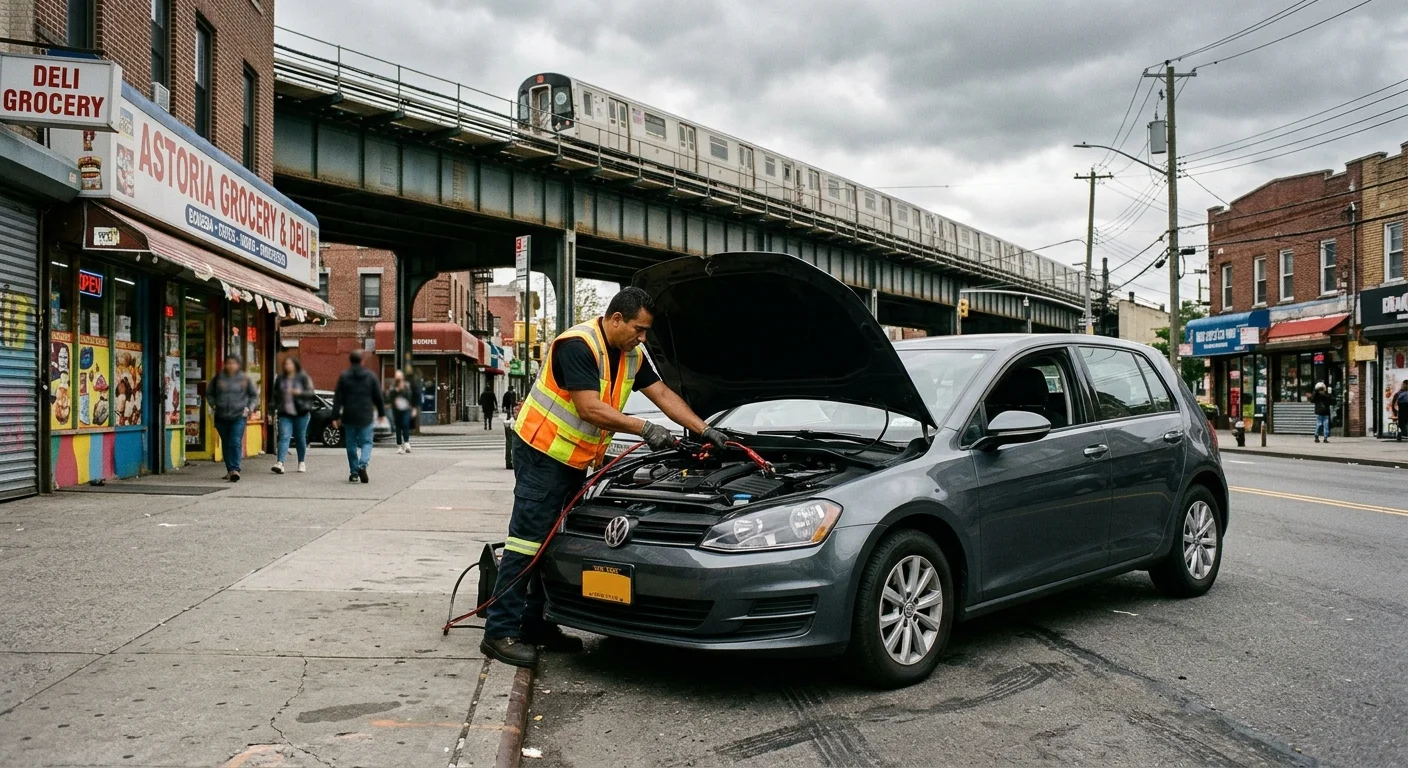
A dead battery is often a jump, not a tow
A dead battery in New York City usually sounds like a click. Sometimes the cabin lights still work. Sometimes the dash is dark. Either way the car is sitting, and you need jump gear at that curb.
You do not need a second car on Steinway Street. You do not need to flag a stranger on Ditmars Boulevard. A portable pack does the same job as jumper cables. It also fits a crowded block better than lining up two bumpers.
Quick Tow NYC is a referral service. We match drivers with independent local operators. We do not own trucks. We do not perform the work. We do not employ mechanics. We do not promise a pack on every truck, which is why the call has to say jump-start out loud.
If you already know the cable sequence, keep it simple. Clamp the red lead to the positive post on the dead battery, then to the positive post on the live side. Clamp the black lead to the live negative, then to a clean metal ground on the dead car, away from the battery. Start the live side. Wait. Try the dead side. That is the outline, not a shop diagnosis. On an Astoria curb with the elevated N and W overhead, an operator with a pack is the cleaner option. You are not standing in the door of traffic.
Club membership is a separate product. We do not speak for AAA. We cannot confirm what a non-member pays them, or whether they will roll at all. You do not need a club card to call our line. Ride-hail apps move people. They do not jump a battery as a default. We could not confirm a current Uber jump-start product that replaces a roadside operator, and those add-ons change. If you need the car to start, you need jump gear on site.
This is roadside assistance, not a repair visit. The operator tries a jump. That is not a promise the battery will hold a charge down Northern Boulevard. If the car starts, drive it. Give it more than a two-block hop to a bodega so the charging system has a chance to work. If it dies again at the light on 31st Street, that is a shop problem.
We publish no brand price. The operator’s price is quoted before dispatch. There is no flat rate on this page.
If you are searching 24 hour roadside assistance because the battery died after a late shift in Long Island City, the line is answered around the clock. Calls are recorded after a notice. An independent operator gets the job once the quote is stated.
Curb jobs in Astoria versus a Manhattan garage ramp
An Astoria curb job and a Manhattan garage job are not the same visit.
On 30th Avenue, 31st Street, or Ditmars, the car is often nose-in at the curb. Alternate-side rules still apply while you wait. Do not leave it on a hydrant, in a bus lane, or in a crosswalk. New York’s parking prohibitions in VTL § 1202 cover hydrants, crosswalks, and signals. If you walk away and come back to an empty space, use the city’s NYC 311 towing guide and the towed-vehicle lookup before you assume theft.
Tell dispatch the cross streets. “Astoria, 30th Avenue and 32nd Street, red Civic, hazards on” is a location. “Queens” is not. Name the bodega, the subway stair, or the firehouse if that is what a driver would see from the cab.
Long Island City is garage country. Court Square, the waterfront lots, the buildings off Jackson Avenue: give the garage name, the level, the space number, and the clearance sign at the entrance. A booster pack walks down a ramp. A wrecker often does not. If the operator cannot reach the aisle, they need to know before they roll.
Manhattan ramps are tighter. A Financial District stack, a Midtown hotel garage, a Washington Heights lot with a steep entrance: there is often no room for a second car. Say “tight ramp” on the call. Say the height posted at the gate. The operator then knows to bring a handheld pack, not to plan on lining up two vehicles in the aisle.
If you died on a parkway, routing changes. Commercial vehicles, trucks, and tow trucks are banned on NYC parkways, including the Belt, the FDR, the Henry Hudson, the Cross Island, the Jackie Robinson, and the Grand Central. A truck on those roads is itself a violation. Say you are on the FDR north of 23rd Street, or on the Belt near the Verrazzano approach, so the operator can use a legal street, not the parkway.
The five boroughs are in play. Astoria and Long Island City sit in Queens. The same referral covers a Bronx curb off the Major Deegan, a Brooklyn block in Bushwick or Sunset Park, and a driveway in Tottenville. Long Island, Westchester, and New Jersey are not the service area. They can be named only as long-distance destinations.
What dispatch needs so the operator brings jump gear
The call is how the right truck shows up. If you say “I need a tow,” you may get a hook and no pack. If you say “I need a jump,” dispatch can look for an operator who actually carries jump gear.
Have this ready.
Make, model, and year. A 2012 Camry and a 2024 hybrid are different hoods.
Exact spot. Street address or the nearest cross streets. In a garage: name, level, space, nearest entrance, posted height. In Astoria, the elevated line is a landmark. In Long Island City, the garage name matters more than the ZIP.
What the car does. One click. Rapid clicks. Dash lights and no crank. Completely dead. Smell of fuel. Water in the engine bay after a flood. Flooded cars need a tow, not a jump.
Gas, diesel, hybrid, or EV. Many hybrids and EVs still have a small 12-volt battery that can be jumped. A drained traction pack is a different job. We do not have a confirmed mobile-charging product to describe here, so say the powertrain out loud and let the operator decide if they can help.
If the keys are locked in and the battery is fine, stop. That is an auto lockout in NYC, not a jump. We already wrote the sibling post on a Williamsburg car lockout. Keep that job on that page.
Turn off lights, radio, and chargers so a jump has a chance. Put the hazards on if you are on a live block. If you feel unsafe, or you are in a travel lane on the BQE or the LIE, call 911 first.
We do not promise every operator in the pool rolls with a pack. That is why this list exists. State the jump. State the garage. State the car. The price is quoted before dispatch. The line is answered around the clock.
When a jump fails and the car still has to move
Sometimes the engine still will not turn. A pack can wake a discharged battery. It cannot rebuild a dead cell. It cannot replace an alternator that is not charging. It cannot dry a bay that sat in floodwater on the Major Deegan.
If the jump fails, the next step is a tow to a shop. That is emergency towing, not another round of cables. Ask for the tow price before anyone hooks the car. We still publish no brand figure. The operator states it.
Do not keep trying until the block goes into street cleaning. Alternate-side parking still tickets and tows cars that block cleaning or emergency access. Sitting through that cycle because the jump almost worked is how a battery job becomes a pound job.
If the car is in a private lot and a lot operator wants it moved, that is a different regime from an NYPD parking-violation pound. Do not mix them. For a wider map of roadside help across the five boroughs, use that guide. A dry tank is fuel delivery. A shredded tire is a flat change. A 12-volt Tesla that will not wake is EV towing. This page stays on the battery.
AWD and low cars often need a flatbed once they have to move. Say the drivetrain. Do not assume a wheel-lift is the default. We do not print a per-mile rate. The quote comes first.
If the car starts, then dies two lights later on Northern Boulevard, treat it as a charging problem. Drive it to a shop if it will stay running. If it will not, stop in a legal space and call for the tow. Do not nurse a dying battery onto a parkway.
Short trips around Astoria, Court Square, and Midtown are hard on a weak battery. Heat soaks a parked car on a blacktop lot. Interior lights left on overnight do the rest. None of that is a published failure rate. It is why the jump is the first try, and the tow is the honest second try.
How a referral line matches a roadside operator
Quick Tow NYC takes the call and matches you with a local operator. That is the product. We are not a DCWP-licensed towing company. We do not hold a yard. We do not stock batteries. We do not run a fleet out of a warehouse in Queens.
You call. You hear a greeting and a recording notice. New York is a one-party-consent state for call recording, and this line records after that notice. You leave the location, the car, and the job: jump-start. The quote is stated before anyone is dispatched. An independent operator in the five boroughs gets the assignment.
That is slower to explain than a slogan, and it is the truth. Searching roadside assistance near me should not dump you into a national template with a fake price. Our own service cost is never a number on this site. City pound fees are public and cited on the city’s own pages. A jump on an Astoria curb is not a pound release.
Coverage is Manhattan, Brooklyn, Queens, the Bronx, and Staten Island. An Astoria curb, a Long Island City garage, a tight Manhattan ramp, a Bronx side street, a Brooklyn block, a Staten Island driveway: those are in. A hop to Nassau or a job in Jersey City is out, except as a long-distance destination.
The operator who arrives is the one doing the work. If they jump the car, they jump the car. If they look at the battery and say it will not hold, listen. Replacement is a shop or a parts counter, not a promise from this brand.
Do not wait in a live lane for a stranger with cables. Do not stand in a Midtown ramp well with the hood up and no hazards. Call, give the garage and the level, and let the operator walk the pack to the car.
When to call us
A dead battery on a city curb stops being a DIY job when you have no pack, no donor car, or no safe place to stand. Call us at (929) 356-7857. The line is answered around the clock, calls are recorded after a notice, and an independent local operator gets dispatched to you.