A Brooklyn tow is a local matching problem. The truck that fits a Park Slope brownstone block is the wrong tool for a disabled van on the BQE shoulder, and a parking-violation pickup at the Navy Yard is a different job from a shop run you called yourself. Quick Tow NYC is a referral service for the five boroughs. We match you with independent local operators. We don’t own trucks, and we don’t perform the tow.
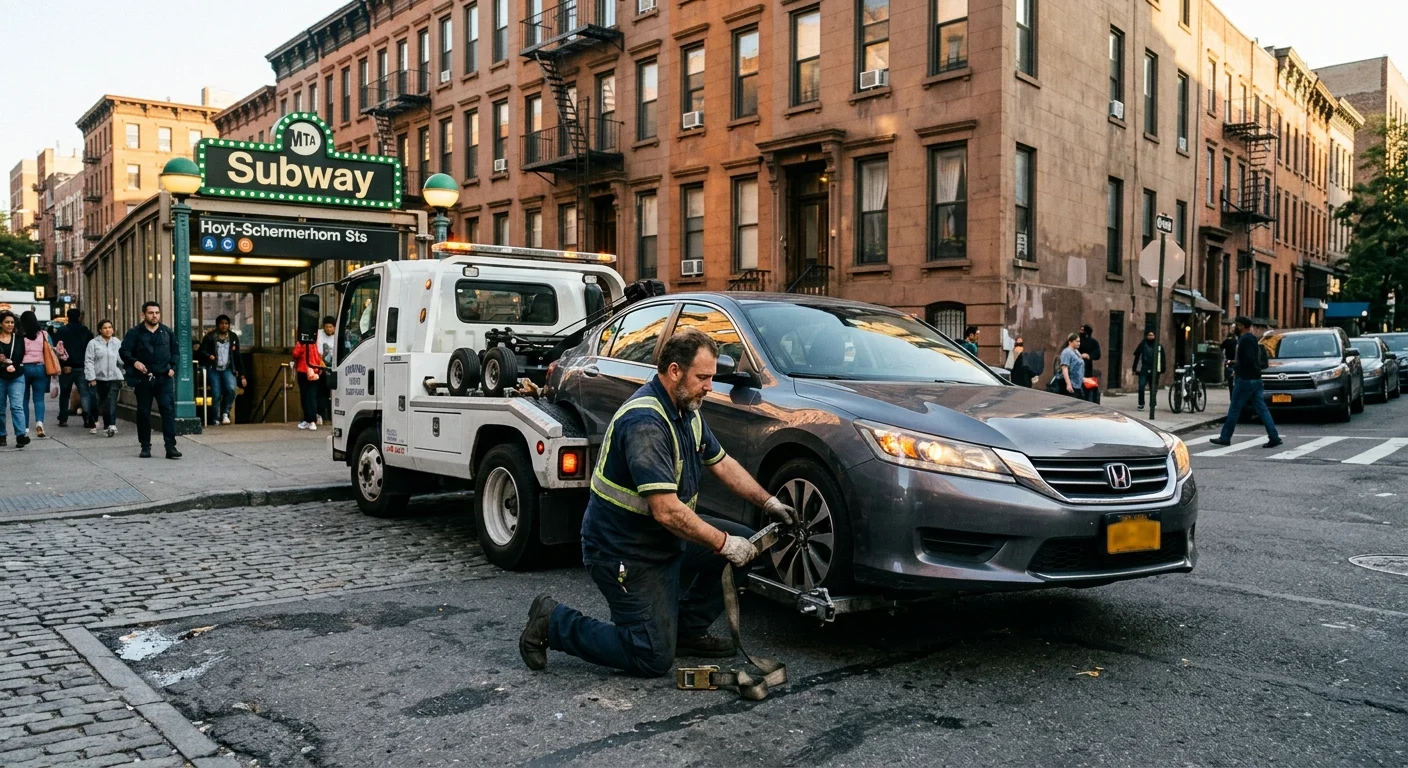
Brooklyn jobs are not a single dispatch
Searchers type tow truck brooklyn and expect one borough-wide answer. The borough is one city jurisdiction, and the job still splits three ways. An NYPD parking-violation tow, a DCWP-regulated private-lot tow, and an accident or rotation tow each send the car somewhere else, under a different fee schedule. A fourth path is a city relocation, which is not a tow at all. Call 311 or use the city’s towed-vehicle lookup before you treat a missing car as stolen.
The operators we dispatch handle the run you asked for: a breakdown on Atlantic Avenue, a disabled car on the Gowanus, a winch off a curb in Bed-Stuy, or emergency towing after a crash. That is a private call you placed. It is a different file from a ticket tow that already left for the pound.
NYPD parking-violation fees are public. NYPD’s towed-vehicles page lists $185 to release a vehicle under 8,000 lbs, $370 at or above that weight, $20 a night for storage, and a 10-day reclaim window. Those figures are the city’s. Confirm them on that page before you pay, because the published schedule is what the pound uses.
Private-property and driveway tows sit under DCWP. DCWP’s towing consumer page caps removal plus the first three days at $125, then $15 a day, with a $62.50 drop fee if the driver returns before the car is removed. Storage has to stay inside city limits and within 10 miles of the removal point (NYC Admin Code § 19-169.1). A Sunset Park lot tow and a Navy Yard pound tow are different counters.
Crash work on the BQE, the Gowanus Expressway, or a surface street can be police-directed. DCWP’s DARP and ROTOW caps are $125 for vehicles at or under 10,000 lbs or $140 above that, with storage at $25 a day for the first three days and $27 after. NYPD rotation-tow fees are a separate published schedule: $50, or $100 for a double, then $10 a day for the first three days and $12 after. Our own price is never a number on this page. The operator states it in the quote before dispatch.
People also look up 24 hour towing brooklyn and accident vehicle recovery service brooklyn ny. The line is answered around the clock. Arrival time is whatever the operator can actually do in that traffic. We don’t publish an ETA, a truck count, or a borough fleet size, because we don’t own one.
Parkways, the BQE, and streets a truck cannot use
DOT bans commercial vehicles, trucks, and tow trucks on NYC parkways. In Brooklyn that list includes the Belt Parkway, Ocean Parkway, and the Jackie Robinson Parkway. A flatbed on those roads is itself a violation. That is why a Coney Island or Bay Ridge job on the Belt cannot be a parkway run. The operator has to come in on surface streets or on the BQE, which is an expressway, not a parkway.
The Belt is also the city’s deadliest single road in the 2023 NYPD figures compiled by aeelaw.com: 1,348 crashes and 8 fatal. A disabled car there is a shoulder problem with no legal truck route on the parkway itself. Tell the line you are on the Belt, name the nearest exit, and say whether you can be reached from the service road. That changes which truck can legally get to you.
The BQE is the spine. It runs from the Verrazzano through Bay Ridge and Sunset Park, past Downtown Brooklyn, and up through Williamsburg toward Queens. Trucks belong there. The catch is the shoulder, the overpass, and the merge. A wheel-lift can be the right call for a rolling sedan. A low sports car, an AWD, an EV, or a van with a locked driveline usually needs a flatbed. The operator quotes that equipment before dispatch.
Brownstone Brooklyn adds a third constraint. Park Slope, Carroll Gardens, and the side streets off Seventh Avenue and Prospect Park West are tight, one-way, and often lined with cars. A full flatbed may not make the turn. Downtown Brooklyn around Borough Hall, Atlantic Terminal, and the bridge approaches is a different squeeze: bus lanes, bike lanes, and the Manhattan Bridge and Brooklyn Bridge ramps. Williamsburg along Kent, Bedford, and the BQE service roads mixes trucks with night traffic. Name the cross streets. The match depends on whether a wrecker can physically stand there.
Grand Central Parkway has a single-unit exception between the RFK Bridge and the BQE. That matters if the drop is in Queens after a Brooklyn pickup. Holland Tunnel rules (height 12 feet 6 inches, and a ban on tractor-trailers, trailers, most hazmat, and 4-plus-axle trucks) only come in if the destination is New Jersey. We serve the five boroughs. New Jersey, Long Island, and Westchester are long-distance destinations, quoted as such.
Navy Yard pound tows versus a shop run you called yourself
If NYPD towed the car off a public street for a parking violation, Brooklyn’s pound is the Navy Yard. The entrance is Sands Street and Navy Street. Hours on the city’s towed-vehicles page run continuously from 7 a.m. Monday to 5 a.m. Sunday. Bring a valid driver’s license, current registration, and a current insurance card. A non-owner needs a notarized authorization letter. Payment is cash or a card in the retriever’s name. Confirm hours and documents on the NYPD page before you go.
That pound is the parking-violation pound. It is a different facility from the Property Clerk lot at Erie Basin, 700 Columbia Street, which holds cars tied to arrests and investigations. Some Brooklyn listings mix those two addresses. If the car was seized in an arrest, you are in a Property Clerk process, credit card only at that lot. If it was a street-parking tow, you are at the Navy Yard. When you are unsure, use NYC 311 and the towed-vehicle lookup. A dedicated Manhattan pound address is not confirmed on the sources we use, and no Staten Island pound is listed. Brooklyn readers still start with 311.
A shop run you called is the other half of this search. You stalled on Fourth Avenue in Park Slope, or the battery died on Fulton in Bed-Stuy, or you need the car taken to a garage in Sunset Park. That is a private dispatch. The operator you are matched with quotes the job, then takes the car where you said. Storage, if any, is the operator’s lot under the written rate, not the Navy Yard window. For the citywide version of that near-me question, see tow truck near me in NYC. For the pound map across boroughs, see where they take a towed car in NYC.
Private-lot tows in Brooklyn follow the DCWP cap, not the NYPD $185 release. A driveway block in Bay Ridge or a garage lot in Downtown Brooklyn is that regime, with the signage rules in Admin Code § 19-169.1 and DCWP Rule 6 RCNY § 2-377. If you got back to the car while it was still on the hook, the published drop fee is $62.50. If it already left, the lot has to be inside the city and within 10 miles of the removal point.
Scofflaw boots are a Finance process, not a shop run. NYC boots at $350-plus in default-judgment parking and camera tickets, tows if unpaid 48 hours after the boot, and tows immediately at $2,500-plus, or for invalid registration, or for a public-safety issue. The city booted 134,945 vehicles in 2023. That path goes through the Marshal and Sheriff process on nyc.gov Finance, then 311, not through our referral line as a pound-release substitute.
Neighborhood patterns from Bay Ridge to Williamsburg
Bay Ridge sits against the Verrazzano, the Belt, and Fourth Avenue. A stall on the bridge approach is expressway work. A stall on Third Avenue is a surface job. The parkway truck ban still blocks a Belt shortcut even when the Belt looks like the obvious path to Coney Island.
Sunset Park and the Gowanus waterfront mix industry, 3rd Avenue traffic, and the expressway. A box truck or a low car under an overpass needs the equipment named on the call. A private-yard tow there is DCWP. A street-parking tow still points at the Navy Yard.
Downtown Brooklyn is the bridge plate. Borough Hall, MetroTech, Atlantic, and the ramps to Manhattan put disabled cars in bus lanes and next to subway stairs. Wheel-lift trucks fit some of those blocks. Flatbeds need a place to stand. Tell the line which bridge you can see and whether you are on Adams, Tillary, or Atlantic.
Park Slope and the streets around Prospect Park are the narrow-block problem. Alternate-side parking is citywide, with about 1.9 million ASP tickets in 11 months of FY2023 and a $65 fine (nyc.streetsblog / nyc.gov DOT). Cars do get towed when they block cleaning or emergency access. If the car is already gone, treat it as a possible NYPD tow and run the lookup. If it is still there and you need a shop, say the street is one-way and parked in.
Bed-Stuy along Fulton, Atlantic, and Malcolm X Blvd is a mix of brownstone blocks and wide commercial streets. Williamsburg is the BQE, the waterfront, and weekend congestion on Bedford and Kent. Coney Island and the southern Belt are parkway-banned truck country. Same borough. Different truck, different route, different drop.
VTL § 1202 still governs the street: 15 feet from a hydrant, 20 feet from a crosswalk, 30 feet from a signal or stop sign, 50 feet from a railroad crossing, plus bridges and tunnels. A “I was only there a minute” stop on a hydrant in Downtown Brooklyn is how a lot of Navy Yard days start.
What to tell the line so the right truck is matched
Give the borough and the neighborhood first: Bay Ridge, Sunset Park, Downtown Brooklyn, Park Slope, Bed-Stuy, Williamsburg, Coney Island. Then the cross streets. Then the road class. “On the BQE southbound near the Brooklyn Heights exit” is a usable location. “In Brooklyn” is not.
Say what failed. Dead battery, flat, overheat, accident, locked driveline, or the car is already gone. If it is already gone, we are in lookup territory, and the next step is 311 and the NYPD towed-vehicles page, not a wrecker. If it is a crash, say whether police are on scene. A rotation tow and a private recovery you requested are different dispatches. A spare on the curb is a flat tire change. An empty tank is fuel delivery. A car across your apron is blocked driveway towing. Manhattan ramps and Staten Island bridge routing live on their own borough posts: tow truck Manhattan and Staten Island towing.
Name the vehicle. Year, make, model, and whether it is AWD, EV, lowered, a motorcycle, or a van. That is how the operator decides wheel-lift versus flatbed. Say the drop: home in Park Slope, a shop on Hamilton Avenue, or a lot in Queens. If the drop is outside the five boroughs, say so, because that is a long-distance quote.
Ask for the rate in the quote before anyone rolls. Our service has no published dollar figure. City pound and DCWP numbers are the only fees this page can state, and you still confirm them with the pound or on the DCWP page. Lien Law § 184 governs garage-keeper tows: certified-mail notice within 5 working days, lienholder notice within 20 days, the lien void if the vehicle leaves possession after 30 days, and the lien capped at any written estimate. Get that estimate in writing.
The line records both sides after a notice. New York is a one-party consent state (Penal Law § 250.00 / § 250.05). You will hear that on the call. An independent local operator is then matched to the job you described.
When to call us
Call when the car cannot move safely, when you need a shop run across Brooklyn, or when a BQE or Belt stall is past a tire change you can do on a quiet block. That is the point a DIY push ends and a matched operator has to take the vehicle. The line is answered around the clock, calls are recorded after a notice, and an independent local operator gets dispatched to you. Call us at (929) 356-7857.