A fifth-wheel on a Staten Island service road is not a long sedan. The hitch, the height, and the city’s parkway truck ban decide the job. If you need a 5th wheel towing service here, you need an operator who can route around the Belt, the FDR, and the Holland Tunnel.
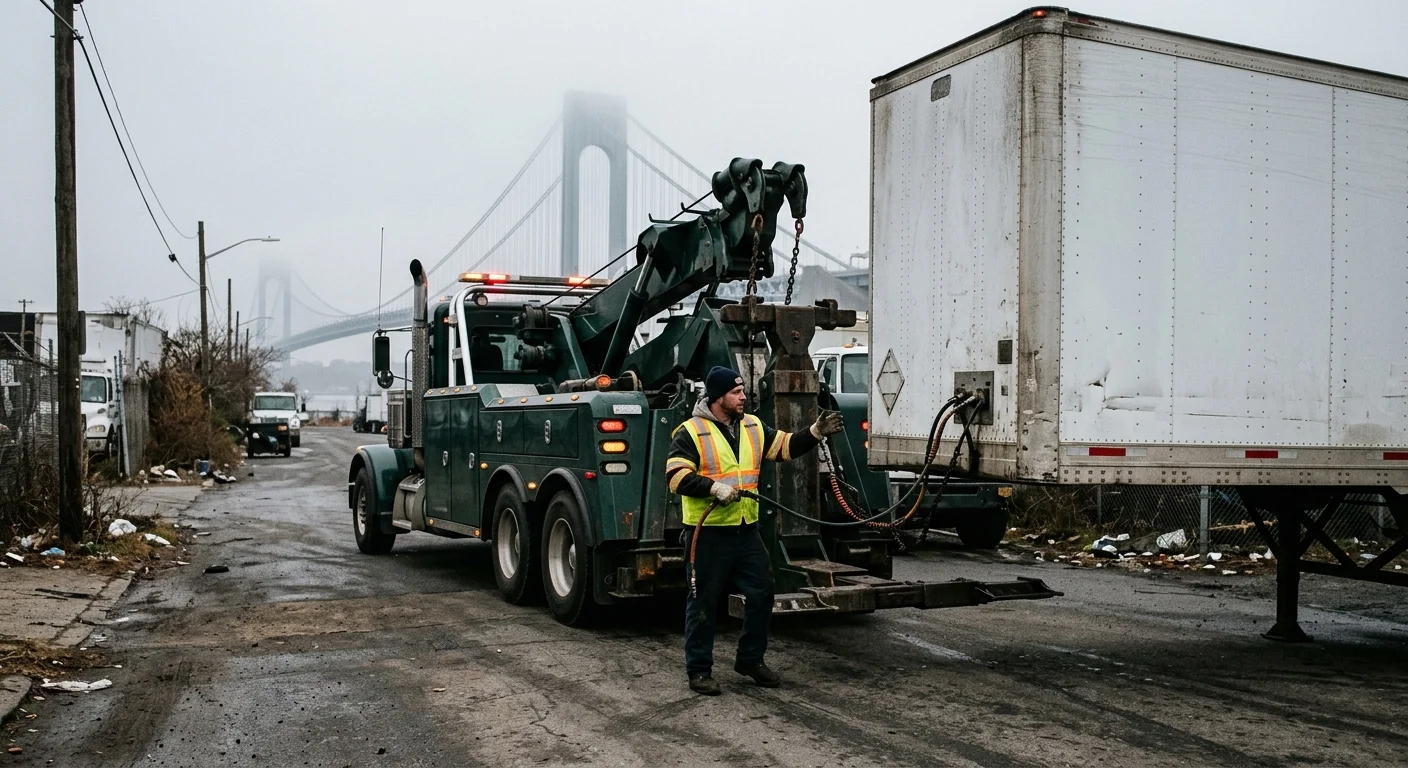
An RV is not a long car on a wheel-lift
Quick Tow NYC is a referral line. We match you with independent local operators. We do not own wreckers, flatbeds, or a yard. We are not a DCWP-licensed towing company. The operators we connect you with are licensed and insured. They run the truck. We do not.
A wheel-lift is built for cars and light SUVs. It grabs a pair of wheels and tows the rest on the pavement. That is fine for a Camry on the BQE shoulder. It is the wrong tool for a fifth-wheel. The trailer’s kingpin sits in a pickup bed, not on a rear ball. The nose is high. The box is long. The axles carry a living space, not a trunk. A light wrecker that grabs the frame or the landing gear can bend what it grabs.
If you are comparing methods, start with our note on when a job needs a flatbed or a wheel-lift. For a fifth-wheel, the method follows the hitch and the tires. If the trailer still rolls, a heavy pickup or wrecker with a fifth-wheel plate can tow it on its own wheels. If a tire is gone, a slider is off, or the landing gear is buried in sand at a Coney Island lot, the operator may need flatbed towing or a heavy-duty towing recovery. We do not pick the truck in this article. The operator states the method in the quote, before dispatch.
A Class A coach is a driven motorhome. It has a chassis, an engine, and a roof that will not clear a lot of Manhattan garage doors. A Class C is shorter and still too tall for most downtown ramps. A travel trailer on a bumper hitch is a third job. It tows from the rear of a truck, not from the bed. Saying “just tow the RV” hides those three setups.
RV and trailer towing in this city starts with that split. Tell dispatch what you actually have. A fifth-wheel behind a dead pickup in St. George is not the same call as a Class A that quit on the service road next to the Verrazzano. Neither one is a passenger-car hook.
Parkways, bridges, and why routing is the job
In New York City, routing is half the tow. Commercial vehicles, trucks, and tow trucks are banned on the parkways. That list includes the Belt, the FDR, the Henry Hudson, the Cross Island, the Jackie Robinson, the Bronx River, the Hutchinson, the Mosholu, the Pelham, Ocean Parkway, the Korean War Veterans Parkway, and the Grand Central. There is a single-unit exception on the Grand Central between the RFK Bridge and the BQE. A flatbed on a parkway is itself a violation. NYC DOT publishes the parkway restrictions. The operator has to treat them as a hard wall, not a shortcut.
That is why a 5th wheel towing service here cannot copy a Houston or Dallas route. From a Coney Island lot, the Belt and Ocean Parkway are closed to the wrecker. The truck runs service roads and the Gowanus, then the BQE if the destination is north. From the west side of Manhattan, the Henry Hudson is closed. From the east side, the FDR is closed, and north of 23rd Street the FDR also carries an 8,000-lb limit. Many coaches sit over that even empty. The FDR is the wrong road twice.
The Holland Tunnel rules close another door. The Port Authority bans tractor-trailers, trailers, trucks with four or more axles, and most hazmat. Height is 12 feet 6 inches. A fifth-wheel is a trailer. It does not go through the Holland. If the drop is in New Jersey, that is a destination only. We do not take pickups in New Jersey, Westchester, or Long Island. The five boroughs are the service area: Manhattan, Brooklyn, Queens, the Bronx, and Staten Island.
Staten Island jobs often turn on the Verrazzano. The bridge carries 220,000-plus vehicles a day. The approaches at Fort Wadsworth and Bay Ridge are tight for a long box. The operator plans the merge and the lane, not only the kingpin. The Korean War Veterans Parkway on the Island is on the same truck ban as the Belt. A wrecker that “just cuts across the parkway” is not doing this job legally.
Tolls, time of day, and a closed ramp change the path. They also change the quote. None of that is a published brand rate. The operator states the price before dispatch.
Fifth-wheels, travel trailers, and Class A coaches
A fifth-wheel is a trailer with a kingpin. The plate lives in the bed of a pickup, over the rear axle. That is a stable hook when the truck is healthy. When the truck is not, you still have a house on wheels and no legal way to drag it with a car wrecker. You do not have to rent another pickup to finish the move. A 5th wheel towing service exists so the operator brings the towing vehicle. You are not required to supply a truck.
People ask if they can rent a truck and tow the fifth-wheel themselves. In some markets that is a real path, if the rental is rated for the hitch and the trailer. In the five boroughs the hitch is only half the problem. The rental still cannot run the Belt, the FDR, or the Henry Hudson. It still has to clear the Verrazzano approaches. It still will not fit a typical Manhattan garage ramp. If your own truck already failed on Richmond Terrace or in a Coney Island lot, renting a second truck on a New York street is often slower than matching a heavy operator.
A travel trailer is the bumper-hitch cousin. It is often shorter in the nose and still wide in traffic. The operator needs the right ball or pintle, working trailer brakes if they are equipped, and a route that is legal for the wrecker. A toy hauler is the same family with a cargo door in the rear. Do not assume a wheel-lift can drag it. Ask for the method in the quote.
A Class A or Class C is not a trailer. It is a motorhome. If it rolls and steers, an operator may still need a heavy wrecker because of weight and height. If it does not roll, it may need a larger bed or a recovery. We do not invent a weight class in this post. Tell dispatch the make, the length, and whether it will move on its tires. A photo of the hitch, the roof, and the street helps more than a guess.
Cost is the other question people type next to “5th wheel towing service.” Quick Tow NYC publishes no brand price. There is no flat rate in this article. The operator quotes before dispatch. Distance, the detour around banned parkways, whether the trailer rolls, and whether the motorhome needs a bed all change that number. Pages that print a per-mile figure for the whole country are not quoting New York City.
If NYPD towed the rig off a public street for a parking violation, that is a different bill. City release fees are $185 under 8,000 lbs and $370 at or above, plus $20 a night in storage, with a 10-day reclaim window, per the NYPD towed-vehicles page. Many coaches sit in the higher band. Use the city’s towed-vehicle lookup before you assume it was stolen. The city sometimes relocates a vehicle instead of impounding it.
Staten Island and outer-borough staging versus Manhattan streets
St. George is a ferry terminal, a hill, and a mix of tight local streets. A fifth-wheel that fit a campground in Pennsylvania will not swing a downtown Manhattan block the same way. Outer-borough staging is often the honest plan. The operator hooks on a service road, a wide lot, or an industrial curb, then tows on a truck route. Trying to back a 30-plus-foot box into a Greenwich Village garage ramp is how roofs get sheared.
Manhattan garage doors are built for sedans and vans. A Class C roof, a fifth-wheel pin box, and the top of a travel trailer all fail that test. If the trailer is already in a garage that it should never have entered, stop. Do not have a friend yank it with a pickup. The operators we dispatch treat that as a recovery, not a casual pull.
Brooklyn jobs cluster where people actually park long boxes: Coney Island lots, Gravesend, Bay Ridge near the Verrazzano, industrial edges of Sunset Park. The Belt is the road everyone wants and the wrecker cannot use. Queens jobs pick up the same pattern along the Cross Island and the Grand Central, both banned, with the Van Wyck and the LIE as the truck-legal spine. The Bronx has the Major Deegan and the Cross Bronx for through moves, and Hunts Point when the call is truly heavy. None of those boroughs is a copy of Staten Island. The Island has the Korean War Veterans ban, the Verrazzano merge, and long residential streets that were never drawn for a kingpin trailer.
If the city took the vehicle, we do not publish a Staten Island pound address. None is confirmed in our claims. Do not guess a Manhattan pound either. Use the city’s towed-vehicle lookup and the NYPD page above. Bronx storage, when it is an NYPD parking tow, is listed at 2444 Exterior Street. Brooklyn’s listed pound is at the Navy Yard, entrance at Sands Street and Navy Street. Queens is listed at 31-22 College Point Boulevard in Flushing. Bring a license, current registration, and a current insurance card if you are reclaiming. A non-owner needs a notarized authorization letter. That is a city pound process, not a Quick Tow NYC yard. We do not store RVs.
Long Island, Westchester, and New Jersey can show up as drop-offs on a long haul. They are not pickup territory for this line. If the fifth-wheel is already in Jersey City, this is not the page that covers that hook.
What dispatch needs before matching a heavy operator
The match is only as good as the description. Have this ready when you call.
What the rig is: fifth-wheel, travel trailer, toy hauler, Class A, or Class C. Make and length if you know them. Whether your pickup is still attached. Whether the trailer or coach will roll. Whether a tire, an axle, or the landing gear has failed. Where you are, down to the borough and the road. St. George, a Coney Island lot, a Bay Ridge curb, and a Manhattan garage ramp are four different trucks. Where it needs to go, including a cross-borough drop or a destination outside the city.
A photo of the hitch, the roof line, and the street in front of the rig saves a wrong send. Height matters at garage doors and at the Holland, which is already closed to trailers. Do not guess a weight you have not read on a plate. If you do not know, say you do not know. The operator would rather ask than send a light wrecker.
The price is quoted before dispatch. There is no published hookup fee, per-mile rate, or after-hours figure from this brand. If the scene is an accident on a city street, that can fall under a police rotation, which is a different fee schedule on the DCWP and NYPD side. If it is your own breakdown or a planned move, it is a private dispatch. Do not mix those in your head. Tell the line which one you are in.
Quick Tow NYC does not promise an arrival clock. Traffic on the Verrazzano, a banned parkway, and a long trailer all stretch a clock that should never have been promised. The line is answered around the clock. After a recording notice, the call is recorded. New York is a one-party consent state for that recording. An independent local operator is then matched to you.
If you were hoping to move a fifth-wheel without a truck of your own, that is the entire point of the call. You are not asked to rent a hitch or supply a dually. You are asked to describe the rig and the street.
When to call us
When the trailer will not move, the pickup is dead, or a Manhattan ramp will not take the height, this is no longer a hitch you sort out in the lot. Call us at (929) 356-7857. The line is answered around the clock. After a recording notice, the call is recorded, and we match you with an independent local operator.