You walk back to a Harlem curb and the space is empty. Before you file a theft report, call 311 and run the city’s towed-vehicle lookup. Most missing cars in New York City were towed, relocated, or taken by a shop, not stolen.
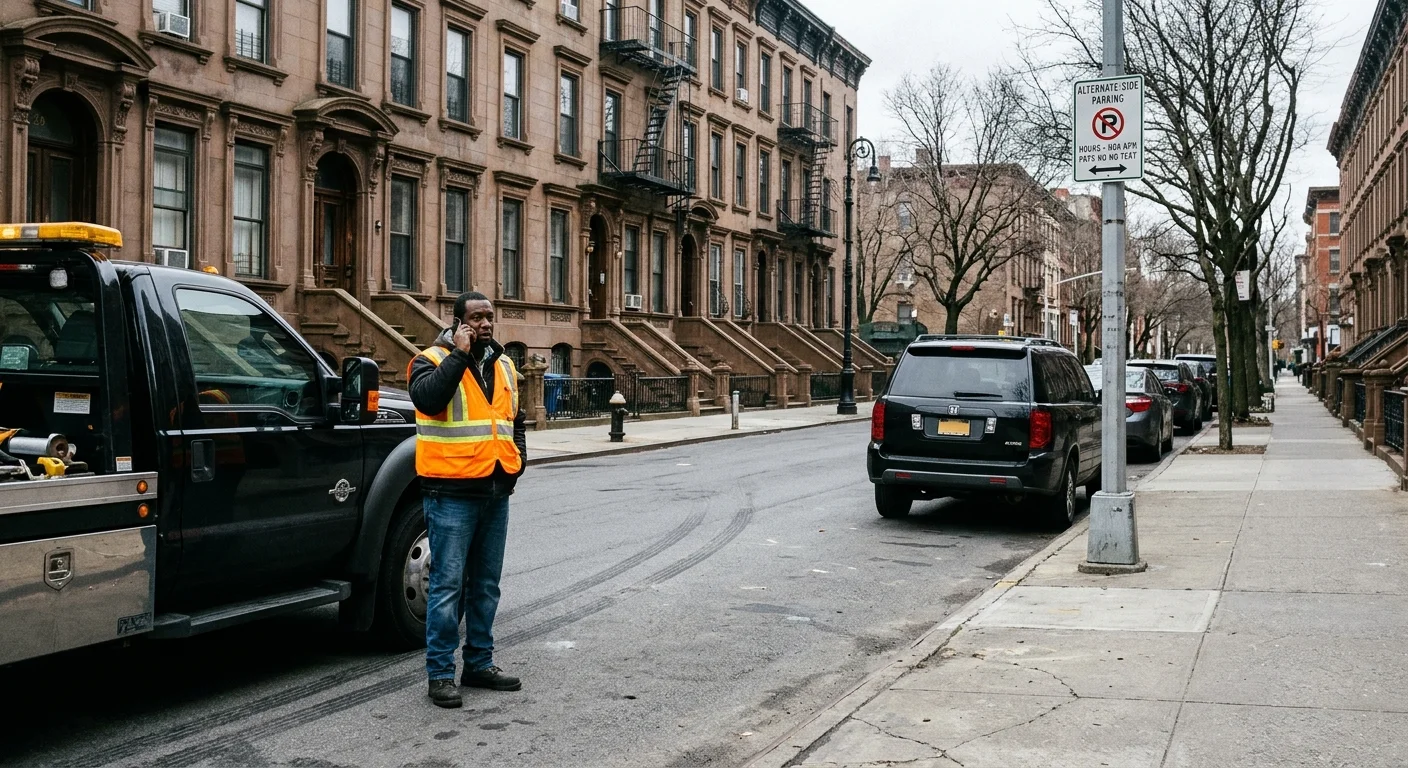
A missing car on an NYC street is not always theft
The empty spot still feels like a crime. Glass on the pavement can mean a break-in. A clean gap under an alternate-side sign usually means a city hook. A Midtown garage ticket in your pocket can mean the attendant called a truck after closing. Those are different systems. Mixing them up sends you to the wrong lot.
Quick Tow NYC did not take the car. We are a referral service. We match drivers with independent local operators in the five boroughs. We do not own trucks, we do not run a pound, and we do not do licensed tows. If NYPD, a DCWP-licensed lot operator, or a shop already has the vehicle, start with the city, not with us.
New York City is one towing jurisdiction. The real fork is which regime took the car. An NYPD parking-violation tow goes to a borough pound. A DCWP-licensed private-lot or driveway tow goes to that operator’s storage lot. An accident rotation tow follows police direction after a crash. The city also relocates cars for street work, parades, and filming. Those cars never hit a pound. A body shop you used last week can still have the keys on a pegboard.
Theft is the last fork, not the first. File a stolen-vehicle report only after 311 and the lookup come back empty, and the precinct covering that block says the car is not in a city system. Until then, treat the gap as a tow question. That is the whole job of “was my car towed nyc” as a search: sort the system before you report a crime.
311 and the towed-vehicle lookup come first
Start with two city tools, in that order. Call 311. Then run the towed-vehicle lookup with the plate, the state, and the vehicle type. Name the borough and the block. Harlem, Washington Heights, and the Upper West Side all sit in Manhattan, but the database wants the plate, not the neighborhood nickname.
311 is the city’s non-emergency line for a 311 towed car check. Ask whether the record shows a tow, a boot, or a relocation. Ask which agency holds it. NYPD, a City Marshal, the Sheriff, and a private operator are different answers. Do not skip this step and walk into a precinct theft desk first.
Use the official NYPD towed-vehicles page and the NYC 311 towing guide as the source of record. Confirm every fee there before you pay. City figures change. A blog number is only as good as the live nyc.gov page.
If the plate does not hit, search again, then call 311 with the cross streets. How long the system takes to post a new tow could not be confirmed as a fixed city rule in our source list. Treat a blank result as “not in the system yet,” not as proof of theft. Ask the 311 operator to check relocation as well as impound. Relocated cars often sit a block away. They never appear as a pound tow.
If 311 still has nothing, go to the precinct that covers the block. Bring the plate, the time you last saw the car, and photos of the empty space and the signs. The desk can tell you whether a private operator called in a hook from that street, or whether you should file a stolen-vehicle report. That is the theft fork. You reach it after the city search.
Do not pay a random wrecker who offers to “find” the car on the spot. Pound work is an NYPD matter. Licensed private-lot work is a DCWP matter. Our brand is in neither role.
Pound tow, private lot, relocation, or a shop you forgot
Once 311 or the lookup returns a hit, name the system. The curb alone will not do that for you. If my car was towed in NYC, the next move depends on which of these paths it took.
An NYPD parking-violation tow is the default when a car leaves a public street for illegal parking or a similar street job. Published city fees on the NYPD towed-vehicles page are $185 for a vehicle under 8,000 lbs and $370 at or above that weight, plus $20 a night in storage, with a 10-day reclaim window. Confirm those figures on nyc.gov and with 311 before you travel. The car goes to a borough NYPD pound. Confirmed pound sites in city materials include 2444 Exterior Street in the Bronx, the Brooklyn Navy Yard entrance at Sands Street and Navy Street, and 31-22 College Point Boulevard in Flushing. A dedicated Manhattan pound address could not be confirmed in our source list. Neither could a Staten Island pound. For those boroughs, use 311 and the lookup instead of a guessed address. For which lot holds a given plate, use where they take a towed car in NYC.
A DCWP-regulated private-property or driveway tow is a different job. A DCWP-licensed operator takes the car from a garage, a driveway, or a lot, then stores it at that operator’s yard. City consumer rules cap that removal at $125, which includes the first three days, then $15 a day after. If you catch the truck before the car leaves, the published drop fee is $62.50. Storage has to stay inside city limits and within 10 miles of the removal point. Read the current caps on the DCWP towing consumer page. If you were hooked from a garage or a fenced lot, start with towed from a private parking lot in NYC, not with a pound.
Relocation is not a tow. The city sometimes moves a car for a street fair, a film shoot, a water-main break, or a similar block closure. The car is supposed to sit nearby. It will not show as a pound record. 311 and the local precinct are how you find that new spot.
An accident or rotation tow is the crash path. Police direct a rotation operator after a collision. DCWP publishes max rates of $125 for vehicles at or under 10,000 lbs, or $140, with storage at $25 a day for the first three days and $27 a day after. NYPD also publishes a separate rotation-tow schedule of $50, or $100 for a double, with storage at $10 a day for the first three days and $12 a day after. Confirm which schedule applies on nyc.gov before you pay. That car may sit at an operator lot, not at Exterior Street. After you get it back, a disabled crash car may still need an independent accident recovery hook to a shop. That price is quoted before dispatch.
A shop you forgot is the quiet fifth path. You left the car with a body shop after a fender-bender on the FDR. A friend drove you home from a Midtown garage that later refused overnight storage. The keys are still in Queens. Call the shop and the garage before you call this a crime.
Neighborhood clues from alternate-side to a garage hook
The block often tells you which system to check first.
A Harlem curb with an alternate-side sign is a street-cleaning suspect. Alternate-side rules generate a huge share of city parking tickets. City figures put those tickets near 1.9 million in 11 months of FY2023, with a $65 fine. Cars also get towed when they block cleaning or emergency access. If you parked on a Harlem or Washington Heights block overnight and the broom already passed, start with 311 and the NYPD lookup. Photograph the signs. Then use our alternate-side parking tow notes for how those days work. Holidays and weather emergencies can suspend the rule. Confirm today’s status with the city, not with a neighbor’s memory.
An Upper West Side alternate-side block behaves the same way, with tighter leftover spots. A car that sat through the posted cleaning window on Columbus or Amsterdam is a pound candidate, not a theft candidate. Hydrant gaps matter too. State parking rules under VTL § 1202 keep you 15 feet from a hydrant. A Harlem brownstone hydrant with a car nosed in tight is a classic NYPD hook.
A Midtown garage is usually a private-lot story. Overnight rates, height bars, and closing times sit on DCWP-required postings. If the attendant is gone and the car is gone, look for the operator name on the wall before you assume a thief pulled onto Eighth Avenue. Call that operator. Call 311 if the sign is missing. NYC Admin Code § 19-169.1 is the city rule on private-property signage, the drop fee, and the 10-mile storage limit.
A driveway blocked in Inwood or a lot behind a Corona bodega is the same private-property regime. The car is not at College Point unless NYPD took it off a public street. Glass, a torn steering column, or a plate left on the asphalt push you toward the precinct. A clean pull, a fresh broom line, or a garage gate down push you toward 311.
What to do once you know which system has it
Match the next step to the system. Do not run every path at once.
For an NYPD pound, bring a valid driver’s license, current registration, and a current insurance card. A non-owner needs a notarized authorization letter. City materials say payment is cash or card in the retriever’s name. Confirm hours and the exact lot on the NYPD towed-vehicles page before you travel. Bronx, Brooklyn Navy Yard, and College Point are the confirmed pound sites. If the lookup names a different holding place, follow that record. Reclaim timing is published as 10 days. Confirm that window with the city. Pay the published tow and storage. The parking ticket that led to the tow is a separate Department of Finance matter. You do not settle that ticket at the pound as a stand-in for the tow bill.
For a Marshal or Sheriff scofflaw tow, start with the Department of Finance, not the NYPD pound desk. City Finance materials say a boot can hit at $350 or more in default-judgment parking or camera tickets. The car can be towed if that debt sits unpaid 48 hours after the boot. An immediate tow can hit at $2,500 or more, or for invalid registration, or for a public-safety issue. NYC booted 134,945 vehicles in 2023, per those same city figures. Confirm your current judgment total with Finance. Our source list does not approve publishing Marshal fee tables, so get those numbers from Finance directly.
For a private-lot tow, call the operator on the sign. Ask for the storage address. Ask whether the $125 cap and the $62.50 drop still match what they will charge. If the numbers do not match the DCWP page, say so and keep the invoice. Lien Law § 184 governs a garage keeper’s tow lien, including certified-mail notice within 5 working days. That is a New York statute, not a shop custom.
For a relocation, walk the block and call the precinct. The car may sit around the corner with no bill at all.
For a rotation or accident tow, the precinct that worked the crash can name the operator. Fees follow the DCWP or NYPD rotation schedule that actually applied. Confirm it before you pay.
For a shop you forgot, call the shop. Ask about storage. Ask what they need to release the car.
Only after those paths fail do you treat the car as stolen. The precinct files that report. Insurance follows the precinct, not 311. If the lookup already named a city yard, skip the hunt and go to getting the car out of the pound.
When to call us
Call us when the city does not have the car, and you still need a local operator to move a disabled vehicle, a crash car, or a car that will not roll from a garage. We match you with an independent operator serving the five boroughs. The line is answered around the clock. Calls are recorded after a notice. Call us at (929) 356-7857.