Your car is missing after a New York City snow emergency. First, confirm the declaration, then check whether the city towed or relocated the vehicle. Don’t assume it was stolen or head directly to a pound.
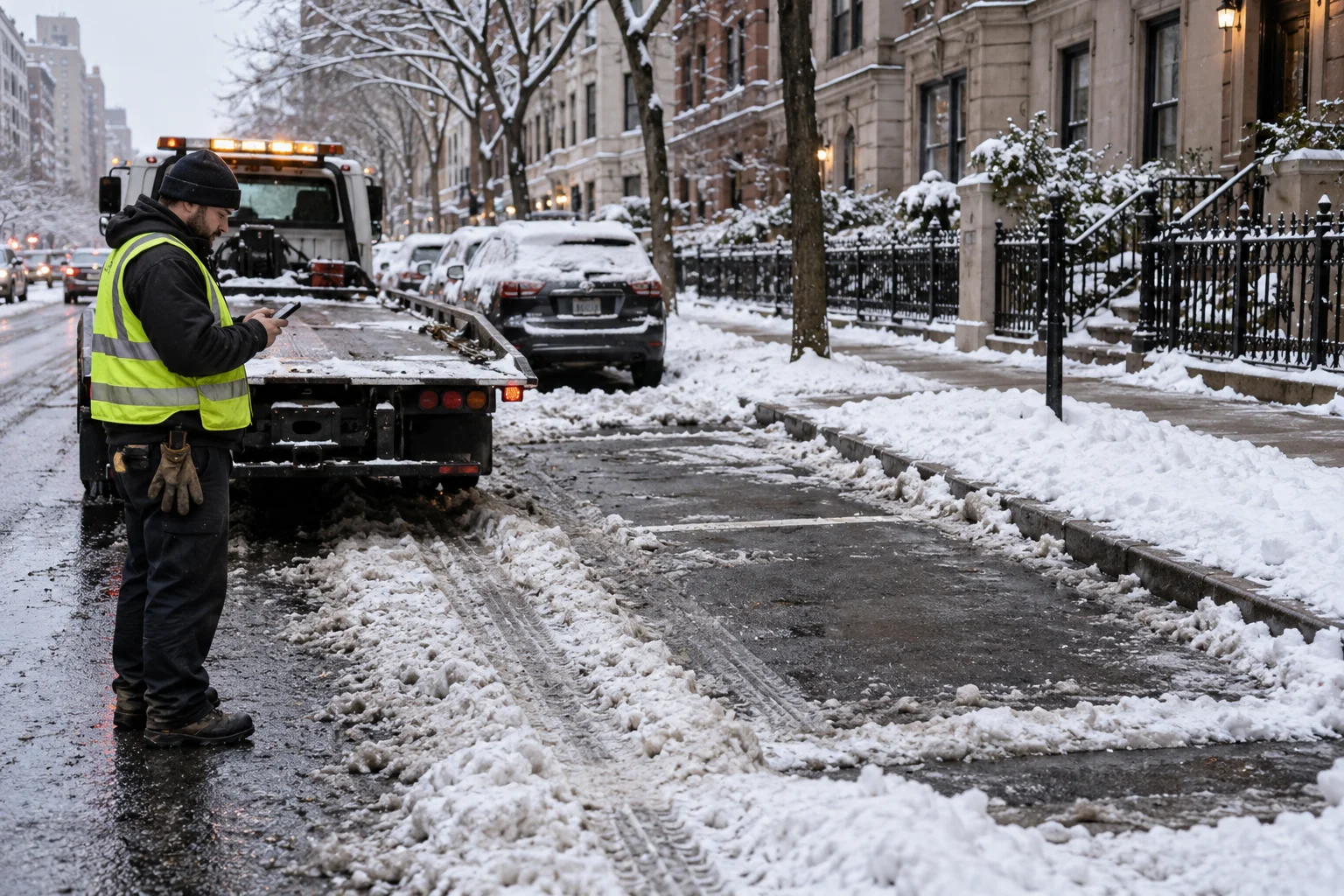
Check whether the city declared a snow emergency
Start with the date, time, and exact block where you parked. Then check NYC Emergency Management announcements and the NYC 311 Towing Guide. Those sources can help separate an official declaration from an ordinary storm or alternate-side suspension.
A declared snow emergency and suspended alternate-side parking aren’t interchangeable. Alternate-side parking may be suspended during a weather emergency. That suspension doesn’t confirm what happened to a particular car.
Check the notice that applied when the vehicle disappeared. Don’t rely on an old social post, a neighborhood group, or a screenshot without a date. Conditions can change while plows are working.
This matters on the Upper West Side, where one missing car can have several explanations. A vehicle left near Broadway may have received different attention than one blocking snow work on a narrower side street. The exact enforcement decision can’t be determined from snowfall alone.
The available approved record doesn’t confirm a fixed snowfall threshold or automatic towing rule. It also doesn’t establish that every vehicle on an affected block will be removed. Check the current city notice for the event itself.
If you parked before the storm, review the curb signs too. A snow announcement doesn’t erase other posted restrictions. Our alternate-side parking tow guide explains that separate issue.
Write down what you find. Save the declaration, suspension notice, parking location, and approximate parking time. Those details will make the next search much easier.
Snow emergency rules are not permanent snow routes
Don’t treat NYC streets as part of a standing snow-route system. The approved city record for this page doesn’t confirm a current permanent system of designated streets under that name. It also doesn’t confirm that a particular avenue automatically triggers towing whenever snow begins.
Instead, focus on current NYC Emergency Management notices, posted parking signs, and 311 guidance. Those sources address the event happening now. A label remembered from another city may send you toward the wrong procedure.
This distinction is especially useful near Riverside Drive, Central Park West, Amsterdam Avenue, and Columbus Avenue. A major Manhattan street may receive intensive snow work. That fact alone doesn’t prove why your car disappeared.
Alternate-side parking is another separate issue. The city may suspend it during listed weather emergencies. A suspension means drivers should check the current parking guidance. It isn’t proof that every other curb rule has stopped.
The same care applies across the five boroughs. A parked car in Washington Heights, Corona, Bushwick, Hunts Point, or Tottenville may be affected by different posted restrictions and street conditions. NYC remains one towing jurisdiction, but the reason for removal still matters.
Look for the enforcement path, not a street nickname. A public-street parking tow generally points toward the NYPD pound process. A private-property tow follows a different DCWP-regulated process. An accident or police-directed tow follows another path.
Snow also creates practical problems after the car is found. If it’s stuck behind a plowed bank, disabled, or unsafe to move, emergency towing may be appropriate. That’s separate from retrieving a car already held by the city.
Confirm whether the car was towed or relocated
A missing car may have been towed, relocated, or stolen. In winter, relocation deserves an early check because the city sometimes moves vehicles without treating the move as a standard pound tow.
A relocation means the car may be parked on another nearby street. It may not appear where you expect, especially after plowing or emergency access work. Search through official channels before walking block after block through snow.
A tow usually sends the vehicle into a defined recovery process. For a public-street parking violation, that generally means an NYPD borough pound. A private-lot removal goes to the towing operator’s storage location. A police-directed accident tow uses a separate process.
The location where the car disappeared offers an important clue. A vehicle missing from a public Upper West Side curb isn’t handled like one removed from a private garage entrance. A car taken after a crash on the FDR also presents a different situation.
Don’t pay anyone based only on an unsolicited text or call. First identify who has the vehicle and why. The agency or operator should match the type of removal shown in the official search.
If the city lookup identifies an NYPD tow, follow that result. If it shows a relocation address, confirm the vehicle description and plate before traveling. If no result appears, keep checking with 311 and follow its current instructions.
Our guide to deciding whether your car was towed in NYC walks through the first checks. It can help when snow, poor visibility, and moved street markers make the original parking spot harder to recognize.
Use 311 and the city lookup before assuming theft
Use 311 and the official towed-vehicle lookup as your first two channels. Search with the vehicle information requested by the city. Check every character before deciding that there’s no record.
A plate error can derail the search. So can mixing up a model year, color, or parking location. Keep the registration nearby while entering the details.
If the lookup returns a result, note the listed agency, location, and removal category. Don’t assume every result leads to the same pound. The destination depends on the towing regime and the circumstances.
For an NYPD parking-violation tow, use the NYPD Towed Vehicles page. It provides the official borough-pound information and retrieval guidance. Our step-by-step guide to finding a towed car can help you organize the search.
The approved records identify NYPD pounds in the Bronx, Brooklyn, and Queens. The Bronx location is on Exterior Street. Brooklyn’s is at the Navy Yard entrance at Sands Street and Navy Street. The Queens pound is on College Point Boulevard in Flushing.
A dedicated Manhattan pound and the pound serving Staten Island couldn’t be confirmed in the approved record. Don’t guess based on an old map or third-party directory. Use 311 or the current lookup for the actual destination.
If the city has no record, verify the plate again. Then follow 311’s current instructions for a vehicle that remains missing. Theft is one possibility, but it shouldn’t be your first assumption during active snow operations.
What to confirm before visiting a pound
Confirm the pound before leaving home. Check its current hours through the official source, especially after severe weather. A saved address from an older post may not reflect the instructions for your vehicle.
For an NYPD pound release, bring a valid driver’s license, current registration, and current insurance card. A person who isn’t the registered owner needs a notarized authorization letter. Payment must be cash or a card in the retriever’s name.
The NYPD publishes a tow-release fee of $185 for vehicles under 8,000 pounds. The published fee is $370 for vehicles at or above that weight. NYPD storage is $20 per night, and the vehicle must be reclaimed within 10 days. Confirm the current amount and payment instructions on the official NYPD page before paying.
Those figures apply to the NYPD parking-violation process. They aren’t Quick Tow NYC prices. They also shouldn’t be applied to a private-property or accident tow.
Before traveling, confirm these details:
- The vehicle’s plate and description match the record.
- The listed location is a pound, storage lot, or relocation address.
- The removal was an NYPD tow, private-property tow, or accident tow.
- You have the required original documents.
- The facility is accepting retrievals when you plan to arrive.
- You understand the payment method listed by the responsible agency.
Photograph the car when you recover it. Clear snow enough to inspect the body, windows, tires, and surrounding area safely. Ask the responsible facility about its procedure if you notice a problem.
Don’t drive away if the vehicle can’t move safely. Snow-packed wheels, collision damage, or a dead battery may require roadside help. The operator sets that service price, and it’s stated in the quote before dispatch.
When to call us
Call when you’ve located the car but can’t drive it safely, or when it needs transport after release. Quick Tow NYC is a referral service that dispatches independent local operators across the five boroughs, and our line is answered around the clock. Call us at (929) 356-7857.