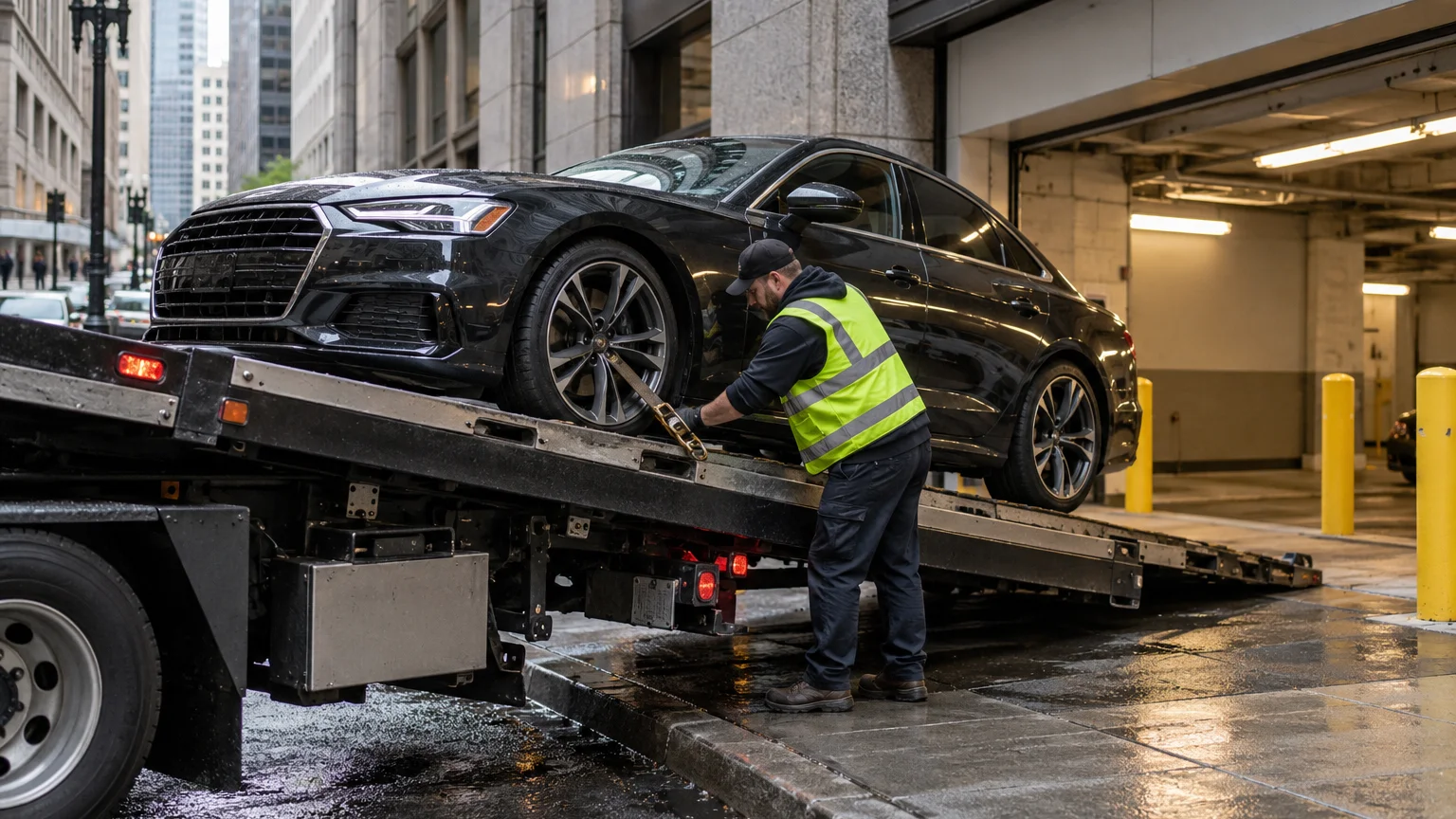
Request a flatbed tow truck when your owner’s manual requires one or the car’s condition makes another towing method unsuitable. Tell dispatch what you’re driving, what broke, where the car sits, and where it needs to go. The operator can then assess the vehicle, loading space, and route before accepting the job.
Start with the vehicle, damage, and pickup location
The towing decision starts with the car, not a blanket rule. Give dispatch the year, make, model, and drivetrain if you know it. Mention modifications, low bodywork, locked wheels, collision damage, or anything hanging beneath the car.
Next, describe the pickup point. A disabled sedan inside a Financial District garage presents a different job from one stopped along a wide industrial street. Note the garage level, entrance slope, overhead signs, tight turns, parked cars, and whether the vehicle faces toward or away from the exit.
Street position matters too. Tell dispatch whether the car is at a curb, in a travel lane, inside a lot, or behind a building. Name the cross streets and borough. A clear pickup description helps an operator decide whether the available loading space fits its equipment.
Don’t try to diagnose hidden damage. Describe what you can see and what the car does. Useful details include:
- The engine starts, but the car won’t move
- A wheel is bent, loose, or pointing the wrong way
- The steering won’t turn normally
- The parking brake won’t release
- The car sits unusually low on one side
- Fluid is visible beneath the vehicle
- The keys are missing or locked inside
- The garage entrance has limited clearance
Send current photos if dispatch requests them. Include the full car, damaged area, surrounding street, and garage entrance. Our flatbed towing referral service matches callers with independent local operators. Quick Tow NYC doesn’t own trucks or perform the tow.
When the owner’s manual calls for a flatbed
Your owner’s manual is the authority for the model-specific towing method. Check its towing, roadside assistance, or emergency transport section before requesting equipment. Follow the stated method rather than relying on a general rule about a vehicle category.
An AWD vehicle in Astoria doesn’t automatically need a flatbed because every AWD system isn’t identical. The same caution applies to electric vehicles, hybrids, performance cars, and vehicles with selectable drive modes. The badge alone doesn’t settle the question.
Look for instructions covering wheel position, drivetrain settings, parking-brake release, and transport method. Some manuals may identify a required procedure or prohibit certain towing configurations. If the instructions call for platform transport, tell dispatch that directly. If the wording isn’t clear, contact the manufacturer or a dealership that services your model.
Don’t attempt unfamiliar override procedures from an online video. A model year or software change can make instructions for a similar-looking car irrelevant. Keep the manual available for the operator when possible.
Electric vehicles need the same model-specific approach. Our guide to Tesla and EV towing in NYC explains what information to gather before requesting a tow. It doesn’t replace the instructions supplied for your exact vehicle.
If you can’t access the manual, say that during the call. Give the operator the complete vehicle details instead of guessing. The operator can decide whether to accept the job and which towing setup it can provide. A request for a flatbed isn’t confirmation that every truck can handle every vehicle or pickup location.
Why damaged wheels and low clearance change the job
A damaged wheel near Downtown Brooklyn can change how the vehicle must be loaded. The car may not roll, steer, or track normally. Tell dispatch which corner is damaged and whether the wheel still turns. Don’t move the car merely to test it if doing so could worsen visible damage.
Photos matter here. Capture the wheel from a safe position, then photograph the space around the car. The operator needs to see curbs, traffic lanes, parked vehicles, and the direction the car faces. Collision debris, a collapsed suspension area, or loose body panels should also be disclosed.
Low clearance creates a separate issue. A low sedan at the bottom of a steep Financial District garage ramp may have limited room beneath its bumpers or underbody. Modified suspension, splitters, long overhangs, and loose exhaust parts can affect the loading plan. Give dispatch measurements when you can verify them. Don’t estimate an overhead clearance or loading angle.
A flatbed isn’t an automatic answer to every clearance problem. The operator still needs enough access to position its truck and load the vehicle. A garage entrance may be too low, a ramp may be too tight, or traffic controls may limit the usable space. In those cases, the operator may need more information before accepting the dispatch.
Owners of collector, exotic, or heavily modified vehicles can also review our exotic and classic car towing service. For a broader equipment comparison, see flatbed or wheel-lift towing in NYC. The final method should still follow the owner’s manual and the vehicle’s actual condition.
How NYC parkway restrictions affect the route
New York City’s parkway restrictions shape flatbed routing. Tow trucks and other trucks are banned from city parkways. That list includes the FDR Drive, Belt Parkway, Henry Hudson Parkway, Cross Island Parkway, Jackie Robinson Parkway, and Bronx River Parkway. The Grand Central Parkway has a single-unit truck exception between the RFK Bridge and the BQE.
That means the nearest familiar road may not be available. A pickup beside the FDR doesn’t allow a flatbed operator to carry the vehicle along the FDR. A trip between Queens and Brooklyn may also require a route that avoids the Grand Central, Cross Island, or Belt.
The operator chooses the lawful route for its truck and the accepted job. The actual choice depends on the pickup, destination, vehicle, current restrictions, and truck.
Tell dispatch about the destination before an operator is matched. “A repair shop in Brooklyn” isn’t enough. Give the exact address, entrance instructions, and any known garage limitations. The operator needs both ends of the trip to evaluate access and routing.
A tow crossing toward New Jersey, Long Island, or Westchester also needs the complete destination. Quick Tow NYC serves pickups across Manhattan, Brooklyn, Queens, the Bronx, and Staten Island. Those other areas may be destinations, but they aren’t part of our five-borough service area.
Don’t use a passenger-car navigation route as proof that a tow truck can follow it. Routing can affect the operator’s quote and whether it accepts the job. Quick Tow NYC doesn’t publish a flatbed price, per-mile amount, or arrival-time promise. The operator states the price before dispatch.
What to tell dispatch before an operator is matched
Have the core details ready before calling. Start with the exact pickup location and destination. Then give the vehicle’s year, make, model, drivetrain, condition, and manual instructions. State clearly that you’re requesting a flatbed tow truck and explain why.
Dispatch also needs to know:
- Whether the car rolls, steers, and brakes normally
- Which wheels or body areas are damaged
- Whether the keys are available
- Whether the vehicle is inside a garage or gated property
- Whether the car has low clearance or modifications
- Whether traffic or parked cars restrict truck access
- Whether the destination can receive the vehicle
- Whether the trip leaves New York City
Ask the operator to confirm that its truck suits the disclosed vehicle and location. No universal load figure can be confirmed for an unseen tow truck flatbed. Capacity depends on the specific truck and the vehicle being transported. The operator should evaluate that match before dispatch.
We also couldn’t confirm one blanket driver-credential answer that covers every rollback truck and operating situation. Ask the matched operator about requirements relevant to its truck and job. Quick Tow NYC doesn’t assign credentials or represent itself as a licensed towing operator.
The price for a requested flatbed job is stated in the operator’s quote. We can’t publish a universal amount for a local trip or a 30-mile tow. Vehicle condition, access, destination, and the accepted towing method must be disclosed before the operator quotes the work.
Make sure this is a voluntary tow before booking. If your parked car has disappeared, don’t assume it needs a private flatbed dispatch. It may have been towed or relocated by the city. Check the NYC 311 towing guide first. A vehicle removed from private property falls under a different process covered by the city’s DCWP towing guidance.
When to call us
When the manual requires a flatbed, a wheel is damaged, or access is uncertain, it’s time for an operator to assess the tow. Quick Tow NYC is a referral service, and our line is answered around the clock to match you with an independent local operator that quotes and performs the job. Call us at (929) 356-7857.